Vietnamese money
Goals
- Know the Vietnamese banknotes and their values.
- Count the money in several banknotes by working in thousands of dong.
- Work out the total cost and the change when you buy things.
- Solve word problems about money, remembering to write the unit dong.
Remember
- The unit of Vietnamese money is the dong. There are , , , , , and dong notes.
- To count money, change each note into thousands of dong and add. Example: thousand, which is dong.
- Total cost: add the prices of the items. Change money handed over total cost.
- You can check with an addition: total cost change money handed over. Remember to write the unit dong. Now you can answer the question from the start: take the total cost away from the money handed over and you have the change. A few practice questions will make it feel natural.
Exercises
Exercise 1
Count the money:
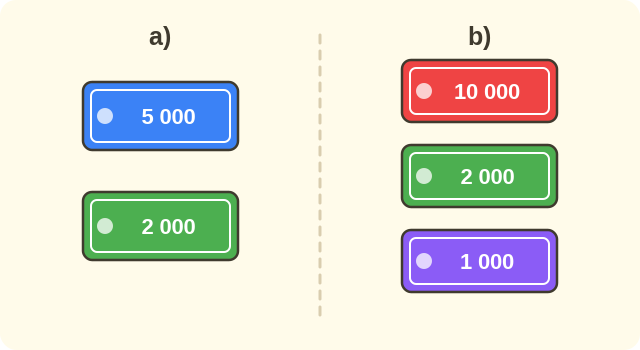
a) One dong note and one dong note.
b) One dong note, one dong note and one dong note.
Exercise 2
a) You have two dong notes and one dong note. How much money do you have?
b) A storybook costs dong and a pencil costs dong. How much do you pay for both?
Exercise 3
Remember the last lesson (telling the time, months and years).
a) Nam arrives at the shop at and finishes shopping minutes later. At what time does he finish?
b) Nam goes to buy books in month (May). How many days does May have?
Exercise 4
a) Mum hands over 50\,000 dong to buy things costing 28\,000 dong. How much change should the seller give her?
b) Dad hands over 20\,000 dong and gets 6\,000 dong change. How much did his shopping cost?
Exercise 5
Choose the operation (addition or subtraction) and say why.
a) Mai has 25\,000 dong and her aunt gives her 10\,000 dong more. How much money does Mai have altogether?
b) Mai has 35\,000 dong and buys a book for 28\,000 dong. How much money does Mai have left?
Exercise 6
Find the mistake in each pupil's work and correct it.
a) Ha: "I have two 10\,000 dong notes and one 5\,000 dong note. I have 10\,000+5\,000=15\,000 (dong)."
b) Tu: "Tu hands over 50\,000 dong and the shopping costs 31\,000 dong. The change is 50\,000+31\,000=81\,000 (dong)."
Exercise 7
A breakfast shop's price list:
| Item | Price (dong) |
|---|---|
| Bread roll | 12\,000 |
| Milk | 8\,000 |
| Juice | 15\,000 |
An buys one bread roll and one carton of milk, and hands over a 50\,000 dong note.
a) What is the total cost?
b) How much change does the seller give An?
Exercise 8 Challenge
Hung has one 20\,000 dong note, one 5\,000 dong note and three 2\,000 dong notes.
a) How much money does Hung have?
b) Hung wants to buy swimming goggles that cost 45\,000 dong. How much more money does he need?
c) Mum gives Hung another 20\,000 dong note. Does he now have enough money for the goggles? If so, how much money is left over?
Mini test
15 minutes, without looking back at the lesson. Part I: circle one letter; Part II: write T or F for each statement; Part III: write the answer in the box.
Part I. Multiple choice
Part II. True or false
| a) Nam has 35\,000 dong. | T / F |
| b) Nam can buy something that costs 40\,000 dong. | T / F |
| c) If Nam buys something for 28\,000 dong, he gets 7\,000 dong change. | T / F |
| d) If Nam hands over all three notes for something costing 30\,000 dong, he gets 15\,000 dong change. | T / F |
Part III. Short answer
Score: ........ / 10
Hints (only when stuck)
What you need: change each note into thousands of dong and add.
Steps:
- Write how many thousand each note is.
- Add them up, then write "thousand dong".
What you need: to count money, change into thousands and add; for the total cost of several items, add their prices.
Steps:
- Part a): 20+20+10 thousand.
- Part b): 15\,000+3\,000.
What you need: 1 hour has 60 minutes; months 1, 3, 5, 7, 8, 10, 12 have 31 days.
Steps:
- Part a): add 10 minutes to 15 minutes.
- Part b): see which group of months May belongs to.
What you need: change = money handed over - total cost. So total cost = money handed over - change.
Steps:
- What do we know? What is asked?
- Part a): find the change. Part b): find the total cost.
- Check with an addition.
What you need: "gives more" and "altogether" mean add; "buys" and "left" mean subtract.
Steps:
- What do we know? What is asked?
- Choose the operation and work it out.
What you need: count every note; change is the money handed over minus the total cost.
Steps:
- Part a): count how many notes there are and how many the working adds.
- Part b): can the change be more than the money handed over?
What you need: the total cost is the sum of the prices; change = money handed over - total cost.
Steps:
- What do we know? What is asked? Find the prices of the bread roll and the milk in the table.
- Part a): add the two prices. Part b): take the total cost away from 50\,000.
- Check with an addition.
What you need: count money by adding the thousands; compare the money you have with the price; the amount short or left over is the difference of the two numbers.
Steps:
- How many thousand are three 2\,000 dong notes?
- Work out how much Hung has, then take it away from 45\,000.
- Part c): add 20\,000, then compare with 45\,000.
Self-check
| # | Did it alone | Needed a hint | Not yet |
|---|---|---|---|
| 1 | ☐ | ☐ | ☐ |
| 2 | ☐ | ☐ | ☐ |
| 3 | ☐ | ☐ | ☐ |
| 4 | ☐ | ☐ | ☐ |
| 5 | ☐ | ☐ | ☐ |
| 6 | ☐ | ☐ | ☐ |
| 7 | ☐ | ☐ | ☐ |
| 8 | ☐ | ☐ | ☐ |
Redo the ones you missed after: ☐ 1 day ☐ 3 days ☐ 7 days
Scan for step-by-step solutions