Vietnamese money
🖨 Print a self-study sheet Why print?
Nam has one dong note. He buys a notebook that costs dong and hands the note to the shopkeeper. The note is worth more than the notebook, so how much change should the shopkeeper give Nam?
Every trip to the shop needs a little arithmetic. You have learned to add and subtract numbers up to . We will use the same two calculations to count money, find the total cost and work out the change.
Let's explore
In Vietnam, we pay in dong. You often see the banknotes in the table below. The right-hand column shows how many thousand dong each note is worth. That column makes counting easier, because we only have to add small numbers.
| Banknote (dong) | Worth in thousands of dong |
|---|---|
| thousand | |
| thousand | |
| thousand | |
| thousand | |
| thousand | |
| thousand | |
| thousand |
Let us try a small example. Mum gives Nam two dong notes and one dong note. How much money does Nam have altogether?
- Change to thousands: each dong note is thousand. Two notes make thousand.
- The dong note is thousand.
- Add them up: thousand.
So Nam has 12 thousand dong, which is 12\,000 dong. Notice what we did: we added the small numbers first and only then put the word "thousand" back. That keeps the adding short.
Back to Nam and his notebook. Nam hands over 20 thousand dong and the notebook costs 12 thousand dong. Look at the number line: how many thousand do you need to go from 12 up to 20?
From 12 to 20 you need 8 thousand more. Another way is to subtract: 20-12=8 thousand. So the shopkeeper gives Nam 8\,000 dong change. Here is the rule we have found:
Why is change a subtraction? Because it is the extra money left after you have paid the full cost. You can always check: total cost + change must equal the money handed over. Above, 12+8=20, which is right.
Examples
First, count a few banknotes.
The next example has more notes. Don't worry: the method is exactly the same.
When you buy several things, you need the total cost. Let us work one out.
Knowing the total cost, you can now find the change.
One more situation comes up often: you have some money, and you must see whether it is enough to buy what you want.
Key terms
Summary
- The unit of Vietnamese money is the dong. There are 1\,000, 2\,000, 5\,000, 10\,000, 20\,000, 50\,000 and 100\,000 dong notes.
- To count money, change each note into thousands of dong and add. Example: 5+5+2=12 thousand, which is 12\,000 dong.
- Total cost: add the prices of the items. Change = money handed over - total cost.
- You can check with an addition: total cost + change = money handed over. Remember to write the unit dong. Now you can answer the question from the start: take the total cost away from the money handed over and you have the change. A few practice questions will make it feel natural.
Practice
Every exercise gives you the idea you need and a hint for getting started. Have a go on your own first. If you get stuck, read the hint, and only then open the solution to compare.
Count the money:
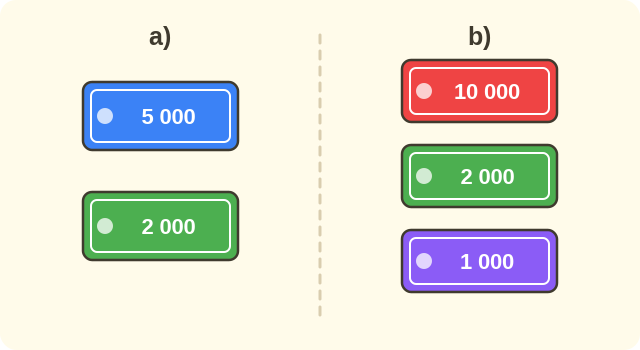
a) One 5\,000 dong note and one 2\,000 dong note.
b) One 10\,000 dong note, one 2\,000 dong note and one 1\,000 dong note.
What you need: change each note into thousands of dong and add.
Steps:
- Write how many thousand each note is.
- Add them up, then write "thousand dong".
Show solution
Solution
a) Group a has one 5\,000 dong note and one 2\,000 dong note. We add the thousands of dong on the notes: 5+2=7\ \text{(thousand dong)} 7 thousand dong is 7\,000 dong.
b) Group b has one 10\,000 dong note, one 2\,000 dong note and one 1\,000 dong note. We have: 10+2+1=13\ \text{(thousand dong)} 13 thousand dong is 13\,000 dong.
So group a has 7\,000 dong and group b has 13\,000 dong.
Answer. a) 7\,000 dong; b) 13\,000 dong.
a) You have two 20\,000 dong notes and one 10\,000 dong note. How much money do you have?
b) A storybook costs 15\,000 dong and a pencil costs 3\,000 dong. How much do you pay for both?
What you need: to count money, change into thousands and add; for the total cost of several items, add their prices.
Steps:
- Part a): 20+20+10 thousand.
- Part b): 15\,000+3\,000.
Show solution
Solution
a) You have two 20\,000 dong notes and one 10\,000 dong note. The money you have is: 20+20+10=50\ \text{(thousand dong)} 50 thousand dong is 50\,000 dong.
b) The amount to pay for the storybook and the pencil together is: 15\,000+3\,000=18\,000\ \text{(dong)}
So you have 50\,000 dong, and you pay 18\,000 dong for both items.
Answer. a) 50\,000 dong; b) 18\,000 dong.
Remember the last lesson (telling the time, months and years).
a) Nam arrives at the shop at 8{:}15 and finishes shopping 10 minutes later. At what time does he finish?
b) Nam goes to buy books in month 5 (May). How many days does May have?
What you need: 1 hour has 60 minutes; months 1, 3, 5, 7, 8, 10, 12 have 31 days.
Steps:
- Part a): add 10 minutes to 15 minutes.
- Part b): see which group of months May belongs to.
Show solution
Solution
a) Nam finishes 10 minutes after 8{:}15, so we add the minutes: 15+10=25\ \text{(minutes)} So Nam finishes at 8{:}25.
b) The months 1, 3, 5, 7, 8, 10 and 12 have 31 days. Month 5 is one of them, so May has 31 days.
So Nam finishes shopping at 8{:}25 and May has 31 days.
Answer. a) 8{:}25; b) 31 days.
a) Mum hands over 50\,000 dong to buy things costing 28\,000 dong. How much change should the seller give her?
b) Dad hands over 20\,000 dong and gets 6\,000 dong change. How much did his shopping cost?
What you need: change = money handed over - total cost. So total cost = money handed over - change.
Steps:
- What do we know? What is asked?
- Part a): find the change. Part b): find the total cost.
- Check with an addition.
Show solution
Solution
a) To find the change, we subtract the cost of the shopping from the money Mum hands over: 50\,000-28\,000=22\,000\ \text{(dong)}
b) To find the cost of Dad's shopping, we subtract the change from the money Dad hands over: 20\,000-6\,000=14\,000\ \text{(dong)}
Check: part a) 28\,000+22\,000=50\,000; part b) 14\,000+6\,000=20\,000. Both are correct.
So the seller gives Mum 22\,000 dong change, and Dad's shopping cost 14\,000 dong.
Answer. a) 22\,000 dong; b) 14\,000 dong.
Choose the operation (addition or subtraction) and say why.
a) Mai has 25\,000 dong and her aunt gives her 10\,000 dong more. How much money does Mai have altogether?
b) Mai has 35\,000 dong and buys a book for 28\,000 dong. How much money does Mai have left?
What you need: "gives more" and "altogether" mean add; "buys" and "left" mean subtract.
Steps:
- What do we know? What is asked?
- Choose the operation and work it out.
Show solution
Solution
a) Her aunt gives her more money, so the amount goes up and we add. The money Mai has altogether is: 25\,000+10\,000=35\,000\ \text{(dong)}
b) Mai pays out part of her money for the book, so the amount goes down and we subtract. The money Mai has left is: 35\,000-28\,000=7\,000\ \text{(dong)}
So Mai has 35\,000 dong altogether in part a), and 7\,000 dong left in part b).
Answer. a) 35\,000 dong; b) 7\,000 dong.
Find the mistake in each pupil's work and correct it.
a) Ha: "I have two 10\,000 dong notes and one 5\,000 dong note. I have 10\,000+5\,000=15\,000 (dong)."
b) Tu: "Tu hands over 50\,000 dong and the shopping costs 31\,000 dong. The change is 50\,000+31\,000=81\,000 (dong)."
What you need: count every note; change is the money handed over minus the total cost.
Steps:
- Part a): count how many notes there are and how many the working adds.
- Part b): can the change be more than the money handed over?
Show solution
Solution
a) Ha has two 10\,000 dong notes and one 5\,000 dong note, but she only added one 10\,000 dong note and left the other out. We must add all three notes: 10\,000+10\,000+5\,000=25\,000\ \text{(dong)}
b) Tu hands over money and gets change, so we must subtract, but Tu added. The change cannot be more than the money handed over (81\,000>50\,000), so Tu's result is impossible. Done correctly: 50\,000-31\,000=19\,000\ \text{(dong)}
So Ha has 25\,000 dong, and Tu's change is 19\,000 dong.
Answer. a) 25\,000 dong; b) 19\,000 dong.
A breakfast shop's price list:
| Item | Price (dong) |
|---|---|
| Bread roll | 12\,000 |
| Milk | 8\,000 |
| Juice | 15\,000 |
An buys one bread roll and one carton of milk, and hands over a 50\,000 dong note.
a) What is the total cost?
b) How much change does the seller give An?
What you need: the total cost is the sum of the prices; change = money handed over - total cost.
Steps:
- What do we know? What is asked? Find the prices of the bread roll and the milk in the table.
- Part a): add the two prices. Part b): take the total cost away from 50\,000.
- Check with an addition.
Show solution
Solution
a) An buys one bread roll costing 12\,000 dong and one carton of milk costing 8\,000 dong. The total cost is: 12\,000+8\,000=20\,000\ \text{(dong)}
b) An hands over 50\,000 dong, so the change the seller gives is: 50\,000-20\,000=30\,000\ \text{(dong)}
Check: 20\,000+30\,000=50\,000. It matches the money An handed over.
So An pays 20\,000 dong in total and the seller gives An 30\,000 dong change.
Answer. a) 20\,000 dong; b) 30\,000 dong.
Hung has one 20\,000 dong note, one 5\,000 dong note and three 2\,000 dong notes.
a) How much money does Hung have?
b) Hung wants to buy swimming goggles that cost 45\,000 dong. How much more money does he need?
c) Mum gives Hung another 20\,000 dong note. Does he now have enough money for the goggles? If so, how much money is left over?
What you need: count money by adding the thousands; compare the money you have with the price; the amount short or left over is the difference of the two numbers.
Steps:
- How many thousand are three 2\,000 dong notes?
- Work out how much Hung has, then take it away from 45\,000.
- Part c): add 20\,000, then compare with 45\,000.
Show solution
Solution
a) Hung has one 20\,000 dong note, one 5\,000 dong note and three 2\,000 dong notes. We add the thousands of dong: 20+5+2+2+2=31\ \text{(thousand dong)} 31 thousand dong is 31\,000 dong.
b) The goggles cost 45\,000 dong and Hung has 31\,000 dong. The money he still needs is: 45\,000-31\,000=14\,000\ \text{(dong)}
c) After Mum gives him another 20\,000 dong note, the money Hung has is: 31\,000+20\,000=51\,000\ \text{(dong)} Since 51\,000>45\,000, he has enough money for the goggles. The money left over is: 51\,000-45\,000=6\,000\ \text{(dong)}
So Hung has 31\,000 dong and needs 14\,000 dong more; after Mum's gift he has enough money and 6\,000 dong is left over.
Answer. a) 31\,000 dong; b) he needs 14\,000 dong more; c) yes, with 6\,000 dong left over.
Mini test
Marked like the Vietnamese graduation exam: Part I 0.25 points per question; Part II up to 1 point per question (1, 2, 3, 4 correct statements give 0.1, 0.25, 0.5, 1 point); Part III 0.5 points per question.
Part I. Multiple choice
10\,000+5\,000+5\,000=20\,000 dong. Option A leaves out one 5\,000 note; option D adds one 5\,000 note too many.
50\,000-32\,000=18\,000. Option A adds instead of subtracting; option B is a subtraction slip (50-32 is not 22).
9\,000+6\,000+4\,000=19\,000. Options B, C and A add only two of the items (9+4, 9+6, 6+4).
The total cost is 25\,000+18\,000=43\,000. Since 43\,000>40\,000, Lan is 43\,000-40\,000=3\,000 dong short. Option B only counts one item; option D takes the total cost as the amount short.
Part II. True or false
| a) Nam has 35\,000 dong. | ||
| b) Nam can buy something that costs 40\,000 dong. | ||
| c) If Nam buys something for 28\,000 dong, he gets 7\,000 dong change. | ||
| d) If Nam hands over all three notes for something costing 30\,000 dong, he gets 15\,000 dong change. |
a) True: 20+10+5=35 thousand. b) False: 35\,000<40\,000, so he does not have enough. c) True: 35\,000-28\,000=7\,000. d) False: 35\,000-30\,000=5\,000, not 15\,000.
Part III. Short answer
5+5+2=12 (thousand dong).
50-36=14 (thousand dong).
Show answers and explanations
- Part I, question 1: B. 10\,000+5\,000+5\,000=20\,000 dong. Option A leaves out one 5\,000 note; option D adds one 5\,000 note too many.
- Part I, question 2: C. 50\,000-32\,000=18\,000. Option A adds instead of subtracting; option B is a subtraction slip (50-32 is not 22).
- Part I, question 3: D. 9\,000+6\,000+4\,000=19\,000. Options B, C and A add only two of the items (9+4, 9+6, 6+4).
- Part I, question 4: A. The total cost is 25\,000+18\,000=43\,000. Since 43\,000>40\,000, Lan is 43\,000-40\,000=3\,000 dong short. Option B only counts one item; option D takes the total cost as the amount short.
- Part II, question 1: a) True; b) False; c) True; d) False. a) True: 20+10+5=35 thousand. b) False: 35\,000<40\,000, so he does not have enough. c) True: 35\,000-28\,000=7\,000. d) False: 35\,000-30\,000=5\,000, not 15\,000.
- Part III, question 1: 12. 5+5+2=12 (thousand dong).
- Part III, question 2: 14. 50-36=14 (thousand dong).