Cubes and cuboids
Goals
- Recognise a cube and a cuboid.
- Say the number of faces, vertices and edges of each solid and the shape of its faces.
- Solve simple problems about faces and about stacking blocks.
Remember
- A cube and a cuboid both have faces, vertices and edges.
- The faces of a cube are equal squares.
- The faces of a cuboid are rectangles; opposite faces are equal.
- layers with blocks in each layer make blocks.
Back to Nam's question: the dice and the box of chalk have the same number of faces, vertices and edges, but their faces are different shapes. Remember to look at the faces first, and then try the practice below.
Exercises
Exercise 1
Fill in the blanks: a cube has faces, vertices and edges.
Exercise 2
What solid is each object:
a) a dice;
b) a box of chalk;
c) a Rubik's cube?
Exercise 3
A cube has an edge of cm. How long is the side of each square face, in centimetres?
Exercise 4
A cuboid has a base that is a rectangle cm long and cm wide. How long and how wide is the opposite face, in centimetres?
Exercise 5
An stacks small cubes in layers, with cubes in each layer. How many cubes does An use altogether?
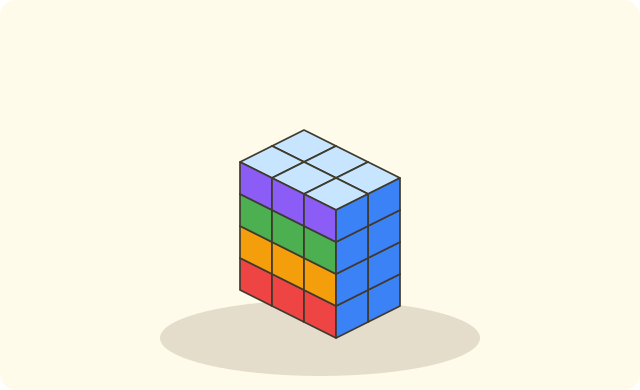
Exercise 6
Binh has small cubes and stacks them equally in layers. How many cubes are in each layer?
Exercise 7
Remember the last lesson: each face of a cube is a square with a side of cm. What is the total length of the four sides of one face, in centimetres?
Exercise 8 Challenge
A dice has faces, and the dots on two opposite faces always add up to . How many dots are there on all faces together?
Mini test
15 minutes, without looking back at the lesson. Part I: circle one letter; Part II: write T or F for each statement; Part III: write the answer in the box.
Part I. Multiple choice
Part II. True or false
| a) It has 6 faces. | T / F |
| b) Each face is a square. | T / F |
| c) It has 6 vertices. | T / F |
| d) It has 12 edges. | T / F |
Part III. Short answer
Score: ........ / 10
Hints (only when stuck)
What you need: a cube has 6 faces, 8 vertices and 12 edges.
Steps:
- Picture a dice.
- Fill in the numbers in the order faces, vertices, edges.
What you need: equal square faces make a cube; rectangular faces make a cuboid.
Steps:
- Look at the faces of the object.
- Are they equal squares?
What you need: the edges of a cube are all equal, and each face is a square.
Steps:
- The side of a face is also an edge of the cube.
- Write the answer with its unit.
What you need: opposite faces of a cuboid are equal.
Steps:
- Which face is opposite the base?
- If two faces are equal, what about their sizes?
What you need: 4 layers of 6 cubes: use multiplication.
Steps:
- What do we know? 4 layers, 6 cubes in each. What is asked? The total number of cubes.
- Work out 6\times4 and write the unit.
What you need: share 20 cubes equally between 4 layers: use division.
Steps:
- What do we know? 20 cubes, 4 equal layers.
- Work out 20\div4.
What you need: a square has 4 equal sides; the total length of its four sides is the side times 4.
Steps:
- What shape is the face, and how many sides does it have?
- Work out 3\times4.
What you need: the 6 faces split into pairs of opposite faces.
Steps:
- How many pairs of opposite faces are there?
- Each pair has 7 dots.
Self-check
| # | Did it alone | Needed a hint | Not yet |
|---|---|---|---|
| 1 | ☐ | ☐ | ☐ |
| 2 | ☐ | ☐ | ☐ |
| 3 | ☐ | ☐ | ☐ |
| 4 | ☐ | ☐ | ☐ |
| 5 | ☐ | ☐ | ☐ |
| 6 | ☐ | ☐ | ☐ |
| 7 | ☐ | ☐ | ☐ |
| 8 | ☐ | ☐ | ☐ |
Redo the ones you missed after: ☐ 1 day ☐ 3 days ☐ 7 days
Scan for step-by-step solutions