Cubes and cuboids
🖨 Print a self-study sheet Why print?
Nam has a dice and a box of chalk. Both have flat faces, but they are not the same shape. How are they different?
Let's find out by picking up each object. Count its faces, then look at what shape the faces are. Those two things are enough to show the difference.
Let's explore
Look at the dice first. It has faces, each face is a square, and all the faces are the same size. A solid like this is called a cube.
Now look at the box of chalk. It also has faces, but each face is a rectangle. This kind of solid is called a cuboid.
What about vertices and edges? In the picture you can count vertices, which are the corners of the solid. Each line segment joining two vertices is an edge, and there are edges.
So the two solids are alike in the number of faces, vertices and edges. The difference is in the shape of the faces: all squares on one, rectangles on the other. That is the answer to Nam's question.
Examples
We start by counting the parts of a cube, using Nam's dice.
Now let's name the solid for some everyday objects. The method is still the same: look at the faces.
Pick up a brick or a box of chalk: opposite faces of a cuboid are equal. So if you know the size of one face, you know the size of the face opposite it.
Finally, a problem about stacking blocks. Picture the blocks in layers, and think about whether to add or multiply.
Key terms
Summary
- A cube and a cuboid both have 6 faces, 8 vertices and 12 edges.
- The faces of a cube are equal squares.
- The faces of a cuboid are rectangles; opposite faces are equal.
- n layers with m blocks in each layer make m\times n blocks.
Back to Nam's question: the dice and the box of chalk have the same number of faces, vertices and edges, but their faces are different shapes. Remember to look at the faces first, and then try the practice below.
Practice
Each exercise has a short reminder of what you need and a hint to get you started. Have a go on your own first, and don't worry if you get stuck. Then open the solution and compare.
Fill in the blanks: a cube has \ldots faces, \ldots vertices and \ldots edges.
What you need: a cube has 6 faces, 8 vertices and 12 edges.
Steps:
- Picture a dice.
- Fill in the numbers in the order faces, vertices, edges.
Show solution
Solution
Look at a cube (like a dice): it has 6 faces that are equal squares, 8 vertices and 12 edges.
So a cube has 6 faces, 8 vertices and 12 edges.
Answer. 6; 8; 12.
What solid is each object:
a) a dice;
b) a box of chalk;
c) a Rubik's cube?
What you need: equal square faces make a cube; rectangular faces make a cuboid.
Steps:
- Look at the faces of the object.
- Are they equal squares?
Show solution
Solution
a) A dice has 6 faces that are all equal squares, so it is a cube.
b) A box of chalk has faces that are rectangles, so it is a cuboid.
c) A Rubik's cube has faces that are all equal squares, so it is a cube.
So the dice and the Rubik's cube are cubes; the box of chalk is a cuboid.
Answer. a) Cube; b) Cuboid; c) Cube.
A cube has an edge of 7 cm. How long is the side of each square face, in centimetres?
What you need: the edges of a cube are all equal, and each face is a square.
Steps:
- The side of a face is also an edge of the cube.
- Write the answer with its unit.
Show solution
Solution
Each face of a cube is a square, and a side of that square is also an edge of the cube. All the edges of a cube are equal, and this cube has an edge of 7 cm.
Hence each side of a square face is 7 cm long.
So each face is a square with a side of 7 cm.
Answer. 7 cm.
A cuboid has a base that is a rectangle 8 cm long and 5 cm wide. How long and how wide is the opposite face, in centimetres?
What you need: opposite faces of a cuboid are equal.
Steps:
- Which face is opposite the base?
- If two faces are equal, what about their sizes?
Show solution
Solution
In a cuboid, two opposite faces are equal rectangles. The top is opposite the base, so the top is equal to the base.
The base is a rectangle 8 cm long and 5 cm wide, so the top is also 8 cm long and 5 cm wide.
So the opposite face is 8 cm long and 5 cm wide.
Answer. 8 cm long, 5 cm wide.
An stacks small cubes in 4 layers, with 6 cubes in each layer. How many cubes does An use altogether?
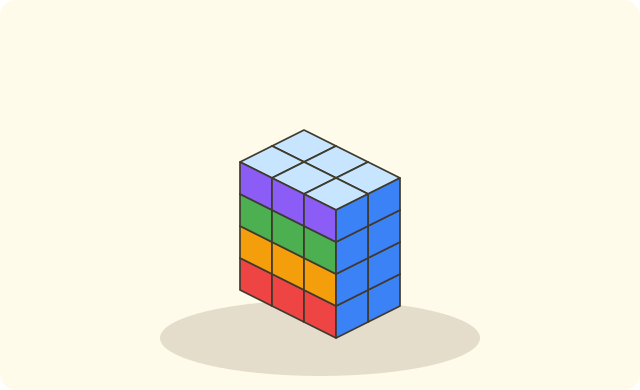
What you need: 4 layers of 6 cubes: use multiplication.
Steps:
- What do we know? 4 layers, 6 cubes in each. What is asked? The total number of cubes.
- Work out 6\times4 and write the unit.
Show solution
Solution
An stacks 4 layers with 6 cubes in each layer. The number of cubes An uses is: 6\times4=24\ \text{(cubes)}
So An uses 24 small cubes altogether.
Answer. 24 cubes.
Binh has 20 small cubes and stacks them equally in 4 layers. How many cubes are in each layer?
What you need: share 20 cubes equally between 4 layers: use division.
Steps:
- What do we know? 20 cubes, 4 equal layers.
- Work out 20\div4.
Show solution
Solution
Binh has 20 cubes stacked equally in 4 layers, so the number of cubes in each layer is: 20\div4=5\ \text{(cubes)}
Check: 5\times4=20. Correct.
So each layer has 5 cubes.
Answer. 5 cubes.
Remember the last lesson: each face of a cube is a square with a side of 3 cm. What is the total length of the four sides of one face, in centimetres?
What you need: a square has 4 equal sides; the total length of its four sides is the side times 4.
Steps:
- What shape is the face, and how many sides does it have?
- Work out 3\times4.
Show solution
Solution
A face of a cube is a square. A square has 4 equal sides, each 3 cm long. The total length of the four sides of one face is: 3\times4=12\ \text{(cm)}
So the total length of the four sides of one face is 12 cm.
Answer. 12 cm.
A dice has 6 faces, and the dots on two opposite faces always add up to 7. How many dots are there on all 6 faces together?
What you need: the 6 faces split into pairs of opposite faces.
Steps:
- How many pairs of opposite faces are there?
- Each pair has 7 dots.
Show solution
Solution
The dice has 6 faces. Two opposite faces form a pair, so the 6 faces split into 3 pairs of opposite faces.
Each pair of opposite faces has 7 dots in total. The total number of dots on all 6 faces is: 7\times3=21\ \text{(dots)}
Check: the faces have 1, 2, 3, 4, 5, 6 dots, and 1+2+3+4+5+6=21. This matches the result above.
So there are 21 dots on all 6 faces together.
Answer. 21 dots.
Mini test
Marked like the Vietnamese graduation exam: Part I 0.25 points per question; Part II up to 1 point per question (1, 2, 3, 4 correct statements give 0.1, 0.25, 0.5, 1 point); Part III 0.5 points per question.
Part I. Multiple choice
A cube has 6 faces. Option C is the number of vertices and option D is the number of edges.
All the faces of a cube are equal squares. Option B is the face of a cuboid.
Opposite faces are equal, so the top is also 9 cm long and 4 cm wide. Option D adds the two numbers by mistake.
5\times3=15 (blocks). Option A adds 5+3 by mistake.
Part II. True or false
| a) It has 6 faces. | ||
| b) Each face is a square. | ||
| c) It has 6 vertices. | ||
| d) It has 12 edges. |
a) True. b) True: all the faces are squares. c) False: it has 8 vertices. d) True: it has 12 edges.
Part III. Short answer
A cube has 8 vertices.
9\times3=27 (cubes).
Show answers and explanations
- Part I, question 1: B. A cube has 6 faces. Option C is the number of vertices and option D is the number of edges.
- Part I, question 2: C. All the faces of a cube are equal squares. Option B is the face of a cuboid.
- Part I, question 3: A. Opposite faces are equal, so the top is also 9 cm long and 4 cm wide. Option D adds the two numbers by mistake.
- Part I, question 4: B. 5\times3=15 (blocks). Option A adds 5+3 by mistake.
- Part II, question 1: a) True; b) True; c) False; d) True. a) True. b) True: all the faces are squares. c) False: it has 8 vertices. d) True: it has 12 edges.
- Part III, question 1: 8. A cube has 8 vertices.
- Part III, question 2: 27. 9\times3=27 (cubes).