Perimeter of triangles, quadrilaterals, rectangles and squares
Goals
- Understand that the perimeter of a shape is the distance all the way round it.
- Find the perimeter of a triangle or a quadrilateral by adding the lengths of its sides.
- Find the perimeter of a rectangle or a square with a quick method.
- Solve word problems about perimeter.
Remember
- The perimeter of a shape is the distance all the way round its edge.
- Perimeter of a triangle or quadrilateral: add the lengths of all the sides.
- Perimeter of a rectangle (length width) . Perimeter of a square side .
- You can check by adding all the sides, and remember to write the unit in the answer. Back to Mai's string: going once all the way round the card is finding the perimeter. Practise a few questions below until it feels natural.
Exercises
Exercise 1
Find the perimeter:
a) A triangle with sides cm, cm and cm.
b) A quadrilateral with sides cm, cm, cm and cm.
Exercise 2
Find the perimeter:
a) A rectangle with length cm and width cm.
b) A square with side cm.
Exercise 3
Remember the last lesson (rounding to the nearest ten).
a) Round to the nearest ten.
b) A square has a side of about m. Estimate its perimeter by multiplying the rounded number from part a) by .
Exercise 4
a) An ant walks once round the edge of a square table top with side cm. How many centimetres does the ant walk?
b) Binh bends a piece of wire into a triangle with sides cm, cm and cm. How many centimetres of wire does he use?
Exercise 5
Find the perimeter of each shape below in the quickest way. Why did you choose that way?
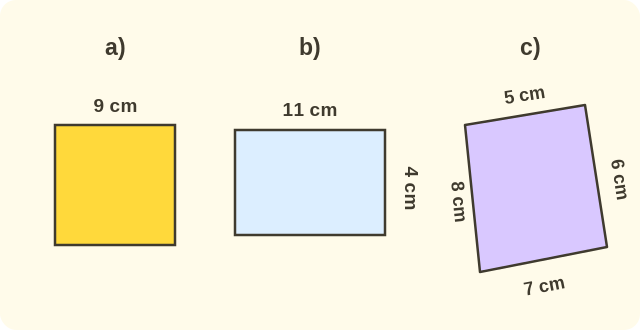
a) A square with side cm.
b) A rectangle cm long and cm wide.
c) A quadrilateral with sides 5 cm, 6 cm, 7 cm and 8 cm.
Exercise 6
Find the mistake in each friend's working and correct it.
a) Binh: "A rectangle is 10 cm long and 3 cm wide. The perimeter is 10+3=13 (cm)."
b) Cuc: "A square has side 5 cm. The perimeter is 5\times2=10 (cm)."
Exercise 7
A vegetable garden is a rectangle 20 m long and 9 m wide. Mr An builds a fence round the garden.
a) If the fence goes all the way round, how many metres long is it?
b) He leaves a gate 2 m wide with no fence. How many metres long is the fence now?
Exercise 8 Challenge
Put two squares, each with side 3 cm, side by side to make one rectangle.
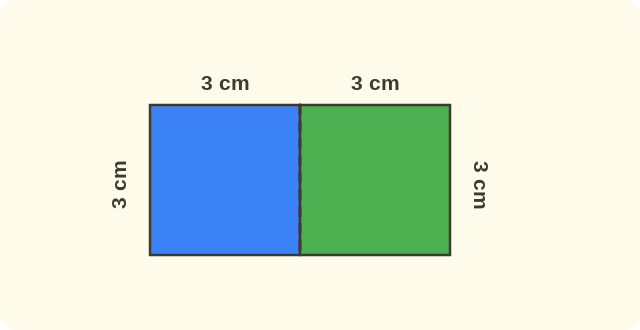
a) Find the perimeter of the rectangle.
b) Find the total perimeter of the two separate squares. Why is this total bigger than the perimeter of the rectangle?
Mini test
15 minutes, without looking back at the lesson. Part I: circle one letter; Part II: write T or F for each statement; Part III: write the answer in the box.
Part I. Multiple choice
Part II. True or false
| a) CD=10 cm. | T / F |
| b) AD=4 cm. | T / F |
| c) The perimeter is 14 cm. | T / F |
| d) The perimeter is 28 cm. | T / F |
Part III. Short answer
Score: ........ / 10
Hints (only when stuck)
What you need: the perimeter of a triangle or a quadrilateral is the total length of its sides.
Steps:
- Write the addition of all the sides.
- Add step by step and write the unit, cm.
What you need: perimeter of a rectangle = (length + width) \times\,2; perimeter of a square = side \times\,4.
Steps:
- Part a): add the length and the width, then multiply by 2.
- Part b): multiply the side by 4.
What you need: when rounding to the nearest ten, a ones digit of 5 or more means you round up.
Steps:
- Look at the ones digit of 38.
- Multiply the round number you found by 4.
What you need: going "once round" a shape means finding its perimeter.
Steps:
- What do we know? What is asked? Which shape is it?
- Choose the right way to find the perimeter, then work it out.
- Check by adding all the sides.
What you need: square: multiply by 4; rectangle: add the two measurements, then multiply by 2; other shapes: add the sides.
Steps:
- Are all the sides equal? Are there two pairs of equal sides?
- Choose the matching method.
What you need: a rectangle has four sides (two pairs of equal sides); a square has four equal sides.
Steps:
- Count how many sides the working has used.
- Do it again so that you go all the way round.
What you need: a fence round the garden goes once all the way round, so we use the perimeter.
Steps:
- What do we know? What is asked?
- Part a): find the perimeter of the rectangle.
- Part b): take away the gap for the gate.
What you need: when two squares are put side by side, they share one side.
Steps:
- How long is the rectangle compared with one square? How wide is it?
- Find the perimeter of each square, add them, then compare.
Self-check
| # | Did it alone | Needed a hint | Not yet |
|---|---|---|---|
| 1 | ☐ | ☐ | ☐ |
| 2 | ☐ | ☐ | ☐ |
| 3 | ☐ | ☐ | ☐ |
| 4 | ☐ | ☐ | ☐ |
| 5 | ☐ | ☐ | ☐ |
| 6 | ☐ | ☐ | ☐ |
| 7 | ☐ | ☐ | ☐ |
| 8 | ☐ | ☐ | ☐ |
Redo the ones you missed after: ☐ 1 day ☐ 3 days ☐ 7 days
Scan for step-by-step solutions