Perimeter of triangles, quadrilaterals, rectangles and squares
🖨 Print a self-study sheet Why print?
Mai has a rectangular card, cm long and cm wide. She wants to stick glittery string along the edge of the card, exactly once round. How long must the string be, in centimetres?
It may sound as if you need a brand-new method, but you do not. You already know how to measure lengths in centimetres and how to add numbers. That is all you need for Mai's string. What is new is one name and one shorter way to add.
Let's explore
Before we get to the card, let's try a simpler shape: a triangle. An ant walks once round the edge of triangle , starting at and coming back to .
Follow the ant and note each part of the walk:
- The first part, from to , is cm long.
- The second part, from to , is cm long.
- The third part, from back to , is cm long.
The whole walk is cm. The distance all the way round a shape has a name: the perimeter. This is the perimeter of the triangle.
Why must we add all the sides? The ant has to walk along every side to get back to the start. If you miss one, the walk is not complete. This is where many people slip, so count the sides before you add.
A quick method for rectangles and squares
Now back to Mai's card. Is there a shorter way to add? Notice that a rectangle has two long sides that are equal and two short sides that are equal.
First, simply add all four sides: cm. In this sum there are two long sides and two short sides, so we can make two pairs of "long and short".
One pair is cm, and there are two such pairs. Why multiply by two? Because the pair "long and short" appears exactly twice. So cm. Mai's string must be cm long.
A square is even tidier, because all four sides are equal. If one side is cm, the walk round is cm, which is cm. Four copies of the same side: multiplying is quickest.
Do not worry if you cannot remember these two rules straight away. They are just shorter ways of adding, and there is nothing new in them. If you forget, add all the sides: it always gives the perimeter.
Examples
We begin with a triangle: three sides, so three lengths to add.
A quadrilateral has one more side, so we add four numbers instead of three. The method is just the same.
For a rectangle, we use the shorter way we just found. Remember why we multiply by two: there are two pairs of equal sides.
A square is even easier, because we only need one side.
Perimeter is useful in many places, for example when building a fence. Let's try one.
Key terms
Summary
- The perimeter of a shape is the distance all the way round its edge.
- Perimeter of a triangle or quadrilateral: add the lengths of all the sides.
- Perimeter of a rectangle = (length + width) \times\,2. Perimeter of a square = side \times\,4.
- You can check by adding all the sides, and remember to write the unit in the answer. Back to Mai's string: going once all the way round the card is finding the perimeter. Practise a few questions below until it feels natural.
Practice
Each exercise comes with what you need and a hint to get started. Try it yourself first. If you get stuck, read the hint, and only then open the solution to compare.
Find the perimeter:
a) A triangle with sides 3 cm, 4 cm and 6 cm.
b) A quadrilateral with sides 2 cm, 3 cm, 4 cm and 5 cm.
What you need: the perimeter of a triangle or a quadrilateral is the total length of its sides.
Steps:
- Write the addition of all the sides.
- Add step by step and write the unit, cm.
Show solution
Solution
The perimeter of a shape is the sum of the lengths of its sides.
a) The perimeter of the triangle is: 3+4+6=13\ \text{(cm)}.
b) The perimeter of the quadrilateral is: 2+3+4+5=14\ \text{(cm)}.
So the perimeter of the triangle is 13 cm and the perimeter of the quadrilateral is 14 cm.
Answer. a) 13 cm; b) 14 cm.
Find the perimeter:
a) A rectangle with length 12 cm and width 5 cm.
b) A square with side 9 cm.
What you need: perimeter of a rectangle = (length + width) \times\,2; perimeter of a square = side \times\,4.
Steps:
- Part a): add the length and the width, then multiply by 2.
- Part b): multiply the side by 4.
Show solution
Solution
a) To find the perimeter of a rectangle, we add the length and the width (in the same unit) and then multiply by 2. The perimeter of the rectangle is: (12+5)\times2=17\times2=34\ \text{(cm)}.
b) A square has 4 equal sides, so to find its perimeter we multiply the length of one side by 4. The perimeter of the square is: 9\times4=36\ \text{(cm)}.
So the perimeter of the rectangle is 34 cm and the perimeter of the square is 36 cm.
Answer. a) 34 cm; b) 36 cm.
Remember the last lesson (rounding to the nearest ten).
a) Round 38 to the nearest ten.
b) A square has a side of about 38 m. Estimate its perimeter by multiplying the rounded number from part a) by 4.
What you need: when rounding to the nearest ten, a ones digit of 5 or more means you round up.
Steps:
- Look at the ones digit of 38.
- Multiply the round number you found by 4.
Show solution
Solution
a) The ones digit of 38 is 8. Since 8 is more than 5, we round up to the nearest ten: 38\approx40.
b) A square has 4 equal sides. We multiply the rounded number from part a) by 4 to estimate the perimeter: 40\times4=160\ \text{(m)}.
Check. 38\times4=152, which is close to 160. The estimate is sensible.
So 38 rounded to the nearest ten is 40, and the perimeter of the square is about 160 m.
Answer. a) 40; b) about 160 m.
a) An ant walks once round the edge of a square table top with side 6 cm. How many centimetres does the ant walk?
b) Binh bends a piece of wire into a triangle with sides 8 cm, 9 cm and 10 cm. How many centimetres of wire does he use?
What you need: going "once round" a shape means finding its perimeter.
Steps:
- What do we know? What is asked? Which shape is it?
- Choose the right way to find the perimeter, then work it out.
- Check by adding all the sides.
Show solution
Solution
a) The ant walks once round the edge of the table top, so the distance it walks is the perimeter of the square. A square has 4 equal sides, so the distance is: 6\times4=24\ \text{(cm)}.
b) The wire is bent into a triangle, so its length equals the perimeter of the triangle. The length of the wire is: 8+9+10=27\ \text{(cm)}.
So the ant walks 24 cm and the wire is 27 cm long.
Answer. a) 24 cm; b) 27 cm.
Find the perimeter of each shape below in the quickest way. Why did you choose that way?
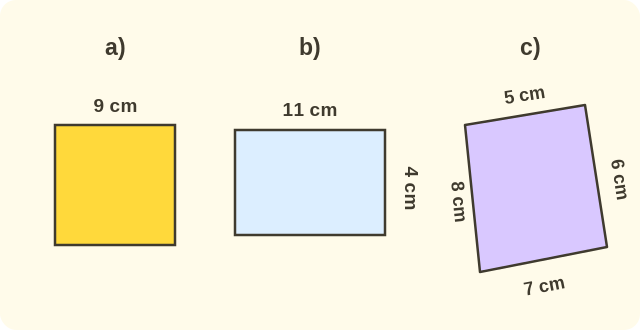
a) A square with side 9 cm.
b) A rectangle 11 cm long and 4 cm wide.
c) A quadrilateral with sides 5 cm, 6 cm, 7 cm and 8 cm.
What you need: square: multiply by 4; rectangle: add the two measurements, then multiply by 2; other shapes: add the sides.
Steps:
- Are all the sides equal? Are there two pairs of equal sides?
- Choose the matching method.
Show solution
Solution
We choose the quickest way by looking at the sides of each shape.
a) A square has four equal sides, so we multiply one side by 4: 9\times4=36\ \text{(cm)}.
b) A rectangle has two pairs of equal sides (two long sides and two short sides), so we add the length and the width and multiply by 2: (11+4)\times2=15\times2=30\ \text{(cm)}.
c) The four sides of the quadrilateral are all different, so we must add all four: 5+6+7+8=26\ \text{(cm)}.
So the perimeter of the square is 36 cm, the perimeter of the rectangle is 30 cm and the perimeter of the quadrilateral is 26 cm.
Answer. a) 36 cm; b) 30 cm; c) 26 cm.
Find the mistake in each friend's working and correct it.
a) Binh: "A rectangle is 10 cm long and 3 cm wide. The perimeter is 10+3=13 (cm)."
b) Cuc: "A square has side 5 cm. The perimeter is 5\times2=10 (cm)."
What you need: a rectangle has four sides (two pairs of equal sides); a square has four equal sides.
Steps:
- Count how many sides the working has used.
- Do it again so that you go all the way round.
Show solution
a) Binh has added only the length and the width, which are two sides next to each other, so he has gone only halfway round the shape. The rectangle has two more sides. The correct working is: (10+3)\times2=13\times2=26\ \text{(cm)}.
b) Cuc multiplied by 2, but a square has 4 equal sides, so she must multiply by 4. The correct working is: 5\times4=20\ \text{(cm)}.
So Binh forgot to multiply by 2 and the correct perimeter is 26 cm; Cuc multiplied by 2 by mistake and the correct perimeter is 20 cm.
Answer. a) 26 cm; b) 20 cm.
A vegetable garden is a rectangle 20 m long and 9 m wide. Mr An builds a fence round the garden.
a) If the fence goes all the way round, how many metres long is it?
b) He leaves a gate 2 m wide with no fence. How many metres long is the fence now?
What you need: a fence round the garden goes once all the way round, so we use the perimeter.
Steps:
- What do we know? What is asked?
- Part a): find the perimeter of the rectangle.
- Part b): take away the gap for the gate.
Show solution
Solution
a) A fence that goes all the way round is as long as the perimeter of the rectangular garden. The fence is: (20+9)\times2=29\times2=58\ \text{(m)}.
b) Mr An leaves a gate 2 m wide with no fence, so the fence is 2 m shorter than the closed fence. The fence is: 58-2=56\ \text{(m)}.
So a fence all the way round is 58 m long, and with the gate left open the fence is 56 m long.
Answer. a) 58 m; b) 56 m.
Put two squares, each with side 3 cm, side by side to make one rectangle.
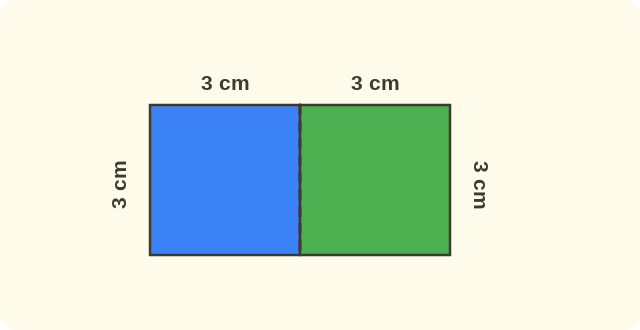
a) Find the perimeter of the rectangle.
b) Find the total perimeter of the two separate squares. Why is this total bigger than the perimeter of the rectangle?
What you need: when two squares are put side by side, they share one side.
Steps:
- How long is the rectangle compared with one square? How wide is it?
- Find the perimeter of each square, add them, then compare.
Show solution
Solution
a) Two squares with side 3 cm put side by side make a rectangle with length 3+3=6 (cm) and width 3 cm. The perimeter of the rectangle is: (6+3)\times2=9\times2=18\ \text{(cm)}.
b) Each square has perimeter 3\times4=12 (cm). The total perimeter of the two separate squares is: 12+12=24\ \text{(cm)}.
This total is bigger than the perimeter of the rectangle because, when we join the squares, the shared side, 3 cm long, is hidden inside and is no longer part of the perimeter of the rectangle. Each square loses 3 cm, so 24-3-3=18\ \text{(cm)}, which is exactly the perimeter of the rectangle in part a).
So the perimeter of the rectangle is 18 cm, the total perimeter of the two separate squares is 24 cm, and the total is bigger because the shared side is hidden.
Answer. a) 18 cm; b) 24 cm.
Mini test
Marked like the Vietnamese graduation exam: Part I 0.25 points per question; Part II up to 1 point per question (1, 2, 3, 4 correct statements give 0.1, 0.25, 0.5, 1 point); Part III 0.5 points per question.
Part I. Multiple choice
4+5+7=16. Options A, B and C add only two sides (4+5, 4+7, 5+7), so a side is missing.
(9+6)\times2=15\times2=30. Option A forgets to multiply by 2; option C is 9+6+9, with a side missing; option D multiplies the two measurements together.
8\times4=32. Option A multiplies by 2, option B multiplies by 3, and option D is 8\times8.
Once round is the perimeter: (12+7)\times2=19\times2=38 m. Option A forgets to multiply by 2; option C is 12+7+12, with a side missing.
Part II. True or false
| a) CD=10 cm. | ||
| b) AD=4 cm. | ||
| c) The perimeter is 14 cm. | ||
| d) The perimeter is 28 cm. |
a) True: opposite sides are equal. b) True: AD and BC are opposite sides. c) False: 14 is only 10+4, not yet multiplied by 2. d) True: (10+4)\times2=28.
Part III. Short answer
6\times4=24 (cm).
(13+8)\times2=21\times2=42 (m).
Show answers and explanations
- Part I, question 1: D. 4+5+7=16. Options A, B and C add only two sides (4+5, 4+7, 5+7), so a side is missing.
- Part I, question 2: B. (9+6)\times2=15\times2=30. Option A forgets to multiply by 2; option C is 9+6+9, with a side missing; option D multiplies the two measurements together.
- Part I, question 3: C. 8\times4=32. Option A multiplies by 2, option B multiplies by 3, and option D is 8\times8.
- Part I, question 4: B. Once round is the perimeter: (12+7)\times2=19\times2=38 m. Option A forgets to multiply by 2; option C is 12+7+12, with a side missing.
- Part II, question 1: a) True; b) True; c) False; d) True. a) True: opposite sides are equal. b) True: AD and BC are opposite sides. c) False: 14 is only 10+4, not yet multiplied by 2. d) True: (10+4)\times2=28.
- Part III, question 1: 24. 6\times4=24 (cm).
- Part III, question 2: 42. (13+8)\times2=21\times2=42 (m).