Collecting, sorting and recording data. Data tables
Goals
- Collect data by asking or by looking.
- Sort data into groups and count it with tally marks.
- Put data in a table and read the table to answer questions.
Remember
- Work in three steps: collect, sort, record in a table.
- Count with tally marks: one stroke for each piece of data, a new group after strokes.
- Reading a table: the biggest number is the "most", the smallest is the "least"; "how many more" means subtract.
- Add the numbers in the table to check: the total must equal the number of times you asked.
Back to our opening question: with a data table, you can see how many children like oranges without counting the whole list again. Remember one thing: after counting, add up to check, and then try the practice below.
Exercises
Exercise 1
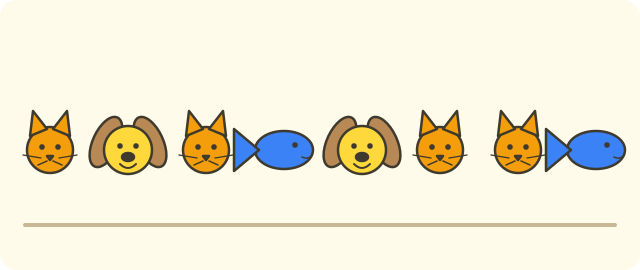
You wrote down the animals children like: cat, dog, cat, fish, dog, cat, cat, fish. Make a data table (with a column of tally marks).
Exercise 2
The table shows how the children in Class 3B travel to school:
| Way of travelling | Walk | Bicycle | Bus | Motorbike (parent) |
|---|---|---|---|---|
| Number of children |
a) Which way has the most children? Which has the fewest?
b) How many children are in Class 3B?
Exercise 3
A class has children and each joins one club. The number who joined art is missing:
| Club | Singing | Dancing | Art |
|---|---|---|---|
| Number of children | ? |
Exercise 4
A farm collects these numbers of eggs in four days:
| Day | Monday | Tuesday | Wednesday | Thursday |
|---|---|---|---|---|
| Number of eggs |
a) How many eggs are collected in all four days?
b) How many more eggs are collected on the best day than on the worst day?
Exercise 5
A table records which ice cream children like:
| Ice cream | Strawberry | Chocolate | Vanilla |
|---|---|---|---|
| Number of children |
Binh says: "There are children in our class and each chose one ice cream." Is Binh right? Why?
Exercise 6
Lan asked children for their colour: blue, red, blue, yellow, red, blue, yellow, blue, red. Lan wrote the table: blue , red , yellow . Where is Lan's table wrong? Correct it.
Exercise 7
Remember the last lesson (dividing a five-digit number by a one-digit number).
a) Work out .
b) A shop sells exercise books in weeks, the same number each week. Put the number of books for each week in a table.
Exercise 8 Challenge
A class has children and each chooses one of three sports: football, badminton, swimming. children choose football. The number who choose badminton is 5 fewer than the number who choose football. How many children choose swimming?
Mini test
15 minutes, without looking back at the lesson. Part I: circle one letter; Part II: write T or F for each statement; Part III: write the answer in the box.
Part I. Multiple choice
Part II. True or false
| a) Roses were chosen by the most children. | T / F |
| b) The total number of children in the table is 25. | T / F |
| c) More children chose daisies than orchids. | T / F |
| d) 3 more children chose roses than daisies. | T / F |
Part III. Short answer
Score: ........ / 10
Hints (only when stuck)
What you need: sort first, then count with tally marks, one stroke for each piece of data.
Steps:
- How many kinds of animal are there?
- Read each animal and draw a stroke in its row.
- Add up to check.
What you need: compare the numbers in the table; add all the numbers to get the number of children in the class.
Steps:
- Find the biggest and the smallest number.
- Add the four numbers.
What you need: the numbers in the table add up to the number of children in the class.
Steps:
- Add the two numbers you know.
- Subtract the result from 28.
What you need: "in all" means add; "how many more" means subtract.
Steps:
- Add the four numbers.
- Find the biggest and smallest numbers, then subtract.
What you need: the numbers in the table add up to the number of children asked.
Steps:
- What do we know? Three numbers in the table.
- Add the three numbers and compare with 30.
What you need: add the numbers in the table and compare with the number of children asked.
Steps:
- Add 5+3+2 and compare with 9.
- Count each colour in the list again.
What you need: divide place by place, starting with the ten thousands.
Steps:
- Divide 12 thousands by 4, then divide the remaining places.
- Each week has the same number of books.
What you need: "fewer" means subtract; the three sports add up to 36.
Steps:
- Find the number who choose badminton.
- Subtract the football and badminton numbers from 36.
Self-check
| # | Did it alone | Needed a hint | Not yet |
|---|---|---|---|
| 1 | ☐ | ☐ | ☐ |
| 2 | ☐ | ☐ | ☐ |
| 3 | ☐ | ☐ | ☐ |
| 4 | ☐ | ☐ | ☐ |
| 5 | ☐ | ☐ | ☐ |
| 6 | ☐ | ☐ | ☐ |
| 7 | ☐ | ☐ | ☐ |
| 8 | ☐ | ☐ | ☐ |
Redo the ones you missed after: ☐ 1 day ☐ 3 days ☐ 7 days
Scan for step-by-step solutions