Collecting, sorting and recording data. Data tables
🖨 Print a self-study sheet Why print?
Your teacher asks children in your group: "Which fruit do you like best: orange, banana or apple?" They answer one by one: orange, banana, orange, apple, banana, banana, orange, apple, orange, banana, apple, orange. How many children like oranges best?
You could count along the list, and with a short list like this that works. But what if we asked the whole class, or the whole school? The longer the list, the easier it is to miss one child or count one twice. There is a tidy way to record the answers so that you can count them in one go and still be sure. Let's see how it works.
Let's explore
We will go step by step, using the list of answers above. Each step does just one job.
Step 1: collect. We asked each child and wrote down the answer. Each answer we write down like this is one piece of data.
Step 2: sort. Looking at the list, only three fruits are named. So we put the answers into three groups: orange, banana, apple.
Step 3: count with tally marks. Now read the answers one at a time. For each answer, draw one stroke in the row of that fruit. Why make groups? A long line of strokes is hard to count, but a group of is quick to read. So start a new group after every strokes. This way you read the list only once.
| Fruit | Tally marks | Number of children |
|---|---|---|
| Orange | ///// | |
| Banana | //// | |
| Apple | /// |
Now we can read the answer straight from the table: children like oranges best. There is one more thing to do. Add the numbers in the table: . That is exactly the number of children we asked, so we know we have not missed anyone.
This last check is small, but it is worth doing. If the total does not match, you know you missed a child or counted one twice, and you can go back and count again.
Examples
Let's make a table from a short list first. Follow the three steps as you go.
Once we have a table, we do not need to read the whole list again. We can look at the table and answer questions straight away. Let's try some.
A table is not only for counting children. It can also record data day by day, such as the exercise books a shop sells.
Sometimes one box in the table is empty. Don't worry: if you know the total, you can find the missing number by taking away the numbers you already have.
Key terms
Summary
- Work in three steps: collect, sort, record in a table.
- Count with tally marks: one stroke for each piece of data, a new group after 5 strokes.
- Reading a table: the biggest number is the "most", the smallest is the "least"; "how many more" means subtract.
- Add the numbers in the table to check: the total must equal the number of times you asked.
Back to our opening question: with a data table, you can see how many children like oranges without counting the whole list again. Remember one thing: after counting, add up to check, and then try the practice below.
Practice
Each exercise has a short reminder of what you need and a hint to get you started. Have a go on your own first, and don't worry if you get stuck. Then open the solution and compare.
You wrote down the animals children like: cat, dog, cat, fish, dog, cat, cat, fish. Make a data table (with a column of tally marks).
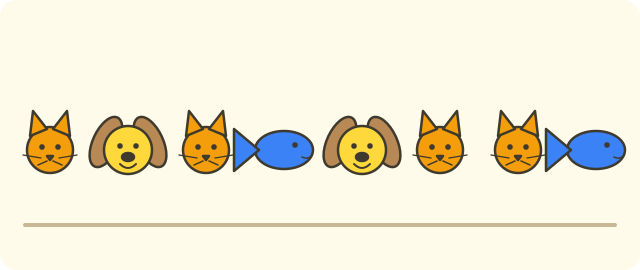
What you need: sort first, then count with tally marks, one stroke for each piece of data.
Steps:
- How many kinds of animal are there?
- Read each animal and draw a stroke in its row.
- Add up to check.
Show solution
We read the animals one by one and draw one tally mark in the row of that animal. Each time we meet an animal, we add one more mark.
The animals in order are: cat, dog, cat, fish, dog, cat, cat, fish.
Counting each kind: cat appears 4 times (in positions 1, 3, 6, 7); dog appears 2 times (in positions 2, 5); fish appears 2 times (in positions 4, 8). We get the data table:
| Animal | Tally marks | Number of children |
|---|---|---|
| Cat | //// | 4 |
| Dog | // | 2 |
| Fish | // | 2 |
Check: 4+2+2=8, the number of children you wrote down.
So in the table, 4 children like cats, 2 children like dogs and 2 children like fish.
Answer. Cat 4, dog 2, fish 2.
The table shows how the children in Class 3B travel to school:
| Way of travelling | Walk | Bicycle | Bus | Motorbike (parent) |
|---|---|---|---|---|
| Number of children | 7 | 11 | 5 | 9 |
a) Which way has the most children? Which has the fewest?
b) How many children are in Class 3B?
What you need: compare the numbers in the table; add all the numbers to get the number of children in the class.
Steps:
- Find the biggest and the smallest number.
- Add the four numbers.
Show solution
a) Reading the table, the numbers of children for the four ways are 7, 11, 5 and 9. Comparing these four numbers, we have 5<7<9<11.
The biggest number is 11, which is bicycle. The smallest number is 5, which is bus.
So bicycle has the most children and bus has the fewest.
b) The number of children in Class 3B is the total of the four ways of travelling. We add the numbers one at a time: 7+11=18;\quad 18+5=23;\quad 23+9=32.
So Class 3B has 32 children.
Answer. a) Bicycle is the most, bus is the fewest. b) 32 children.
A class has 28 children and each joins one club. The number who joined art is missing:
| Club | Singing | Dancing | Art |
|---|---|---|---|
| Number of children | 11 | 8 | ? |
What you need: the numbers in the table add up to the number of children in the class.
Steps:
- Add the two numbers you know.
- Subtract the result from 28.
Show solution
Solution
The class has 28 children and each child joins exactly one club, so the three clubs together have 28 children.
The number of children who joined singing and dancing is: 11+8=19\ \text{(children)}. The number of children who joined art is: 28-19=9\ \text{(children)}.
Check: 11+8+9=28, the number of children in the class.
So 9 children joined art.
Answer. 9 children.
A farm collects these numbers of eggs in four days:
| Day | Monday | Tuesday | Wednesday | Thursday |
|---|---|---|---|---|
| Number of eggs | 24 | 30 | 27 | 21 |
a) How many eggs are collected in all four days?
b) How many more eggs are collected on the best day than on the worst day?
What you need: "in all" means add; "how many more" means subtract.
Steps:
- Add the four numbers.
- Find the biggest and smallest numbers, then subtract.
Show solution
a) The number of eggs collected in all four days is the total of the four numbers in the table. We add the numbers one at a time: 24+30=54;\quad 54+27=81;\quad 81+21=102.
So 102 eggs are collected in the four days.
b) Comparing the four numbers 24, 30, 27, 21: the biggest number is 30 (Tuesday) and the smallest is 21 (Thursday).
The number of eggs by which the best day beats the worst day is: 30-21=9\ \text{(eggs)}.
So the best day has 9 more eggs than the worst day.
Answer. a) 102 eggs. b) 9 eggs.
A table records which ice cream children like:
| Ice cream | Strawberry | Chocolate | Vanilla |
|---|---|---|---|
| Number of children | 8 | 12 | 6 |
Binh says: "There are 30 children in our class and each chose one ice cream." Is Binh right? Why?
What you need: the numbers in the table add up to the number of children asked.
Steps:
- What do we know? Three numbers in the table.
- Add the three numbers and compare with 30.
Show solution
If the class has 30 children and each child chooses one ice cream, the total number of children in the table must be 30.
The total number of children in the table is: 8+12+6=26\ \text{(children)}.
Since 26\neq30, the table does not have 30 children. The number of children missing is: 30-26=4\ \text{(children)}.
So Binh is not right, because the table has only 26 children, so 4 are missing.
Answer. Binh is not right: the table has only 26 children, so 4 are missing.
Lan asked 9 children for their colour: blue, red, blue, yellow, red, blue, yellow, blue, red. Lan wrote the table: blue 5, red 3, yellow 2. Where is Lan's table wrong? Correct it.
What you need: add the numbers in the table and compare with the number of children asked.
Steps:
- Add 5+3+2 and compare with 9.
- Count each colour in the list again.
Show solution
Lan asked 9 children, so the total in the table must be 9. Lan's table has a total of: 5+3+2=10.
Since 10\neq9, Lan's table is wrong.
Counting again from the list of answers: blue, red, blue, yellow, red, blue, yellow, blue, red.
Blue is chosen by the 1st, 3rd, 6th and 8th children, that is 4 children. Red is chosen by the 2nd, 5th and 9th children, that is 3 children. Yellow is chosen by the 4th and 7th children, that is 2 children.
Check: 4+3+2=9, the number of children Lan asked.
So Lan counted one blue child too many. The correct table is: blue 4, red 3, yellow 2.
Answer. Lan counted one blue too many; the correct table is blue 4, red 3, yellow 2.
Remember the last lesson (dividing a five-digit number by a one-digit number).
a) Work out 12\,640\div4.
b) A shop sells 12\,640 exercise books in 4 weeks, the same number each week. Put the number of books for each week in a table.
What you need: divide place by place, starting with the ten thousands.
Steps:
- Divide 12 thousands by 4, then divide the remaining places.
- Each week has the same number of books.
Show solution
a) We divide 12\,640 by 4 step by step from left to right.
Take 12 and divide by 4 to get 3, remainder 0. Bring down 6 to make 6; 6\div4=1, remainder 2. Bring down 4 to make 24; 24\div4=6, remainder 0. Bring down 0 to make 0; 0\div4=0, remainder 0.
So 12\,640\div4=3\,160.
b) The shop sells 12\,640 exercise books in 4 weeks, the same number each week, so the number of books each week is 12\,640\div4=3\,160 (books). We put this in the table:
| Week | One | Two | Three | Four |
|---|---|---|---|---|
| Number of books | 3\,160 | 3\,160 | 3\,160 | 3\,160 |
Check: 3\,160\times4=12\,640.
So the shop sells 3\,160 books each week.
Answer. a) 3\,160. b) 3\,160 books each week.
A class has 36 children and each chooses one of three sports: football, badminton, swimming. 15 children choose football. The number who choose badminton is 5 fewer than the number who choose football. How many children choose swimming?
What you need: "fewer" means subtract; the three sports add up to 36.
Steps:
- Find the number who choose badminton.
- Subtract the football and badminton numbers from 36.
Show solution
Solution
The number of children who choose badminton is: 15-5=10\ \text{(children)}. The number of children who choose football and badminton together is: 15+10=25\ \text{(children)}. The number of children who choose swimming is: 36-25=11\ \text{(children)}.
Check: 15+10+11=36, the number of children in the class.
So 11 children choose swimming.
Answer. 11 children.
Mini test
Marked like the Vietnamese graduation exam: Part I 0.25 points per question; Part II up to 1 point per question (1, 2, 3, 4 correct statements give 0.1, 0.25, 0.5, 1 point); Part III 0.5 points per question.
Part I. Multiple choice
Orange appears in places 1, 3 and 4, so there are 3 oranges. Option B counts the whole list.
The smallest of 8, 5, 7 is 5, which is chess. Option B picks the biggest number.
8+5+7=20. Option A adds only the first two numbers, and option C adds only football and swimming.
"How many more" means subtract: 16-13=3. Option A adds by mistake.
Part II. True or false
| a) Roses were chosen by the most children. | ||
| b) The total number of children in the table is 25. | ||
| c) More children chose daisies than orchids. | ||
| d) 3 more children chose roses than daisies. |
a) True: 10 is the biggest number. b) True: 10+7+8=25. c) False: 7<8. d) True: 10-7=3.
Part III. Short answer
14+11+12=37 (cranes).
32-14-10=8 (children).
Show answers and explanations
- Part I, question 1: D. Orange appears in places 1, 3 and 4, so there are 3 oranges. Option B counts the whole list.
- Part I, question 2: A. The smallest of 8, 5, 7 is 5, which is chess. Option B picks the biggest number.
- Part I, question 3: B. 8+5+7=20. Option A adds only the first two numbers, and option C adds only football and swimming.
- Part I, question 4: C. "How many more" means subtract: 16-13=3. Option A adds by mistake.
- Part II, question 1: a) True; b) True; c) False; d) True. a) True: 10 is the biggest number. b) True: 10+7+8=25. c) False: 7<8. d) True: 10-7=3.
- Part III, question 1: 37. 14+11+12=37 (cranes).
- Part III, question 2: 8. 32-14-10=8 (children).