Unit fractions
Goals
- Recognise one-th of a shape, and read and write .
- Know that the more equal parts there are, the smaller each part is.
- Find one-th of a number by dividing, and solve word problems.
Remember
- Split a shape (or a number) into equal parts: each part is of it.
- is one half, is one third, is one quarter.
- The more equal parts, the smaller each part.
- One-th of a number is that number divided by .
- Check with multiplication; write the unit in the answer. Back to the cake: shared equally among four friends, each friend gets one quarter. Remember that the parts must be equal, and practise a few questions to make it stick.
Exercises
Exercise 1
Each shape is split into equal parts. Write the fraction for one part:
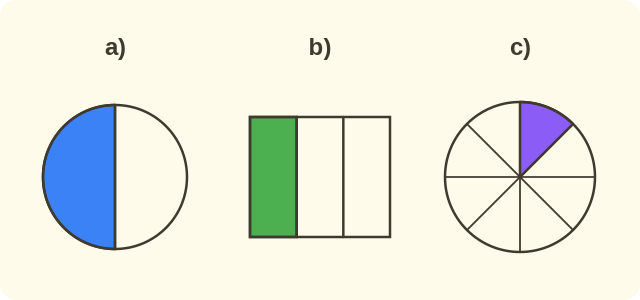
a) A shape split into equal parts.
b) A shape split into equal parts.
c) A shape split into equal parts.
Exercise 2
Write with numbers:
a) One quarter.
b) One sixth.
c) One tenth.
Exercise 3
Remember the last lesson. Find when . Then find of .
Exercise 4
Find:
a) of .
b) of .
c) of .
Exercise 5
a) To find of , do you multiply or divide? Why? Then work it out.
b) One cake is shared equally among 2 friends, and an identical cake is shared equally among 4 friends. Who gets the bigger piece? Why?
Exercise 6
Nam wrote: "\dfrac{1}{3} of 12 is 36 because 12\times3=36". Where did Nam go wrong? Correct it.
Exercise 7
a) There are 24 sweets and Lan takes \dfrac{1}{6} of them. How many sweets does Lan take?
b) A piece of string 40 cm long is cut into 5 equal lengths. How many centimetres is each length, and what fraction of the string is it?
Exercise 8 Challenge
A class has 36 pupils. \dfrac{1}{4} of the pupils go to swimming club and \dfrac{1}{9} of the pupils go to art club. How many more pupils go to swimming club than to art club?
Mini test
15 minutes, without looking back at the lesson. Part I: circle one letter; Part II: write T or F for each statement; Part III: write the answer in the box.
Part I. Multiple choice
Part II. True or false
| a) Each part is \dfrac{1}{4} of the rectangle. | T / F |
| b) \dfrac{1}{4} of 20 is 5. | T / F |
| c) \dfrac{1}{4} of 20 is 80. | T / F |
| d) Each part is \dfrac{1}{5} of the rectangle. | T / F |
Part III. Short answer
Score: ........ / 10
Hints (only when stuck)
What you need: split into n equal parts: each part is \dfrac{1}{n}.
Steps:
- Count the equal parts.
- Write 1 over that number.
What you need: "one-nth" is written \dfrac{1}{n}.
Steps:
- Find the number n in the name.
- Write 1 over n.
What you need: the missing factor is the product divided by the known factor. One third of a number is that number divided by 3.
Steps:
- Find \square by dividing.
- Work out 15\div3 and compare.
What you need: one-nth of a number is that number divided by n.
Steps:
- Find n.
- Divide the number by n, then check.
What you need: one-nth of a number is that number divided by n; the more equal parts, the smaller each part.
Steps:
- How many equal parts do we split into?
- Compare the number of parts in the two cases.
What you need: one third of a number is that number divided by 3.
Steps:
- Can one third of 12 be bigger than 12?
- Use the right operation.
What you need: one-nth of a number is that number divided by n.
Steps:
- What do we know? What is asked?
- Divide by the number of equal parts and write the answer with its unit.
What you need: find each part by dividing, then find the difference.
Steps:
- Work out \dfrac{1}{4} of 36 and \dfrac{1}{9} of 36.
- Subtract the two results.
Self-check
| # | Did it alone | Needed a hint | Not yet |
|---|---|---|---|
| 1 | ☐ | ☐ | ☐ |
| 2 | ☐ | ☐ | ☐ |
| 3 | ☐ | ☐ | ☐ |
| 4 | ☐ | ☐ | ☐ |
| 5 | ☐ | ☐ | ☐ |
| 6 | ☐ | ☐ | ☐ |
| 7 | ☐ | ☐ | ☐ |
| 8 | ☐ | ☐ | ☐ |
Redo the ones you missed after: ☐ 1 day ☐ 3 days ☐ 7 days
Scan for step-by-step solutions