Unit fractions
🖨 Print a self-study sheet Why print?
Mum cuts a cake into equal pieces to share among friends, one piece each. Think about it: what fraction of the cake does each friend get?
You could answer in words, but saying "one part out of so many" again and again is slow. Maths has a short way to write it. You will learn to read it, write it and use it to share a number equally.
Let's explore
To see it clearly, we draw the cake as a rectangle and split it into equal parts.
Count the parts: the shape is split into equal parts. Each part is called one quarter of the shape, and we write it . So each friend gets of the cake.
Try other splits. With equal parts, each part is of the shape. With equal parts, each part is . Notice that the more equal parts we make, the smaller each part is, just as a cake shared among more friends gives each friend less.
Why do we divide? Because splitting the number into equal parts makes each part exactly one-th of it. For example, sweets split into 3 equal parts give 12\div3=4 in each part, so \dfrac{1}{3} of 12 is 4.
Examples
We start by naming one part of a piece of string.
Now practise reading and writing. Remember that the bottom number tells you how many equal parts there are.
Now we use division to find one-nth of a number.
The method is the same; only the number is bigger.
Finally, we use the method on something that happens at home: sharing oranges.
Key terms
Summary
- Split a shape (or a number) into n equal parts: each part is \dfrac{1}{n} of it.
- \dfrac{1}{2} is one half, \dfrac{1}{3} is one third, \dfrac{1}{4} is one quarter.
- The more equal parts, the smaller each part.
- One-nth of a number is that number divided by n.
- Check with multiplication; write the unit in the answer. Back to the cake: shared equally among four friends, each friend gets one quarter. Remember that the parts must be equal, and practise a few questions to make it stick.
Practice
Every exercise has the key idea and a hint to get you started. Have a go on your own first, use the hint if you get stuck, and open the solution last to check.
Each shape is split into equal parts. Write the fraction for one part:
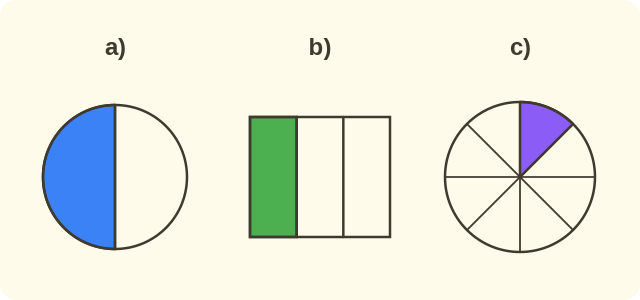
a) A shape split into 2 equal parts.
b) A shape split into 3 equal parts.
c) A shape split into 8 equal parts.
What you need: split into n equal parts: each part is \dfrac{1}{n}.
Steps:
- Count the equal parts.
- Write 1 over that number.
Show solution
Each shape is split into equal parts and one part is shaded. One part out of n equal parts is written as \dfrac{1}{n}.
a) The shape is split into 2 equal parts, so one part is \dfrac{1}{2}.
b) The shape is split into 3 equal parts, so one part is \dfrac{1}{3}.
c) The shape is split into 8 equal parts, so one part is \dfrac{1}{8}.
So the fractions for one part of the shapes are \dfrac{1}{2}, \dfrac{1}{3}, \dfrac{1}{8}.
Answer. a) \dfrac{1}{2}; b) \dfrac{1}{3}; c) \dfrac{1}{8}.
Write with numbers:
a) One quarter.
b) One sixth.
c) One tenth.
What you need: "one-nth" is written \dfrac{1}{n}.
Steps:
- Find the number n in the name.
- Write 1 over n.
Show solution
One part out of n equal parts is written as \dfrac{1}{n}.
a) One quarter is one fourth, written \dfrac{1}{4}.
b) One sixth is one part out of 6 equal parts, written \dfrac{1}{6}.
c) One tenth is one part out of 10 equal parts, written \dfrac{1}{10}.
So the three fractions are \dfrac{1}{4}, \dfrac{1}{6}, \dfrac{1}{10}.
Answer. a) \dfrac{1}{4}; b) \dfrac{1}{6}; c) \dfrac{1}{10}.
Remember the last lesson. Find \square when \square\times3=15. Then find \dfrac{1}{3} of 15.
What you need: the missing factor is the product divided by the known factor. One third of a number is that number divided by 3.
Steps:
- Find \square by dividing.
- Work out 15\div3 and compare.
Show solution
Find \square: \square is the unknown factor. To find an unknown factor, we divide the product by the known factor: \square=15\div3=5
Check: 5\times3=15. Correct.
Find \dfrac{1}{3} of 15: split 15 into 3 equal parts, and each part is one third of 15: 15\div3=5
We see that one third of 15 is 5, the same as \square.
So \square=5 and \dfrac{1}{3} of 15 is 5.
Answer. \square=5 and \dfrac{1}{3} of 15 is 5.
Find:
a) \dfrac{1}{2} of 16.
b) \dfrac{1}{5} of 30.
c) \dfrac{1}{9} of 54.
What you need: one-nth of a number is that number divided by n.
Steps:
- Find n.
- Divide the number by n, then check.
Show solution
To find \dfrac{1}{n} of a number, we divide that number by n.
a) \dfrac{1}{2} of 16 is: 16\div2=8
b) \dfrac{1}{5} of 30 is: 30\div5=6
c) \dfrac{1}{9} of 54 is: 54\div9=6
So the results are 8, 6, 6 in turn.
Answer. a) 8; b) 6; c) 6.
a) To find \dfrac{1}{4} of 28, do you multiply or divide? Why? Then work it out.
b) One cake is shared equally among 2 friends, and an identical cake is shared equally among 4 friends. Who gets the bigger piece? Why?
What you need: one-nth of a number is that number divided by n; the more equal parts, the smaller each part.
Steps:
- How many equal parts do we split into?
- Compare the number of parts in the two cases.
Show solution
a) We divide, because splitting 28 into 4 equal parts gives parts that are each \dfrac{1}{4} of 28. We work out: 28\div4=7
So \dfrac{1}{4} of 28 is 7.
b) A friend in the group of 2 gets \dfrac{1}{2} of a cake; a friend in the group of 4 gets \dfrac{1}{4} of a cake.
The two cakes are identical, and fewer parts means bigger parts. Since 2<4, \dfrac{1}{2} is bigger than \dfrac{1}{4}.
So a friend in the group of 2, who gets \dfrac{1}{2} of a cake, has the bigger piece.
Answer. a) Divide, result 7; b) a friend who gets \dfrac{1}{2} of a cake has the bigger piece.
Nam wrote: "\dfrac{1}{3} of 12 is 36 because 12\times3=36". Where did Nam go wrong? Correct it.
What you need: one third of a number is that number divided by 3.
Steps:
- Can one third of 12 be bigger than 12?
- Use the right operation.
Show solution
Nam worked out 12\times3=36, which is multiplication. But to find \dfrac{1}{3} of a number we must divide it by 3, and one part must be smaller than 12, not bigger.
The correct working is: 12\div3=4
Check: 3\times4=12. Correct.
So Nam went wrong by multiplying instead of dividing; \dfrac{1}{3} of 12 is 4.
Answer. Nam used the wrong operation; the right answer is 4.
a) There are 24 sweets and Lan takes \dfrac{1}{6} of them. How many sweets does Lan take?
b) A piece of string 40 cm long is cut into 5 equal lengths. How many centimetres is each length, and what fraction of the string is it?
What you need: one-nth of a number is that number divided by n.
Steps:
- What do we know? What is asked?
- Divide by the number of equal parts and write the answer with its unit.
Show solution
a) Lan takes \dfrac{1}{6} of the sweets, so we divide 24 by 6. The number of sweets Lan takes is: 24\div6=4\ \text{(sweets)}
So Lan takes 4 sweets.
b) The string is cut into 5 equal lengths, so each length is: 40\div5=8\ \text{(cm)}
Each length is one part out of 5 equal parts of the string, so it is \dfrac{1}{5} of the string.
So each length is 8 cm and is \dfrac{1}{5} of the string.
Answer. a) 4 sweets; b) 8 cm, which is \dfrac{1}{5} of the string.
A class has 36 pupils. \dfrac{1}{4} of the pupils go to swimming club and \dfrac{1}{9} of the pupils go to art club. How many more pupils go to swimming club than to art club?
What you need: find each part by dividing, then find the difference.
Steps:
- Work out \dfrac{1}{4} of 36 and \dfrac{1}{9} of 36.
- Subtract the two results.
Show solution
Solution
The number of pupils at swimming club (\dfrac{1}{4} of 36 pupils) is: 36\div4=9\ \text{(pupils)}
The number of pupils at art club (\dfrac{1}{9} of 36 pupils) is: 36\div9=4\ \text{(pupils)}
The number of pupils at swimming club more than at art club is: 9-4=5\ \text{(pupils)}
So 5 more pupils go to swimming club than to art club.
Answer. 5 pupils.
Mini test
Marked like the Vietnamese graduation exam: Part I 0.25 points per question; Part II up to 1 point per question (1, 2, 3, 4 correct statements give 0.1, 0.25, 0.5, 1 point); Part III 0.5 points per question.
Part I. Multiple choice
The cake is split into 6 equal parts, so each part is \dfrac{1}{6}. Option C is the mistake of writing the number of parts instead of a fraction.
We divide: 18\div3=6. Option A is the mistake of multiplying 18\times3, and option B is subtracting 18-3.
40\div8=5. Option B is the mistake of subtracting 40-8, and option C is adding 40+8.
The fewer equal parts, the bigger each part, so \dfrac{1}{2} is the biggest. Option D is the mistake of thinking that a bigger bottom number means a bigger part.
Part II. True or false
| a) Each part is \dfrac{1}{4} of the rectangle. | ||
| b) \dfrac{1}{4} of 20 is 5. | ||
| c) \dfrac{1}{4} of 20 is 80. | ||
| d) Each part is \dfrac{1}{5} of the rectangle. |
a) True: 4 equal parts. b) True: 20\div4=5. c) False: 80 is 20\times4. d) False: there are 4 parts, not 5.
Part III. Short answer
56\div7=8.
45\div9=5 (marbles).
Show answers and explanations
- Part I, question 1: B. The cake is split into 6 equal parts, so each part is \dfrac{1}{6}. Option C is the mistake of writing the number of parts instead of a fraction.
- Part I, question 2: C. We divide: 18\div3=6. Option A is the mistake of multiplying 18\times3, and option B is subtracting 18-3.
- Part I, question 3: A. 40\div8=5. Option B is the mistake of subtracting 40-8, and option C is adding 40+8.
- Part I, question 4: A. The fewer equal parts, the bigger each part, so \dfrac{1}{2} is the biggest. Option D is the mistake of thinking that a bigger bottom number means a bigger part.
- Part II, question 1: a) True; b) True; c) False; d) False. a) True: 4 equal parts. b) True: 20\div4=5. c) False: 80 is 20\times4. d) False: there are 4 parts, not 5.
- Part III, question 1: 8. 56\div7=8.
- Part III, question 2: 5. 45\div9=5 (marbles).