Fractions and division of whole numbers
Goals
- Know that the quotient of two whole numbers (, ) can be written as the fraction .
- Write a whole number as a fraction.
- Solve sharing problems whose answer is a fraction.
Remember
- with : the dividend is the numerator and the divisor is the denominator.
- Example: .
- A fraction can have a numerator larger than its denominator, for example .
- A whole number can be written as ; the number can be written as .
- We never divide by . Back to the cakes: when a division does not come out exactly, the answer is not lost. It sits right there in the fraction. Remember the dividend goes on top and the divisor underneath. Try the practice section to make it feel natural.
Exercises
Exercise 1
Write the quotient of as a fraction.
Exercise 2
Share cakes equally among children. What part of a cake does each child get?
Exercise 3
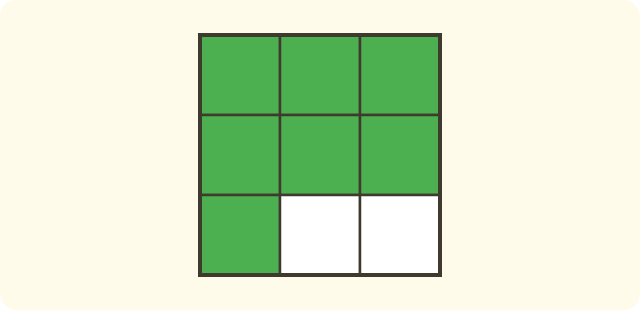
Remember the last lesson: a shape is cut into equal parts and parts are coloured. Write the fraction for the coloured part, then write that fraction as a division.
Exercise 4
Write each whole number as a fraction with denominator : a) ; b) . Write the number as a fraction with denominator .
Exercise 5
Why can we not write as a fraction?
Exercise 6
Ha wrote: "." Where did Ha go wrong? Write it correctly.
Exercise 7
Write the answer to each problem as a fraction:
a) Share litres of water equally into 3 bottles. How many litres in each bottle?
b) Share 3 litres of water equally into 2 bottles. How many litres in each bottle?
c) Share 6 litres of water equally into 6 bottles. How many litres in each bottle?
Exercise 8 Challenge
Find the number that goes in place of ?:
a) 4\div9=\dfrac{?}{9}.
b) 12\div?=\dfrac{12}{5}.
c) 7\div4=\dfrac{?}{4}.
Mini test
15 minutes, without looking back at the lesson. Part I: circle one letter; Part II: write T or F for each statement; Part III: write the answer in the box.
Part I. Multiple choice
Part II. True or false
| a) 3\div5=\dfrac{3}{5}. | T / F |
| b) 5\div3=\dfrac{3}{5}. | T / F |
| c) \dfrac{8}{8}=1. | T / F |
| d) We can write 5\div0 as the fraction \dfrac{5}{0}. | T / F |
Part III. Short answer
Score: ........ / 10
Hints (only when stuck)
What you need: a\div b=\dfrac{a}{b}.
Steps:
- The dividend is the numerator.
- The divisor is the denominator.
What you need: sharing equally means dividing; write the quotient as a fraction.
Steps:
- What do we know? What is asked?
- Write the division, then the fraction.
What you need: the numerator is the number of coloured parts, the denominator is the number of equal parts; \dfrac{a}{b}=a\div b.
Steps:
- Write the fraction.
- Write the division whose dividend is the numerator.
What you need: a=\dfrac{a}{1}; 1=\dfrac{b}{b}.
Steps:
- Put 1 under the whole number.
- For the number 1, make the numerator equal to the denominator.
What you need: the divisor is the denominator; dividing by 0 has no meaning.
Steps:
- What is the divisor of 5\div0?
- Can the denominator be that number?
What you need: a\div b=\dfrac{a}{b}: the dividend goes on top.
Steps:
- Which number is the dividend?
- Does the dividend go in the numerator or the denominator?
What you need: litres divided by the number of bottles.
Steps:
- Write the division for each part.
- Write the quotient as a fraction.
What you need: a\div b=\dfrac{a}{b}; match the dividend with the numerator and the divisor with the denominator.
Steps:
- The dividend is the numerator.
- The divisor is the denominator.
Self-check
| # | Did it alone | Needed a hint | Not yet |
|---|---|---|---|
| 1 | ☐ | ☐ | ☐ |
| 2 | ☐ | ☐ | ☐ |
| 3 | ☐ | ☐ | ☐ |
| 4 | ☐ | ☐ | ☐ |
| 5 | ☐ | ☐ | ☐ |
| 6 | ☐ | ☐ | ☐ |
| 7 | ☐ | ☐ | ☐ |
| 8 | ☐ | ☐ | ☐ |
Redo the ones you missed after: ☐ 1 day ☐ 3 days ☐ 7 days
Scan for step-by-step solutions