Fractions and division of whole numbers
🖨 Print a self-study sheet Why print?
A teacher shares cakes equally among children. What part of a cake does each child get? There are fewer cakes than children, so nobody gets a whole cake. How much do they get, then?
You know that , a division that works out exactly. But does not divide exactly, and we need a new kind of number to write the answer. That number is the fraction you have just learned. With it, even a division that does not work out exactly has an answer we can write down.
Let's explore
We share step by step, just as the teacher would.
- Cut each cake into equal pieces. Each piece is of a cake.
- Each child takes piece from the first cake, piece from the second cake and piece from the third cake.
- So each child has pieces, and each piece is of a cake. Cut equally and share equally, and every child gets the same amount.
Each child gets of a cake. Notice that . Division and fractions are two ways of writing the same thing.
Why is this true? Sharing cakes equally among children gives each child pieces, and each piece is \dfrac{1}{b} of a cake. Put them together and each child has \dfrac{a}{b} of a cake.
Examples
We start with a division where the number being divided is smaller than the divisor.
What if the number being divided is larger than the divisor? Then the numerator is larger than the denominator. That is still fine, so don't let it worry you.
Whole numbers can be written as fractions too. Let's see how.
We can also go the other way: look at a fraction and read it as a division.
Key terms
Summary
- a\div b=\dfrac{a}{b} with b\neq0: the dividend is the numerator and the divisor is the denominator.
- Example: 3\div4=\dfrac{3}{4}.
- A fraction can have a numerator larger than its denominator, for example 5\div4=\dfrac{5}{4}.
- A whole number a can be written as \dfrac{a}{1}; the number 1 can be written as \dfrac{b}{b}.
- We never divide by 0. Back to the cakes: when a division does not come out exactly, the answer is not lost. It sits right there in the fraction. Remember the dividend goes on top and the divisor underneath. Try the practice section to make it feel natural.
Practice
Each exercise comes with what you need to remember and a hint to get started. Try it yourself first, and open the solution only when you are stuck. A mistake is not a problem: that is when you learn the most.
Write the quotient of 3\div5 as a fraction.
What you need: a\div b=\dfrac{a}{b}.
Steps:
- The dividend is the numerator.
- The divisor is the denominator.
Show solution
The quotient of a whole number divided by a non-zero whole number can be written as a fraction, where the numerator is the dividend and the denominator is the divisor.
In the division 3\div5, the dividend is 3 and the divisor is 5, so 3\div5=\frac{3}{5}.
So the quotient of 3\div5 written as a fraction is \dfrac{3}{5}.
Answer. \dfrac{3}{5}.
Share 4 cakes equally among 6 children. What part of a cake does each child get?
What you need: sharing equally means dividing; write the quotient as a fraction.
Steps:
- What do we know? What is asked?
- Write the division, then the fraction.
Show solution
Solution
Sharing 4 cakes equally among 6 children, the part of a cake each child gets is: 4\div6=\frac{4}{6}\ \text{(of a cake)}
So each child gets \dfrac{4}{6} of a cake.
Answer. \dfrac{4}{6} of a cake.
Remember the last lesson: a shape is cut into 9 equal parts and 7 parts are coloured. Write the fraction for the coloured part, then write that fraction as a division.
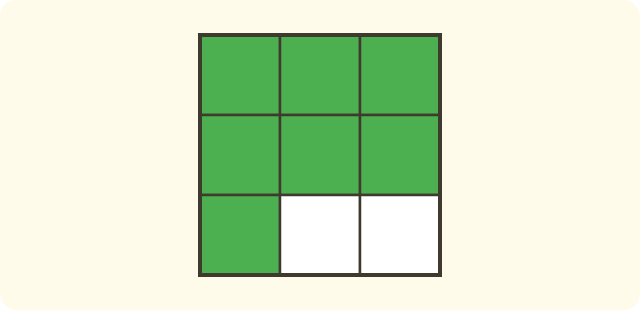
What you need: the numerator is the number of coloured parts, the denominator is the number of equal parts; \dfrac{a}{b}=a\div b.
Steps:
- Write the fraction.
- Write the division whose dividend is the numerator.
Show solution
The shape is cut into 9 equal parts, so the denominator is 9. Seven parts are coloured, so the numerator is 7. The fraction for the coloured part is \dfrac{7}{9}.
A fraction can be written as a division: the numerator is the dividend and the denominator is the divisor. Therefore \frac{7}{9}=7\div9.
So the fraction for the coloured part is \dfrac{7}{9} and \dfrac{7}{9}=7\div9.
Answer. \dfrac{7}{9}=7\div9.
Write each whole number as a fraction with denominator 1: a) 5; b) 12. Write the number 1 as a fraction with denominator 6.
What you need: a=\dfrac{a}{1}; 1=\dfrac{b}{b}.
Steps:
- Put 1 under the whole number.
- For the number 1, make the numerator equal to the denominator.
Show solution
Every whole number can be written as a fraction with denominator 1: the numerator is the number itself, because dividing a number by 1 gives the same number.
a) We have 5=5\div1, so 5=\frac{5}{1}.
b) We have 12=12\div1, so 12=\frac{12}{1}.
Writing the number 1 as a fraction with denominator 6, the numerator is also 6, because 6\div6=1. Therefore 1=\frac{6}{6}.
So 5=\dfrac{5}{1}; 12=\dfrac{12}{1}; 1=\dfrac{6}{6}.
Answer. \dfrac{5}{1}; \dfrac{12}{1}; \dfrac{6}{6}.
Why can we not write 5\div0 as a fraction?
What you need: the divisor is the denominator; dividing by 0 has no meaning.
Steps:
- What is the divisor of 5\div0?
- Can the denominator be that number?
Show solution
To write the quotient of 5\div0 as a fraction, the divisor 0 would have to become the denominator, giving the fraction \dfrac{5}{0}.
The denominator of a fraction tells us how many equal parts the whole is cut into. We cannot share 5 into 0 equal parts, so there is no fraction \dfrac{5}{0}.
So we cannot write 5\div0 as a fraction because the denominator cannot be 0.
Answer. Because the denominator cannot be 0.
Ha wrote: "2\div3=\dfrac{3}{2}." Where did Ha go wrong? Write it correctly.
What you need: a\div b=\dfrac{a}{b}: the dividend goes on top.
Steps:
- Which number is the dividend?
- Does the dividend go in the numerator or the denominator?
Show solution
When we write a division as a fraction, the dividend is the numerator and the divisor is the denominator.
In the division 2\div3, the dividend is 2, so 2 is the numerator, and the divisor is 3, so 3 is the denominator. Ha wrote the numerator and the denominator the wrong way round, so 2\div3=\dfrac{3}{2} is wrong.
Writing it correctly: 2\div3=\frac{2}{3}.
So Ha wrote the numerator and denominator the wrong way round; the correct form is 2\div3=\dfrac{2}{3}.
Answer. \dfrac{2}{3}.
Write the answer to each problem as a fraction:
a) Share 2 litres of water equally into 3 bottles. How many litres in each bottle?
b) Share 3 litres of water equally into 2 bottles. How many litres in each bottle?
c) Share 6 litres of water equally into 6 bottles. How many litres in each bottle?
What you need: litres divided by the number of bottles.
Steps:
- Write the division for each part.
- Write the quotient as a fraction.
Show solution
Solution
a) Sharing 2 litres of water equally into 3 bottles, the number of litres in each bottle is: 2\div3=\frac{2}{3}\ \text{(litres)}
b) Sharing 3 litres of water equally into 2 bottles, the number of litres in each bottle is: 3\div2=\frac{3}{2}\ \text{(litres)}
c) Sharing 6 litres of water equally into 6 bottles, the number of litres in each bottle is: 6\div6=\frac{6}{6}=1\ \text{(litre)}
So each bottle holds \dfrac{2}{3} litre in part a), \dfrac{3}{2} litres in part b) and 1 litre in part c).
Answer. a) \dfrac{2}{3} litre; b) \dfrac{3}{2} litres; c) 1 litre.
Find the number that goes in place of ?:
a) 4\div9=\dfrac{?}{9}.
b) 12\div?=\dfrac{12}{5}.
c) 7\div4=\dfrac{?}{4}.
What you need: a\div b=\dfrac{a}{b}; match the dividend with the numerator and the divisor with the denominator.
Steps:
- The dividend is the numerator.
- The divisor is the denominator.
Show solution
We recall that a\div b=\dfrac{a}{b}: the dividend is the numerator and the divisor is the denominator.
a) In 4\div9=\dfrac{?}{9}, the dividend is 4, so the numerator is 4. So ?=4.
b) In 12\div?=\dfrac{12}{5}, the denominator is 5, so the divisor is 5. So ?=5.
c) In 7\div4=\dfrac{?}{4}, the dividend is 7, so the numerator is 7. So ?=7.
Check. 4\div9=\dfrac{4}{9}; 12\div5=\dfrac{12}{5}; 7\div4=\dfrac{7}{4}. Correct.
So the numbers to write in are 4, 5 and 7 in that order.
Answer. a) 4; b) 5; c) 7.
Mini test
Marked like the Vietnamese graduation exam: Part I 0.25 points per question; Part II up to 1 point per question (1, 2, 3, 4 correct statements give 0.1, 0.25, 0.5, 1 point); Part III 0.5 points per question.
Part I. Multiple choice
The dividend 5 is the numerator and the divisor 8 is the denominator. Option A is the mistake of writing it the wrong way round.
3\div4=\dfrac{3}{4}. Option A is the wrong way round.
7\div1=7, so 7=\dfrac{7}{1}. Option C equals 1, not 7.
The numerator is the dividend and the denominator is the divisor, so \dfrac{9}{4}=9\div4.
Part II. True or false
| a) 3\div5=\dfrac{3}{5}. | ||
| b) 5\div3=\dfrac{3}{5}. | ||
| c) \dfrac{8}{8}=1. | ||
| d) We can write 5\div0 as the fraction \dfrac{5}{0}. |
a) True. b) False: 5\div3=\dfrac{5}{3}. c) True: 8\div8=1. d) False: we never divide by 0.
Part III. Short answer
The divisor is the denominator, so ?=5.
10\div10=1.
Show answers and explanations
- Part I, question 1: C. The dividend 5 is the numerator and the divisor 8 is the denominator. Option A is the mistake of writing it the wrong way round.
- Part I, question 2: D. 3\div4=\dfrac{3}{4}. Option A is the wrong way round.
- Part I, question 3: A. 7\div1=7, so 7=\dfrac{7}{1}. Option C equals 1, not 7.
- Part I, question 4: B. The numerator is the dividend and the denominator is the divisor, so \dfrac{9}{4}=9\div4.
- Part II, question 1: a) True; b) False; c) True; d) False. a) True. b) False: 5\div3=\dfrac{5}{3}. c) True: 8\div8=1. d) False: we never divide by 0.
- Part III, question 1: 5. The divisor is the denominator, so ?=5.
- Part III, question 2: 1. 10\div10=1.