The idea of a fraction
Goals
- Understand that a fraction shows one or more of the equal parts of a whole.
- Read and write fractions, and name the numerator and denominator.
- Show fractions with shapes and on a number line.
Remember
- The fraction : a whole cut into equal parts, with parts taken.
- The numerator is on top and the denominator underneath; the denominator is not .
- The parts must be equal.
- Example: is read "three quarters".
- A fraction can be shown with a shape or as a point on a number line.
Back to the pizza: Lan eats one quarter, Nam eats three quarters, and together they eat the whole pizza. Remember that the denominator counts the parts of the whole and the numerator counts the parts taken. Try the practice questions to get used to reading and writing fractions.
Exercises
Exercise 1
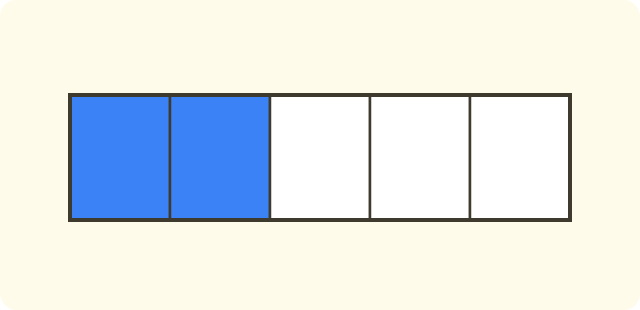
A rectangle is cut into equal parts and parts are coloured in. Write the fraction for the coloured part.
Exercise 2
Write these fractions: a) four sevenths; b) two fifths; c) eleven twelfths.
Exercise 3
Remember the last lesson (how many times an event happens): a coin is tossed times and heads comes up times. Write the fraction showing the heads out of all the tosses.
Exercise 4
Read the fractions and , then name the numerator and the denominator of each.
Exercise 5
A cake is cut into pieces of different sizes and Lan eats piece. Can we say Lan ate of the cake? Why?
Exercise 6
Nam wrote: "The cake is cut into parts and are eaten, so the fraction is ." Where did Nam go wrong? Write it correctly.
Exercise 7
A bar of chocolate has equal squares. Mai eats squares and Nam eats squares.
a) Write the fraction for the part Mai ate.
b) Write the fraction for the part Nam ate.
c) Write the fraction for the part left.
Exercise 8 Challenge
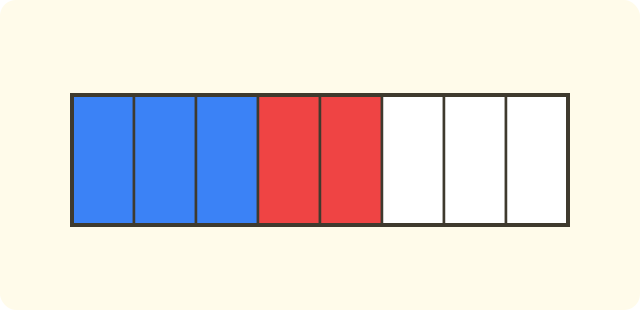
A paper strip is cut into equal parts. You colour parts blue and parts red, and leave the rest white. Write the fraction for each colour and the fraction for the part that is coloured (both colours together).
Mini test
15 minutes, without looking back at the lesson. Part I: circle one letter; Part II: write T or F for each statement; Part III: write the answer in the box.
Part I. Multiple choice
Part II. True or false
| a) The numerator is 5. | T / F |
| b) The denominator is 9. | T / F |
| c) It is read "nine fifths". | T / F |
| d) It can show 5 parts of a shape cut into 9 equal parts. | T / F |
Part III. Short answer
Score: ........ / 10
Hints (only when stuck)
What you need: the denominator is the number of equal parts and the numerator is the number of coloured parts.
Steps:
- What do we know? What is asked?
- Write the numerator and the denominator.
What you need: when you read "a over b", write \dfrac{a}{b}.
Steps:
- The first number you say is the numerator.
- The number in the name of the part is the denominator.
What you need: the number of tosses is the denominator and the number of heads is the numerator.
Steps:
- How many tosses were there?
- How many heads were there?
What you need: the numerator is on top and the denominator is underneath.
Steps:
- Say the numerator, then the name of the part.
- Point to each number.
What you need: a fraction works only when the parts are equal.
Steps:
- Are the parts equal?
- Compare with the meaning of a fraction.
What you need: the denominator is the number of equal parts in the whole.
Steps:
- How many parts does the whole cake have?
- How many parts were eaten?
What you need: the denominator is 12; the numerator is the number of squares.
Steps:
- Write a) and b).
- Find how many squares are left, then write the fraction.
What you need: the denominator is always 8; find the white parts by subtracting.
Steps:
- Write the fractions for blue and red.
- Find the white parts: 8-3-2.
- Find the coloured parts: 3+2.
Self-check
| # | Did it alone | Needed a hint | Not yet |
|---|---|---|---|
| 1 | ☐ | ☐ | ☐ |
| 2 | ☐ | ☐ | ☐ |
| 3 | ☐ | ☐ | ☐ |
| 4 | ☐ | ☐ | ☐ |
| 5 | ☐ | ☐ | ☐ |
| 6 | ☐ | ☐ | ☐ |
| 7 | ☐ | ☐ | ☐ |
| 8 | ☐ | ☐ | ☐ |
Redo the ones you missed after: ☐ 1 day ☐ 3 days ☐ 7 days
Scan for step-by-step solutions