The idea of a fraction
🖨 Print a self-study sheet Why print?
Think about sharing a pizza. This one is cut into equal slices. Lan eats slice and Nam eats slices. What part of the pizza does each child eat? Can we write that part as a number?
Whole numbers cannot write "one quarter" or "three quarters". They count whole pizzas well, but a part of a pizza has no number yet. This lesson gives you a new kind of number for writing parts of a whole, so we can say exactly how much each child ate.
Let's explore
We go step by step, with Lan and Nam's pizza.
- The pizza is cut into equal slices. The number tells us how many equal parts the pizza has.
- Lan eats slice. We write the part Lan eats as , read "one quarter".
- Nam eats slices. We write , read "three quarters".
- Together they eat all slices, which is the whole pizza. We write .
All four lines are about the same pizza. Only the number of slices we take changes.
We can also put fractions on a number line. The stretch from to is cut into equal parts, and each part is . This stretch is our whole, just as the pizza was.
There are two things to remember. The denominator tells us how many equal parts the whole is cut into. The numerator tells us how many parts we take. The number underneath counts the slices in the whole pizza, and the number on top counts the slices we take.
Examples
We start by writing a fraction for a shape. Count all the parts, then the parts taken.
Now you read a fraction and name its numerator and denominator. Don't worry if the words feel strange at first. Say them aloud a few times and they will stick.
We can also write a fraction for the part that is left. What is left is a part of the whole too.
Finally, we mark a fraction on a number line, counting the parts one by one from the start.
Key terms
Summary
- The fraction \dfrac{a}{b}: a whole cut into b equal parts, with a parts taken.
- The numerator a is on top and the denominator b underneath; the denominator is not 0.
- The parts must be equal.
- Example: \dfrac{3}{4} is read "three quarters".
- A fraction can be shown with a shape or as a point on a number line.
Back to the pizza: Lan eats one quarter, Nam eats three quarters, and together they eat the whole pizza. Remember that the denominator counts the parts of the whole and the numerator counts the parts taken. Try the practice questions to get used to reading and writing fractions.
Practice
Each exercise comes with what you need and how to start. Try it yourself first, then open the solution. Getting one wrong is fine, because a mistake usually shows you exactly what to remember.
A rectangle is cut into 5 equal parts and 2 parts are coloured in. Write the fraction for the coloured part.
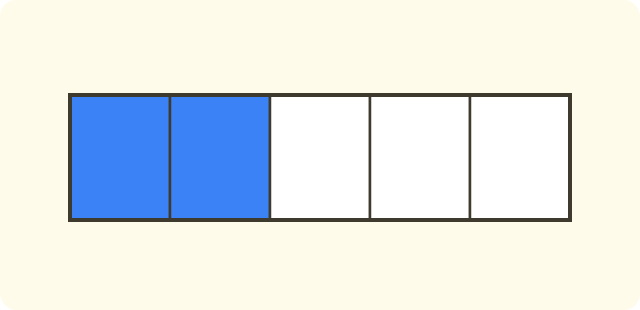
What you need: the denominator is the number of equal parts and the numerator is the number of coloured parts.
Steps:
- What do we know? What is asked?
- Write the numerator and the denominator.
Show solution
The rectangle is cut into 5 equal parts, so the denominator is 5 (the whole shape has 5 parts).
2 parts are coloured in, so the numerator is 2.
So the fraction for the coloured part is \dfrac{2}{5}.
Answer. \dfrac{2}{5}.
Write these fractions: a) four sevenths; b) two fifths; c) eleven twelfths.
What you need: when you read "a over b", write \dfrac{a}{b}.
Steps:
- The first number you say is the numerator.
- The number in the name of the part is the denominator.
Show solution
In a fraction, the numerator is on top and the denominator is at the bottom; we say the numerator first, then the denominator.
a) "Four sevenths": the numerator is 4 and the denominator is 7, so we write \dfrac{4}{7}.
b) "Two fifths": the numerator is 2 and the denominator is 5, so we write \dfrac{2}{5}.
c) "Eleven twelfths": the numerator is 11 and the denominator is 12, so we write \dfrac{11}{12}.
So the fractions are \dfrac{4}{7}, \dfrac{2}{5} and \dfrac{11}{12}.
Answer. \dfrac{4}{7}, \dfrac{2}{5}, \dfrac{11}{12}.
Remember the last lesson (how many times an event happens): a coin is tossed 10 times and heads comes up 6 times. Write the fraction showing the heads out of all the tosses.
What you need: the number of tosses is the denominator and the number of heads is the numerator.
Steps:
- How many tosses were there?
- How many heads were there?
Show solution
The coin is tossed 10 times in all, so the denominator is 10.
Heads comes up 6 times, so the numerator is 6.
So the fraction showing the heads out of all the tosses is \dfrac{6}{10}.
Answer. \dfrac{6}{10}.
Read the fractions \dfrac{7}{10} and \dfrac{3}{8}, then name the numerator and the denominator of each.
What you need: the numerator is on top and the denominator is underneath.
Steps:
- Say the numerator, then the name of the part.
- Point to each number.
Show solution
In a fraction, the number above the line is the numerator and the number below the line is the denominator.
The fraction \dfrac{7}{10} is read "seven tenths": the numerator is 7 and the denominator is 10.
The fraction \dfrac{3}{8} is read "three eighths": the numerator is 3 and the denominator is 8.
So \dfrac{7}{10} has numerator 7 and denominator 10; \dfrac{3}{8} has numerator 3 and denominator 8.
Answer. See the solution.
A cake is cut into 4 pieces of different sizes and Lan eats 1 piece. Can we say Lan ate \dfrac{1}{4} of the cake? Why?
What you need: a fraction works only when the parts are equal.
Steps:
- Are the parts equal?
- Compare with the meaning of a fraction.
Show solution
To say that a piece of the cake is \dfrac{1}{4}, the cake must be cut into 4 equal parts.
Here the cake is cut into 4 pieces of different sizes, so the parts are not equal. The piece Lan ate may be bigger or smaller than a quarter of the cake, so it is not necessarily \dfrac{1}{4}.
So we cannot say that Lan ate \dfrac{1}{4} of the cake, because the parts are not equal.
Answer. No, because the parts are not equal.
Nam wrote: "The cake is cut into 4 parts and 3 are eaten, so the fraction is \dfrac{4}{3}." Where did Nam go wrong? Write it correctly.
What you need: the denominator is the number of equal parts in the whole.
Steps:
- How many parts does the whole cake have?
- How many parts were eaten?
Show solution
Nam wrote the numerator and the denominator the wrong way round. The denominator tells us how many equal parts the whole cake is cut into, and the numerator tells us how many parts were eaten. Also, \dfrac{4}{3} has a numerator greater than its denominator, so it is greater than 1, while the part eaten is less than the whole cake.
Written correctly: the whole cake has 4 parts, so the denominator is 4; 3 parts were eaten, so the numerator is 3. The correct fraction is \dfrac{3}{4}.
So Nam went wrong by writing the numerator and denominator the wrong way round; the correct fraction for the part eaten is \dfrac{3}{4}.
Answer. \dfrac{3}{4}.
A bar of chocolate has 12 equal squares. Mai eats 5 squares and Nam eats 4 squares.
a) Write the fraction for the part Mai ate.
b) Write the fraction for the part Nam ate.
c) Write the fraction for the part left.
What you need: the denominator is 12; the numerator is the number of squares.
Steps:
- Write a) and b).
- Find how many squares are left, then write the fraction.
Show solution
The bar of chocolate has 12 equal squares, so the denominator of every fraction below is 12.
a) Mai eats 5 squares, so the part Mai ate is \dfrac{5}{12} of the bar.
b) Nam eats 4 squares, so the part Nam ate is \dfrac{4}{12} of the bar.
c) The number of squares left is: 12-5-4=3\ \text{(squares)}. So the part left is \dfrac{3}{12} of the bar.
Check: 5+4+3=12 squares, which is the number of squares in the whole bar.
So the part Mai ate is \dfrac{5}{12}, the part Nam ate is \dfrac{4}{12} and the part left is \dfrac{3}{12}.
Answer. a) \dfrac{5}{12}; b) \dfrac{4}{12}; c) \dfrac{3}{12}.
A paper strip is cut into 8 equal parts. You colour 3 parts blue and 2 parts red, and leave the rest white. Write the fraction for each colour and the fraction for the part that is coloured (both colours together).
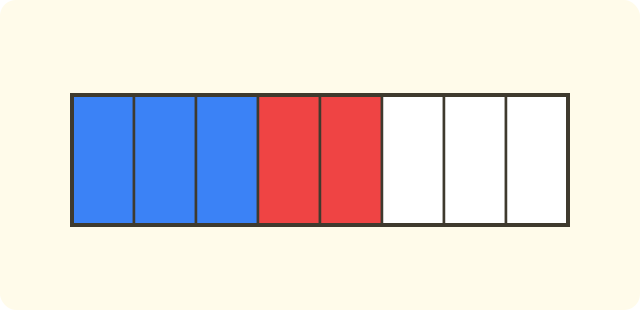
What you need: the denominator is always 8; find the white parts by subtracting.
Steps:
- Write the fractions for blue and red.
- Find the white parts: 8-3-2.
- Find the coloured parts: 3+2.
Show solution
The strip is cut into 8 equal parts, so the denominator of every fraction below is 8.
The blue part has 3 parts, so it is \dfrac{3}{8} of the strip.
The red part has 2 parts, so it is \dfrac{2}{8} of the strip.
The number of white parts is: 8-3-2=3\ \text{(parts)}, so the white part is \dfrac{3}{8} of the strip.
The number of coloured parts (both colours together) is: 3+2=5\ \text{(parts)}, so the coloured part is \dfrac{5}{8} of the strip.
Check: 3+2+3=8 parts, which is the number of parts in the whole strip.
So blue is \dfrac{3}{8}, red is \dfrac{2}{8}, white is \dfrac{3}{8} and the coloured part is \dfrac{5}{8}.
Answer. Blue \dfrac{3}{8}, red \dfrac{2}{8}, white \dfrac{3}{8}; coloured \dfrac{5}{8}.
Mini test
Marked like the Vietnamese graduation exam: Part I 0.25 points per question; Part II up to 1 point per question (1, 2, 3, 4 correct statements give 0.1, 0.25, 0.5, 1 point); Part III 0.5 points per question.
Part I. Multiple choice
The denominator is the number underneath, 5. Option B is the numerator, and C is the sum of the two numbers.
The whole cake has 6 pieces and 1 is eaten, so \dfrac{1}{6}. Option A is the wrong way round, and D is the part not eaten.
Numerator 7, denominator 10. Option A swaps the numerator and denominator.
The part not coloured is 8-5=3 parts, so \dfrac{3}{8}. Option A is the coloured part.
Part II. True or false
| a) The numerator is 5. | ||
| b) The denominator is 9. | ||
| c) It is read "nine fifths". | ||
| d) It can show 5 parts of a shape cut into 9 equal parts. |
a) True. b) True. c) False: it is read "five ninths". d) True.
Part III. Short answer
12-5=7 pieces.
The denominator is the number underneath, 8.
Show answers and explanations
- Part I, question 1: A. The denominator is the number underneath, 5. Option B is the numerator, and C is the sum of the two numbers.
- Part I, question 2: B. The whole cake has 6 pieces and 1 is eaten, so \dfrac{1}{6}. Option A is the wrong way round, and D is the part not eaten.
- Part I, question 3: C. Numerator 7, denominator 10. Option A swaps the numerator and denominator.
- Part I, question 4: D. The part not coloured is 8-5=3 parts, so \dfrac{3}{8}. Option A is the coloured part.
- Part II, question 1: a) True; b) True; c) False; d) True. a) True. b) True. c) False: it is read "five ninths". d) True.
- Part III, question 1: 7. 12-5=7 pieces.
- Part III, question 2: 8. The denominator is the number underneath, 8.