Lateral and total surface area of a cuboid
Goals
- Recognise the lateral and total surface areas of a cuboid.
- Find both areas from the length, width and height.
- Choose the correct faces to include in a real-life problem.
Remember
- The lateral surface area is the total area of the four side faces.
- Lateral surface area perimeter of the base height.
- Total surface area lateral surface area area of the two bases.
- Use one unit, give a square unit and include only the faces named. The opening question asked how much paper Minh needs for each job: covering the four side faces needs the lateral surface area, and wrapping the whole box needs the total surface area. Remember to check which faces the problem asks for, and practise a few more until it feels easy.
Exercises
Exercise 1
A cuboid is cm long, cm wide and cm high. Find its lateral area.
Exercise 2
A cuboid is dm long, dm wide and dm high. Find its total area.
Exercise 3
A cuboid is cm long and cm wide. Its lateral area is . Find its height.
Exercise 4
Box A measures cm by cm by cm; B measures cm by cm by cm. Which has the greater lateral area, and by how much?
Exercise 5
Think back: a net has two cm by cm faces, two cm by cm faces and two cm by cm faces. Find the total area.
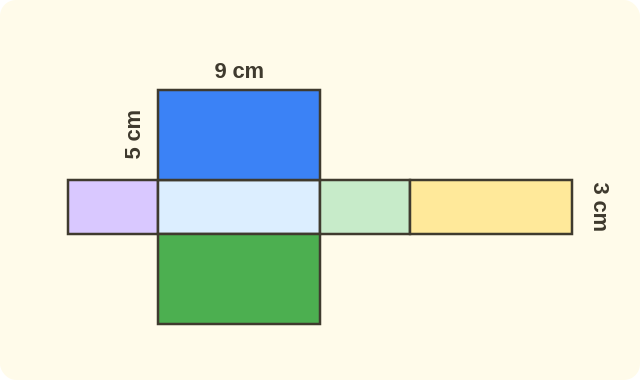
Exercise 6
A tea box is 14 cm long, 8 cm wide and 20 cm high. A label covers its sides with no overlap. Find its area.
Exercise 7
A box is 50 cm long, 30 cm wide and 20 cm high. Its sides and top are painted. Find the painted area.
Exercise 8 Challenge
A cuboid is 10 cm long and 4 cm wide. Its total area is 248\ \text{cm}^2. Find its height.
Mini test
15 minutes, without looking back at the lesson. Part I: circle one letter; Part II: write T or F for each statement; Part III: write the answer in the box.
Part I. Multiple choice
Part II. True or false
| a) The perimeter of its base is 32 cm. | T / F |
| b) The area of one base is 60\ \text{cm}^2. | T / F |
| c) Its lateral surface area is 128\ \text{cm}^2. | T / F |
| d) Its total surface area is 188\ \text{cm}^2. | T / F |
Part III. Short answer
Score: ........ / 10
Hints (only when stuck)
What you need: Base perimeter \times height.
Steps:
- Work out (11+4)\times2.
- Multiply by 6; use a square unit.
What you need: Lateral area + two base areas.
Steps:
- Find the four side faces.
- Add both bases; check all six faces.
What you need: Height = lateral area \div base perimeter.
Steps:
- Find the base perimeter.
- Divide 216 by it.
What you need: Find both lateral areas and compare.
Steps:
- Find each area.
- Subtract the smaller from the larger.
What you need: A net contains all six faces.
Steps:
- Find each pair's area.
- Add the three results.
What you need: The label has the lateral area.
Steps:
- Find the base perimeter.
- Multiply by the height; omit the bases.
What you need: Four side faces + one base.
Steps:
- Find the four side faces.
- Add 50\times30 for the top.
What you need: Total area minus the two bases.
Steps:
- Find the lateral area.
- Divide by the base perimeter.
Self-check
| # | Did it alone | Needed a hint | Not yet |
|---|---|---|---|
| 1 | ☐ | ☐ | ☐ |
| 2 | ☐ | ☐ | ☐ |
| 3 | ☐ | ☐ | ☐ |
| 4 | ☐ | ☐ | ☐ |
| 5 | ☐ | ☐ | ☐ |
| 6 | ☐ | ☐ | ☐ |
| 7 | ☐ | ☐ | ☐ |
| 8 | ☐ | ☐ | ☐ |
Redo the ones you missed after: ☐ 1 day ☐ 3 days ☐ 7 days
Scan for step-by-step solutions