Lateral and total surface area of a cuboid
🖨 Print a self-study sheet Why print?
A cuboid gift box is cm long, cm wide and cm high. Minh wants to put paper around its four side faces, then wrap the whole closed box. How many square centimetres of paper does each job need?
Let's explore
The four side faces are two rectangles measuring cm by cm and two measuring cm by cm. Add their areas:
There is also a quicker way to see it. The base perimeter is cm. Open the four side faces into one strip cm wide; the strip is as long as the base perimeter, so its area is also .
The two bases have total area . Add them to the four side faces, and the area of all six faces is . That answers the job of wrapping the whole box.
Why does the rule work? The side strip is as long as the base perimeter and as wide as the height. Total surface area also includes the two equal bases.
Examples
We start with the four side faces: you only need the base perimeter and the height.
Now we include all six faces, which means adding the two bases.
You can also work backwards to find a missing dimension.
Real objects do not always need all six faces. In the last example we include only the painted faces.
Key terms
Summary
- The lateral surface area is the total area of the four side faces.
- Lateral surface area = perimeter of the base \times height.
- Total surface area = lateral surface area + area of the two bases.
- Use one unit, give a square unit and include only the faces named. The opening question asked how much paper Minh needs for each job: covering the four side faces needs the lateral surface area, and wrapping the whole box needs the total surface area. Remember to check which faces the problem asks for, and practise a few more until it feels easy.
Practice
Each exercise gives you what you need and a way to start. Try it yourself first, and only then open the solution. A wrong first try is part of learning.
A cuboid is 11 cm long, 4 cm wide and 6 cm high. Find its lateral area.
What you need: Base perimeter \times height.
Steps:
- Work out (11+4)\times2.
- Multiply by 6; use a square unit.
Show solution
Solution
The lateral area of a cuboid equals the perimeter of the base multiplied by the height.
The base is 11 cm long and 4 cm wide; the height is 6 cm. The lateral area of the cuboid is: (11+4)\times2\times6=15\times2\times6=180\ \text{cm}^2.
So the lateral area of the cuboid is 180\ \text{cm}^2.
Answer. 180\ \text{cm}^2.
A cuboid is 7 dm long, 5 dm wide and 3 dm high. Find its total area.
What you need: Lateral area + two base areas.
Steps:
- Find the four side faces.
- Add both bases; check all six faces.
Show solution
Solution
The total surface area equals the lateral area plus the area of the two bases.
The lateral area is: (7+5)\times2\times3=12\times2\times3=72\ \text{dm}^2.
The area of one base is 7\times5=35\ \text{dm}^2, so the area of the two bases is: 2\times35=70\ \text{dm}^2.
The total surface area of the cuboid is: 72+70=142\ \text{dm}^2.
So the total surface area of the cuboid is 142\ \text{dm}^2.
Answer. 142\ \text{dm}^2.
A cuboid is 8 cm long and 4 cm wide. Its lateral area is 216\ \text{cm}^2. Find its height.
What you need: Height = lateral area \div base perimeter.
Steps:
- Find the base perimeter.
- Divide 216 by it.
Show solution
Solution
The lateral area equals the base perimeter multiplied by the height, so the height equals the lateral area divided by the base perimeter.
The base perimeter is: (8+4)\times2=24\ \text{(cm)}.
The height of the cuboid is: 216\div24=9\ \text{(cm)}.
Check: 24\times9=216, which matches the problem.
So the height of the cuboid is 9 cm.
Answer. 9 cm.
Box A measures 10 cm by 6 cm by 4 cm; B measures 8 cm by 7 cm by 4 cm. Which has the greater lateral area, and by how much?
What you need: Find both lateral areas and compare.
Steps:
- Find each area.
- Subtract the smaller from the larger.
Show solution
Solution
The lateral area of box A is: (10+6)\times2\times4=16\times2\times4=128\ \text{cm}^2.
The lateral area of box B is: (8+7)\times2\times4=15\times2\times4=120\ \text{cm}^2.
Since 128>120, box A has the greater lateral area. The difference is: 128-120=8\ \text{cm}^2.
So box A has the greater lateral area, by 8\ \text{cm}^2.
Answer. Box A, by 8\ \text{cm}^2.
Think back: a net has two 9 cm by 5 cm faces, two 9 cm by 3 cm faces and two 5 cm by 3 cm faces. Find the total area.
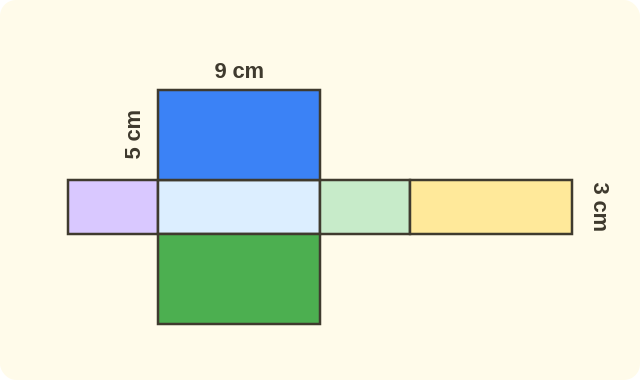
What you need: A net contains all six faces.
Steps:
- Find each pair's area.
- Add the three results.
Show solution
Solution
A cuboid has 6 faces, which form three pairs of equal faces, so the total surface area is the sum of the areas of these three pairs.
The two 9 cm by 5 cm faces have area 2\times9\times5=90\ \text{cm}^2.
The two 9 cm by 3 cm faces have area 2\times9\times3=54\ \text{cm}^2.
The two 5 cm by 3 cm faces have area 2\times5\times3=30\ \text{cm}^2.
The total surface area is: 90+54+30=174\ \text{cm}^2.
So the total surface area of the cuboid is 174\ \text{cm}^2.
Answer. 174\ \text{cm}^2.
A tea box is 14 cm long, 8 cm wide and 20 cm high. A label covers its sides with no overlap. Find its area.
What you need: The label has the lateral area.
Steps:
- Find the base perimeter.
- Multiply by the height; omit the bases.
Show solution
Solution
The label covers the four side faces with no overlap, so its area equals the lateral area of the box.
The area of the label is: (14+8)\times2\times20=22\times2\times20=880\ \text{cm}^2.
So the area of the label is 880\ \text{cm}^2.
Answer. 880\ \text{cm}^2.
A box is 50 cm long, 30 cm wide and 20 cm high. Its sides and top are painted. Find the painted area.
What you need: Four side faces + one base.
Steps:
- Find the four side faces.
- Add 50\times30 for the top.
Show solution
Solution
The painted area consists of the four side faces (the lateral area) and the top face (equal to the area of one base).
The area of the four side faces is: (50+30)\times2\times20=80\times2\times20=3\,200\ \text{cm}^2.
The area of the top face is 50\times30=1\,500\ \text{cm}^2.
The painted area is: 3\,200+1\,500=4\,700\ \text{cm}^2.
So the painted area is 4\,700\ \text{cm}^2.
Answer. 4\,700\ \text{cm}^2.
A cuboid is 10 cm long and 4 cm wide. Its total area is 248\ \text{cm}^2. Find its height.
What you need: Total area minus the two bases.
Steps:
- Find the lateral area.
- Divide by the base perimeter.
Show solution
Solution
The total area equals the lateral area plus the area of the two bases, so the lateral area equals the total area minus the area of the two bases.
The area of the two bases is: 2\times10\times4=80\ \text{cm}^2.
The lateral area is: 248-80=168\ \text{cm}^2.
The base perimeter is: (10+4)\times2=28\ \text{(cm)}.
The height of the cuboid is: 168\div28=6\ \text{(cm)}.
Check: 28\times6+80=168+80=248, which matches the problem.
So the height of the cuboid is 6 cm.
Answer. 6 cm.
Mini test
Marked like the Vietnamese graduation exam: Part I 0.25 points per question; Part II up to 1 point per question (1, 2, 3, 4 correct statements give 0.1, 0.25, 0.5, 1 point); Part III 0.5 points per question.
Part I. Multiple choice
We have (6+4)\times2\times5=100\ \text{cm}^2.
We have 44+48=92\ \text{cm}^2.
We have 30\times7=210\ \text{cm}^2.
We have (9+5)\times2\times12=336\ \text{cm}^2.
Part II. True or false
| a) The perimeter of its base is 32 cm. | ||
| b) The area of one base is 60\ \text{cm}^2. | ||
| c) Its lateral surface area is 128\ \text{cm}^2. | ||
| d) Its total surface area is 188\ \text{cm}^2. |
a) True since (10+6)\times2=32. b) True since 10\times6=60. c) True since 32\times4=128. d) False: the correct total is 248\ \text{cm}^2.
Part III. Short answer
The base perimeter is (7+3)\times2=20 cm, so the height is 120\div20=6 cm.
The lateral area is (5+4)\times2\times3=54\ \text{cm}^2 and the two bases have area 40\ \text{cm}^2, giving 94\ \text{cm}^2.
Show answers and explanations
- Part I, question 1: A. We have (6+4)\times2\times5=100\ \text{cm}^2.
- Part I, question 2: B. We have 44+48=92\ \text{cm}^2.
- Part I, question 3: C. We have 30\times7=210\ \text{cm}^2.
- Part I, question 4: D. We have (9+5)\times2\times12=336\ \text{cm}^2.
- Part II, question 1: a) True; b) True; c) True; d) False. a) True since (10+6)\times2=32. b) True since 10\times6=60. c) True since 32\times4=128. d) False: the correct total is 248\ \text{cm}^2.
- Part III, question 1: 6. The base perimeter is (7+3)\times2=20 cm, so the height is 120\div20=6 cm.
- Part III, question 2: 94. The lateral area is (5+4)\times2\times3=54\ \text{cm}^2 and the two bases have area 40\ \text{cm}^2, giving 94\ \text{cm}^2.