More, fewer, the same
🖨 Print a self-study sheet Why print?
On the table there are cups and spoons. Mum wants each cup to have one spoon. Are there more cups or more spoons?
You could count each group. But there is another way that needs no counting at all: match the things in pairs and see which side has some left.
Let's explore
Let us put one spoon in each cup. One spoon for each cup, and never two spoons in the same cup.
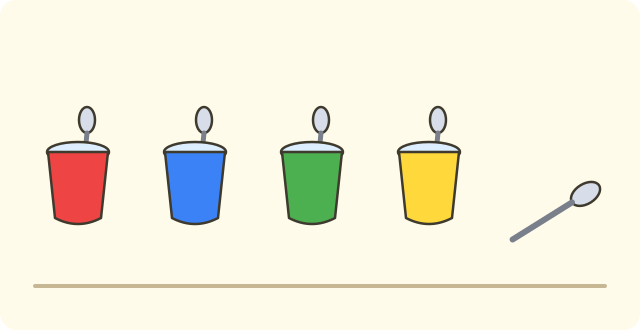
- The first cup has one spoon. The second cup has one spoon.
- The third cup and the fourth cup also have one spoon each.
- All four cups have a spoon, but one spoon is left over.
One spoon is left over. The group with something left over is the group with more, so there are more spoons than cups. The cups ran out first, so there are fewer cups than spoons.
Why does matching tell us which group has more? Each pair uses up one thing from each group. So the group that still has things left is the one with more.
Examples
We go back to the question at the start, about the cups and spoons on the table.
Sometimes the matching ends with nothing left on either side. Here is an example.
Once you know which group has more, you can also say how many more it has. That is just the number left over.
Matching also answers everyday questions, like whether every bird has a nest.
Key terms
Summary
- Match one to one: each thing in one group goes with one thing in the other group.
- The group with things left over has more; the group that runs out first has fewer.
- If both groups run out together, they are the same.
- A bigger thing does not always mean more things.
Back to the opening question: a spoon is left over, so there are more spoons than cups. Remember to use each thing only once, look at which side has some left, and then try some exercises.
Practice
Each exercise has the key idea and a hint to get you started. Try it yourself first, look at the hint if you are stuck, and open the solution last. Going slowly is fine.
There are cups and spoons. Which group has more?
What you need: match in pairs; the group with things left over has more.
Steps:
- Match each cup with one spoon.
- See which group has things left over.
Show solution
We match each cup with one spoon. There are cups, so spoons are matched.
The number of spoons left over is:
The cups are used up but spoon is still left over, so there are more spoons than cups.
So there are more spoons than cups.
Answer. There are more spoons than cups.
There are children and 5 hats. Each child wears one hat. What can you say about the two groups?
What you need: if both groups run out together, they are the same.
Steps:
- Match each child with one hat.
- Is anything left over?
Show solution
Each child wears one hat, so we match each child with one hat.
There are 5 children and 5 hats, so after matching, no child is without a hat and no hat is left over.
So the number of children is the same as the number of hats.
Answer. The number of children is the same as the number of hats.
Remember the last lesson. a) Fill in the box: 6, 7, \square, 9, 10. b) There are 7 fish and 9 prawns. Which group has fewer?
What you need: a row goes in counting order; match in pairs to find the group that runs out first.
Steps:
- Say: six, seven, ...
- Match each fish with one prawn.
Show solution
a) We count: 6, 7, 8, 9, 10. After 7 comes 8, so the number for the box is 8.
b) We match each fish with one prawn. There are 7 fish, so 7 prawns are matched.
The number of prawns left over is: 9-7=2\ \text{(prawns)}
The fish are used up but 2 prawns are still left over, so the fish ran out first. That means there are fewer fish than prawns.
So a) the number for the box is 8; b) there are fewer fish than prawns.
Answer. a) 8. b) There are fewer fish than prawns.
There are 6 birds and 4 nests. Each bird goes into one nest. Is any bird without a nest? How many?
What you need: match each nest with one bird; the left over ones have no nest.
Steps:
- Match 4 nests with 4 birds.
- Count the birds left.
Show solution
Solution
We match each bird with one nest. There are 4 nests, so 4 birds are matched.
The number of birds without a nest is: 6-4=2\ \text{(birds)}
The nests are used up but some birds are still left over, so there are birds without a nest.
So 2 birds have no nest.
Answer. 2 birds have no nest.
A big box has 3 marbles and a small box has 5 marbles. Binh says: "The big box has more marbles." Is Binh right? Why?
What you need: "more" is about how many, not how big the box is.
Steps:
- Match the marbles of the two boxes.
- See which group has some left over.
Show solution
We match each marble of the big box with one marble of the small box. The big box has 3 marbles, so 3 marbles of the small box are matched.
The number of marbles left over in the small box is: 5-3=2\ \text{(marbles)}
The marbles of the big box are used up but 2 marbles of the small box are still left over, so the small box has more marbles. Also 5>3.
So Binh is wrong, because the small box has more marbles than the big box.
Answer. No. The small box has more marbles.
Lan matches 4 bowls with 4 spoons and says: "There are more bowls than spoons." Where did Lan go wrong? What should she say?
What you need: if both groups run out, they are the same.
Steps:
- After matching, is anything left over?
- Choose: more, fewer or the same.
Show solution
We match each bowl with one spoon. There are 4 bowls and 4 spoons, so after matching, no bowl is left over and no spoon is left over.
Since nothing is left over, the two groups are the same. Lan's sentence "There are more bowls than spoons" is wrong.
So Lan went wrong by saying there are more bowls than spoons; the right thing to say is that the number of bowls is the same as the number of spoons.
Answer. The number of bowls is the same as the number of spoons.
The table shows how many sweets three children have:
| Child | Mai | Nam | Ha |
|---|---|---|---|
| Sweets | 5 | 7 | 5 |
a) Who has more sweets than Mai?
b) Which two children have the same number of sweets?
What you need: match or count the sweets of each child.
Steps:
- Compare Mai with each child.
- Find two numbers that are the same.
Show solution
By the table, Mai has 5 sweets, Nam has 7 sweets and Ha has 5 sweets.
a) We compare each child's sweets with Mai's. Nam has 7 sweets and 7>5, so Nam has more sweets than Mai. Nam has 7-5=2 more sweets than Mai. Ha has 5 sweets, the same as Mai, so Ha does not have more than Mai. The child who has more sweets than Mai is Nam.
b) Mai and Ha both have 5 sweets, while Nam has 7 sweets. The two children with the same number of sweets are Mai and Ha.
So a) Nam has more sweets than Mai; b) Mai and Ha have the same number of sweets.
Answer. a) Nam. b) Mai and Ha.
Group A has 6 circles and group B has 9 circles. How many circles must you draw in group A to make the two groups the same?
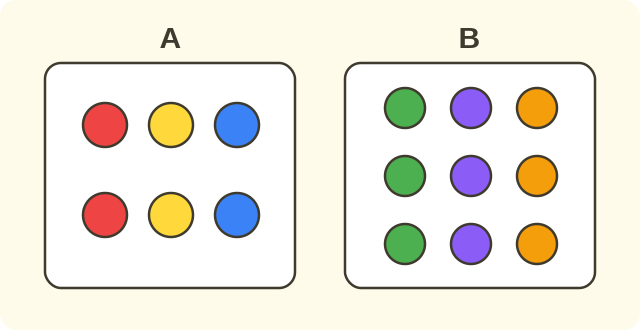
What you need: match group A with group B; the circles left over in B show how many to draw.
Steps:
- Match 6 circles of A with 6 circles of B.
- Count the circles left over in B.
Show solution
Solution
We match each circle of group A with one circle of group B. Group A has 6 circles, so 6 circles of group B are matched.
The number of circles left over in group B is: 9-6=3\ \text{(circles)}
To make the two groups the same, we draw in group A as many circles as are left over in group B, that is 3 circles.
Check: group A has 6 circles, and after drawing 3 more it has 6+3=9 circles, the same as group B. Correct.
So we must draw 3 more circles in group A.
Answer. 3 circles.
Mini test
Marked like the Vietnamese graduation exam: Part I 0.25 points per question; Part II up to 1 point per question (1, 2, 3, 4 correct statements give 0.1, 0.25, 0.5, 1 point); Part III 0.5 points per question.
Part I. Multiple choice
Matching 5 cups with 5 spoons leaves 1 spoon, so there are more spoons. Option A picks the group that ran out first.
Nothing is left over after matching, so the two groups are the same.
The vases ran out first, so there are fewer vases. Option B picks the group left over.
7 marbles are more than 4 marbles. Option A confuses big with many.
Part II. True or false
| a) There are more ducks than hens. | ||
| b) There are more hens than ducks. | ||
| c) 2 ducks are left over. | ||
| d) The hens and ducks are the same. |
a) True. b) False: the hens ran out first. c) True: after matching 3 hens, 2 ducks are left. d) False.
Part III. Short answer
Matching 5 plates with 5 oranges leaves 3 oranges.
Matching 6 nests with 6 birds leaves 1 bird.
Show answers and explanations
- Part I, question 1: C. Matching 5 cups with 5 spoons leaves 1 spoon, so there are more spoons. Option A picks the group that ran out first.
- Part I, question 2: D. Nothing is left over after matching, so the two groups are the same.
- Part I, question 3: A. The vases ran out first, so there are fewer vases. Option B picks the group left over.
- Part I, question 4: B. 7 marbles are more than 4 marbles. Option A confuses big with many.
- Part II, question 1: a) True; b) False; c) True; d) False. a) True. b) False: the hens ran out first. c) True: after matching 3 hens, 2 ducks are left. d) False.
- Part III, question 1: 3. Matching 5 plates with 5 oranges leaves 3 oranges.
- Part III, question 2: 1. Matching 6 nests with 6 birds leaves 1 bird.