Numbers 6, 7, 8, 9, 10
🖨 Print a self-study sheet Why print?
There are some marbles in a box. Mai counts each one and says: "There are marbles." How does Mai know she counted right? And how do you write the number ?
You already know the numbers from to . But Mai's box holds more marbles than that, so we need more numbers. Now you meet five new numbers: .
Let's explore
We count as before: touch each thing and count it only once.
- There are six pencils. You count: "one, two, three, four, five, six". We write the number .
- There are seven leaves. We write the number .
- There are eight marbles. We write the number .
- There are nine eggs. We write the number .
- Two hands have ten fingers. We write the number .
The number looks a little different, because you write it with two digits. The digit comes first, then the digit .
Count to , then count on one more, and you get . We say is the number after . It is simply the next number you meet when you count.
Why does counting on one more give the number after? Each number is exactly one more thing than the number just before it. You stop at the number where you finish counting, and that number tells you how many things there are.
Examples
We begin by counting the pencils in a box, one at a time.
You always have fingers to count. Try it.
Now you know what the number after is. Try finding it for another number.
Once you know the number after, you can find a number hidden in a row. Have a go.
Key terms
Summary
- The new numbers are 6, 7, 8, 9, 10.
- Counting order: 0, 1, 2, 3, 4, 5, 6, 7, 8, 9, 10.
- Count on one more to get the number after.
- The number 10 is written with the digit 1, then the digit 0. Mai knows she counted right because she touched each marble once and stopped at the last one. Keep practising, and the new numbers will soon feel familiar.
Practice
Each exercise comes with what you need to remember and a hint to start you off. Try it yourself first, then open the solution. If the answer does not come at once, do not worry. Count it one step at a time.
There are seven apples on a plate. Write the number of apples.
What you need: count each one; the last number is the answer.
Steps:
- What do we know? Seven apples.
- Write seven as a digit.
Show solution
There are seven apples on the plate. We count: one, two, three, four, five, six, seven. The number "seven" is written with the digit 7.
So there are 7 apples on the plate.
Answer. 7 apples.
Fill in the box: 6, 7, 8, \square, 10.
What you need: the numbers go in counting order.
Steps:
- Say: six, seven, eight, ...
- Which number is between 8 and 10?
Show solution
We read the numbers in order from smallest to largest: 6, 7, 8, then the box, then 10.
After 8 comes 9, and after 9 comes 10. So the number for the box is 9.
Check: we read the whole row 6, 7, 8, 9, 10. Correct.
So the number to fill in is 9.
Answer. 9.
Remember the last lesson: what is the number after 5? Then fill in the box: 0, 1, \square, 3, 4, 5.
What you need: the number after is one more.
Steps:
- Count: ... four, five, ...
- Say the row 0, 1, ... to find the missing number.
Show solution
The number after a given number is the one that comes right after it when we count. After five comes six, so the number after 5 is 6.
In the row 0, 1, \square, 3, 4, 5, we read in order: after 1 comes 2, and after 2 comes 3. So the number for the box is 2.
Check: we read the whole row 0, 1, 2, 3, 4, 5. Correct.
So the number after 5 is 6 and the number for the box is 2.
Answer. 6 and 2.
How many fingers does Lan have on her two hands? Write the number.
What you need: each hand has 5 fingers; carry on counting from 5.
Steps:
- Count the first hand up to 5.
- Carry on with the second hand: six, seven, ...
Show solution
Each of Lan's two hands has 5 fingers. We count on from one hand to the other: one, two, three, four, five, six, seven, eight, nine, ten.
The number "ten" is written 10.
So Lan has 10 fingers on her two hands.
Answer. 10 fingers.
Binh writes the number ten as 01. Is Binh right? Why?
What you need: 10 is written with the digit 1 first, then the digit 0.
Steps:
- What do we know? Binh wrote 01.
- Which digit must come first?
Show solution
The number ten has the digit 1 first and the digit 0 after it, so it is written 10.
Binh writes 01, which has the digit 0 first and the digit 1 after it. This is not how ten is written.
So Binh is wrong; ten must be written 10.
Answer. No. It should be 10.
An counts eight chairs and says: "one, two, three, four, five, six, eight". Where did An go wrong? What is the right count?
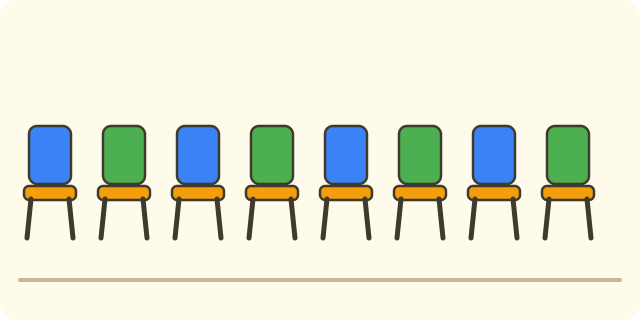
What you need: say every number in order.
Steps:
- Read An's count again.
- Find the number that is missing.
Show solution
There are eight chairs, so the right way to count is: one, two, three, four, five, six, seven, eight.
An counts: "one, two, three, four, five, six, eight". After six, An jumps to eight, which means she leaves out seven.
So An went wrong by missing the number 7; the right count is 1, 2, 3, 4, 5, 6, 7, 8.
Answer. An missed 7.
The table shows how many things are in a school box:
| Thing | Pens | Exercise books | Rubbers | Rulers |
|---|---|---|---|---|
| Number | 6 | 9 | 0 | 10 |
a) Which thing has 10?
b) Which thing has none?
What you need: read the number under each name.
Steps:
- Find 10 in the row "Number".
- Find 0.
Show solution
By the table, the numbers of things are: pens 6, exercise books 9, rubbers 0, rulers 10.
a) We look for the number 10 in the table. The number 10 is under rulers, so there are 10 rulers.
b) The number 0 means there is none. The number 0 is under rubbers, so the box has no rubber.
So a) there are 10 rulers; b) there are no rubbers.
Answer. a) Rulers. b) Rubbers.
Fill in the boxes (count backwards): 10, \square, 8, \square, 6, \square.
What you need: counting backwards means saying numbers from big to small.
Steps:
- Say: ten, ..., eight.
- What comes after 8? What comes after 6?
Show solution
We count backwards, going down by one each time: 10, 9, 8, 7, 6, 5.
The number between 10 and 8 is 9. The number between 8 and 6 is 7. The number after 6 is 5.
Check: we read forwards from 5 to 10: 5, 6, 7, 8, 9, 10. Correct.
So the numbers for the boxes are 9, 7, 5 in order.
Answer. 9, 7, 5.
Mini test
Marked like the Vietnamese graduation exam: Part I 0.25 points per question; Part II up to 1 point per question (1, 2, 3, 4 correct statements give 0.1, 0.25, 0.5, 1 point); Part III 0.5 points per question.
Part I. Multiple choice
Eight is written 8. Option A is the mistake of missing one marble.
Count on one after nine and you get ten. Option A is the number before.
After 7 comes 8, then 9. Option A repeats the number 7.
The number 10 has the digit 1 first, then the digit 0. Option B is the backwards mistake.
Part II. True or false
| a) The number 6 is read "six". | ||
| b) The number after 7 is 8. | ||
| c) When you count, 9 comes after 10. | ||
| d) The row 6, 7, 8, 9, 10 has five numbers. |
a) True. b) True. c) False: when you count, 9 comes before 10. d) True: six, seven, eight, nine, ten make five numbers.
Part III. Short answer
After 8 comes 7, then 6.
Count: eight, nine. The number after 8 is 9.
Show answers and explanations
- Part I, question 1: B. Eight is written 8. Option A is the mistake of missing one marble.
- Part I, question 2: C. Count on one after nine and you get ten. Option A is the number before.
- Part I, question 3: B. After 7 comes 8, then 9. Option A repeats the number 7.
- Part I, question 4: A. The number 10 has the digit 1 first, then the digit 0. Option B is the backwards mistake.
- Part II, question 1: a) True; b) True; c) False; d) True. a) True. b) True. c) False: when you count, 9 comes before 10. d) True: six, seven, eight, nine, ten make five numbers.
- Part III, question 1: 7. After 8 comes 7, then 6.
- Part III, question 2: 9. Count: eight, nine. The number after 8 is 9.