Two-digit numbers
🖨 Print a self-study sheet Why print?
Lan has lots of marbles. She makes bundles of marbles and gets bundles, with marbles left over. How many marbles does Lan have altogether?
You already know how to count up to . But if Lan had more marbles than that, counting them one by one would be easy to muddle. Putting them into bundles and counting the bundles is much tidier. This lesson shows you how to read and write numbers that way.
Let's explore
When you put things together, you make one ten. So one ten has ones.
- marbles make ten and ones. We write the number .
- bundles of marbles and loose marbles are tens and ones. We write the number (read "twenty-three").
- bundles of marbles and loose marbles are tens and ones. We write the number (read "forty-seven"). Notice that the tens come first and the ones come second.
So Lan has marbles. Look at the table:
| Number | Tens | Ones |
|---|---|---|
| 2 | 3 | |
| 47 | 4 | 7 |
Why does this work? Each bundle has 10 marbles. Counting the bundles gives the tens, and counting the loose marbles gives the ones.
Examples
We start with a number and ask: how many tens and ones?
Now we go the other way: you know the tens and the ones, and you write the number.
Some numbers are whole tens, with no loose ones at all. Here is one.
Last, we use bundles to count something real: sticks.
Key terms
Summary
- One ten is 10 ones.
- A two-digit number has tens and ones: 23 is 2 tens and 3 ones.
- The digit on the left is the tens digit; the digit on the right is the ones digit.
- 5 tens is written 50. Lan's question at the start is answered the same way: counting bundles gives the tens, and counting loose marbles gives the ones. Practise reading and writing a few more numbers until it feels natural.
Practice
Each exercise comes with a reminder of what you need and a hint to start you off. Try it yourself first. If you get stuck, or when you have finished, open the solution.
The number 34 is \square tens and \square ones.
What you need: the digit on the left is the tens digit, the digit on the right is the ones digit.
Steps:
- Find the digit on the left.
- Find the digit on the right.
Show solution
The number 34 has 3 in the tens place and 4 in the ones place.
The digit 3 in the tens place means 3 tens; the digit 4 in the ones place means 4 ones.
Check: 3 tens is 30 and 30+4=34, which is correct.
So the number 34 is 3 tens and 4 ones.
Answer. 3 tens and 4 ones.
Write the number made of 6 tens and 2 ones.
What you need: write the tens digit first, then the ones digit.
Steps:
- What is the tens digit?
- What is the ones digit?
Show solution
The number made of 6 tens and 2 ones has 6 in the tens place and 2 in the ones place.
We write the tens digit first and then the ones digit: write 6 and then 2.
Check: 60+2=62, which is correct.
So the number made of 6 tens and 2 ones is 62.
Answer. 62.
Remember the last lesson: 6 children are in a line and Nam is fourth from the start. How many children are behind Nam?
What you need: the children behind Nam are the fifth and the sixth.
Steps:
- Write the order from first to sixth.
- Count the children after Nam.
Show solution
There are 6 children in the line and Nam is fourth from the start.
After the fourth child come the fifth and the sixth, which is 2 children.
Check: 6-4=2 (children), which is correct.
So there are 2 children behind Nam.
Answer. 2 children.
a) How many tens and ones are in the number 70?
b) Write the number made of 9 tens and 1 one.
What you need: write the tens digit first; a whole-ten number has 0 ones.
Steps:
- Read the two digits of 70.
- Write 9 then 1.
Show solution
a) The number 70 has 7 in the tens place and 0 in the ones place. So the number 70 is 7 tens and 0 ones.
b) The number made of 9 tens and 1 one has 9 in the tens place and 1 in the ones place, so we write 9 and then 1. So the number is 91.
Answer. a) 7 tens and 0 ones. b) 91.
Nam says: "32 and 23 are the same number because they both have the digits 2 and 3." Is Nam right? Why?
What you need: the place of a digit decides its value.
Steps:
- How many tens and ones are in 32?
- How many tens and ones are in 23?
Show solution
We look at how many tens and ones each number has.
The number 32 has 3 in the tens place and 2 in the ones place, so 32 is 3 tens and 2 ones.
The number 23 has 2 in the tens place and 3 in the ones place, so 23 is 2 tens and 3 ones.
The two numbers use the same digits 2 and 3, but each digit is in a different place, so the values are different: 32=30+2 and 23=20+3.
So Nam is wrong: 32 and 23 are different numbers.
Answer. No. 32 and 23 are different numbers.
Mai says: "5 tens is written 5." Where did Mai go wrong? Write it correctly.
What you need: 5 tens is 5 bundles of ten, with 0 loose ones.
Steps:
- What is the tens digit? What is the ones digit?
- Write both digits.
Show solution
5 tens means the digit in the tens place is 5 and there are 0 ones.
A two-digit number must show both the tens digit and the ones digit: the digit 5 in the tens place and the digit 0 in the ones place.
Mai wrote only 5, so Mai forgot the digit 0 in the ones place. The number 5 is only 5 ones, not 5 tens.
Written correctly: 5 tens is 50. Check: the number 50 has 5 in the tens place and 0 in the ones place, which is correct.
So Mai went wrong by forgetting the digit 0; 5 tens is written 50.
Answer. 5 tens is written 50.
There are 4 bundles of sticks with 10 sticks in each, and 5 loose sticks. How many sticks are there altogether?
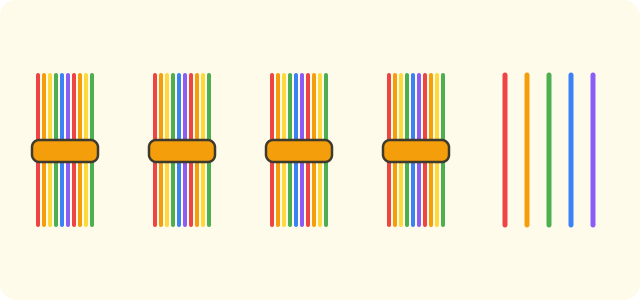
What you need: the bundles are the tens and the loose sticks are the ones.
Steps:
- What do we know? 4 bundles and 5 loose sticks. What is asked? How many sticks altogether.
- Write the tens, then the ones.
Show solution
Each bundle has 10 sticks, which is 1 ten. There are 4 bundles, so there are 4 tens, that is 40 sticks.
There are also 5 loose sticks, which is 5 ones.
The number of sticks altogether is: 40+5=45\ \text{(sticks)}.
So there are 45 sticks altogether.
Answer. 45 sticks.
A two-digit number has 4 in the tens place and a digit less than 2 in the ones place. Which numbers could it be?
What you need: the digits less than 2 are 0 and 1.
Steps:
- Write 4 in the tens place.
- Try 0 and 1 in the ones place.
Show solution
The number has two digits and the tens digit is 4, so it has the form 4\square, where \square is the ones digit.
The ones digit is less than 2, so it is 0 or 1.
With ones digit 0 we get the number 40; with ones digit 1 we get the number 41.
Check: both 40 and 41 have 4 tens and fewer than 2 ones, which is correct.
So the numbers are 40 and 41.
Answer. 40 and 41.
Mini test
Marked like the Vietnamese graduation exam: Part I 0.25 points per question; Part II up to 1 point per question (1, 2, 3, 4 correct statements give 0.1, 0.25, 0.5, 1 point); Part III 0.5 points per question.
Part I. Multiple choice
The digit on the left, 2, is in the tens place and the digit on the right, 5, is in the ones place. Option A swaps the digits.
Write 4 first, then 7. Option A is written backwards.
The tens digit is 5 and the ones digit is 0. Option B swaps the digits.
The digit on the left, 6, is the tens digit. Option B is the ones digit.
Part II. True or false
| a) The tens digit is 3. | ||
| b) The ones digit is 6. | ||
| c) 36 is 6 tens and 3 ones. | ||
| d) 36 and 63 are the same number. |
a) True. b) True. c) False: 36 is 3 tens and 6 ones. d) False: they are different numbers.
Part III. Short answer
2 tens and 6 ones make 26.
Write 9 then 0.
Show answers and explanations
- Part I, question 1: B. The digit on the left, 2, is in the tens place and the digit on the right, 5, is in the ones place. Option A swaps the digits.
- Part I, question 2: B. Write 4 first, then 7. Option A is written backwards.
- Part I, question 3: A. The tens digit is 5 and the ones digit is 0. Option B swaps the digits.
- Part I, question 4: A. The digit on the left, 6, is the tens digit. Option B is the ones digit.
- Part II, question 1: a) True; b) True; c) False; d) False. a) True. b) True. c) False: 36 is 3 tens and 6 ones. d) False: they are different numbers.
- Part III, question 1: 26. 2 tens and 6 ones make 26.
- Part III, question 2: 90. Write 9 then 0.