Simplifying fractions. Finding a common denominator
🖨 Print a self-study sheet Why print?
Mum cuts a cake into equal pieces. An eats pieces, which is of the cake. Binh eats of the cake.
Did they eat the same amount, or did one of them eat more? The two fractions have different numerators and denominators, so it is hard to see at once. This lesson teaches two techniques for comparing and working with fractions like these: simplifying and writing over a common denominator.
Simplifying fractions
Let's explore
Cut the cake into equal pieces; An eats pieces. If you join every neighbouring pieces into big piece, the cake has big pieces and An eats big piece. So:
Notice: dividing the numerator and denominator by the same number does not change the value of the fraction. The other way round, multiplying the numerator and denominator by the same number does not change the value either: .
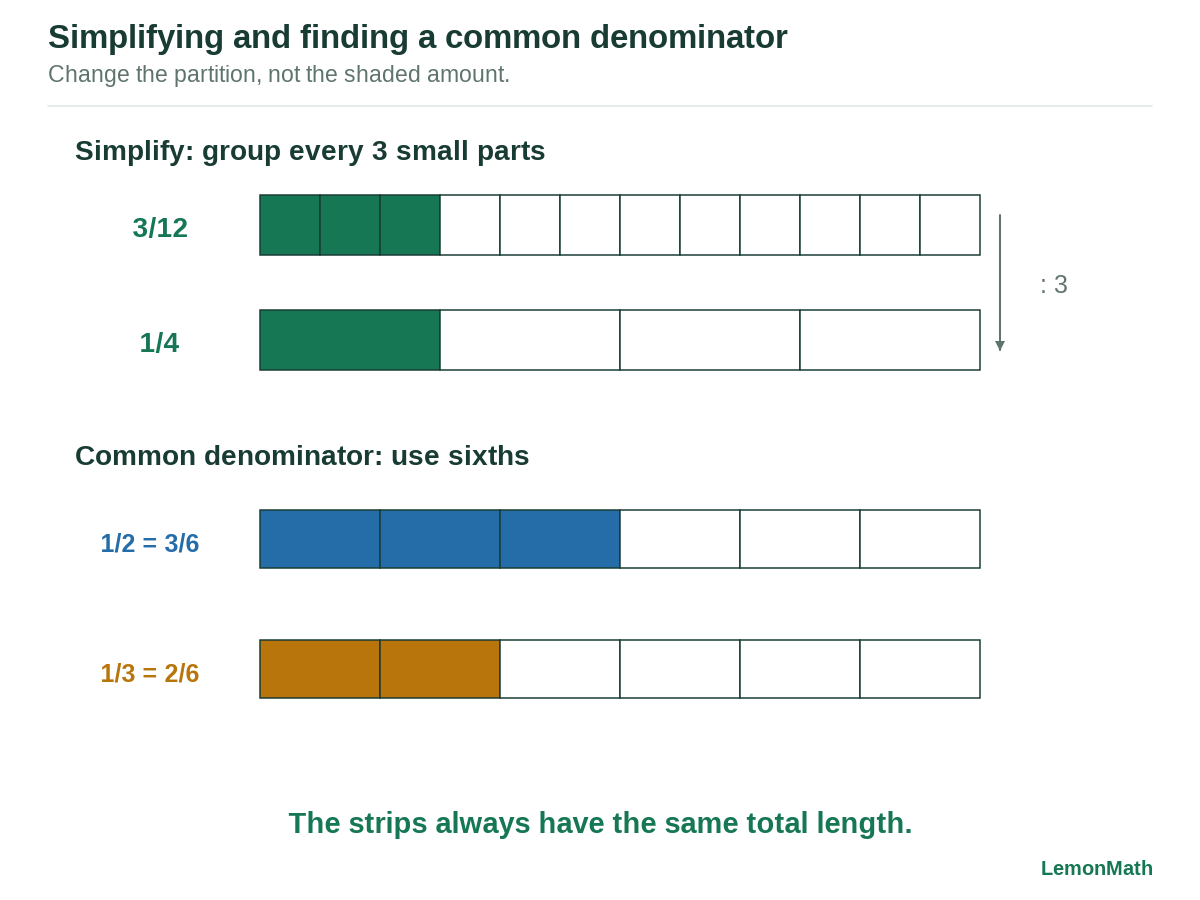
Why is it true? Multiplying the numerator and denominator by means cutting every piece of the cake into smaller pieces and taking times as many small pieces. The amount of cake taken stays the same.
Dividing the numerator and denominator of a fraction by a number greater than to get a simpler fraction is called simplifying the fraction.
To simplify, find a number greater than that divides both the numerator and the denominator, then divide both by it. Use the divisibility tests for , , and that you have learned to find such a number. Repeat until the fraction is in its simplest form.
Connection. This lesson uses times tables, division and the divisibility tests. It prepares you for comparing fractions and for adding and subtracting fractions.
Now let's check whether a fraction is already in its simplest form.
When you find a large common divisor, you can simplify faster.
Finding a common denominator
Let's explore
Look at the fractions \dfrac{1}{2} and \dfrac{1}{3}, which have different denominators. To work with them, change both to the same denominator. The number 6 is divisible by both 2 and 3, so: \dfrac{1}{2}=\dfrac{1\times3}{2\times3}=\dfrac{3}{6},\qquad \dfrac{1}{3}=\dfrac{1\times2}{3\times2}=\dfrac{2}{6}.
The fractions \dfrac{3}{6} and \dfrac{2}{6} have the same denominator 6 and are equal to the original fractions. Doing this is called writing the fractions over a common denominator, and 6 is the common denominator.
Why does this work? By the basic property, multiplying the numerator and denominator by the same number does not change the value of the fraction. The method above makes both denominators equal to b\times d.
Let's write two fractions with different denominators, neither dividing the other, over a common denominator.
When one denominator divides by the other, the work is simpler.
Sometimes there is a common denominator smaller than the product of the two denominators.
Now back to An's and Binh's cake.
Key terms
Summary
- Multiplying or dividing the numerator and denominator by the same number other than 0 gives an equivalent fraction.
- To simplify a fraction: divide the numerator and denominator by a common divisor greater than 1, and continue until the fraction is in its simplest form.
- To write two fractions over a common denominator: multiply the numerator and denominator of each fraction by the denominator of the other.
- If one denominator is divisible by the other, only one fraction needs changing.
- Two fractions are equal when simplifying or using a common denominator gives the same result.
Practice
Each exercise comes with what you need and how to start. Try it yourself first, then open the solution.
Simplify the fraction \dfrac{10}{25}.
What you need: divide the numerator and denominator by a common divisor greater than 1.
Steps:
- Which number divides both 10 and 25?
- Divide both by it and check whether the fraction is in its simplest form.
Show solution
To simplify a fraction, we look for a whole number greater than 1 that divides both the numerator and the denominator. Both 10 and 25 are divisible by 5.
Dividing the numerator and the denominator by 5, we get \frac{10}{25}=\frac{10\div5}{25\div5}=\frac{2}{5}.
For the fraction \dfrac{2}{5}, the numbers 2 and 5 have no common divisor greater than 1, so it cannot be simplified further.
So \dfrac{10}{25} simplifies to \dfrac{2}{5}.
Answer. \dfrac{2}{5}.
Simplify the fraction \dfrac{36}{48} to its simplest form.
What you need: you can simplify several times, or divide once by a large common divisor.
Steps:
- Both 36 and 48 are divisible by 12.
- Divide both by 12.
Show solution
We look for the greatest number that divides both 36 and 48. We have 36=12\times3 and 48=12\times4, so both numbers are divisible by 12.
Dividing the numerator and the denominator by 12, we get \frac{36}{48}=\frac{36\div12}{48\div12}=\frac{3}{4}.
For the fraction \dfrac{3}{4}, the numbers 3 and 4 have no common divisor greater than 1, so it is in its simplest form.
So \dfrac{36}{48} in its simplest form is \dfrac{3}{4}.
Answer. \dfrac{3}{4}.
Which of the fractions \dfrac{4}{9}, \dfrac{6}{14}, \dfrac{15}{22}, \dfrac{18}{27} are in their simplest form?
What you need: a fraction in its simplest form cannot be simplified.
Steps:
- For each fraction, see whether the numerator and denominator are both divisible by a number greater than 1.
- Try simplifying the even fractions and those whose digit sums are divisible by 3 or 9.
Show solution
A fraction is in its simplest form when its numerator and denominator have no common divisor greater than 1. We check each fraction.
- \dfrac{4}{9}: 4 and 9 have no common divisor greater than 1, so it is in its simplest form.
- \dfrac{6}{14}: both 6 and 14 are divisible by 2, so \dfrac{6}{14}=\dfrac{6\div2}{14\div2}=\dfrac{3}{7}; it can be simplified.
- \dfrac{15}{22}: 15 and 22 have no common divisor greater than 1, so it is in its simplest form.
- \dfrac{18}{27}: both 18 and 27 are divisible by 9, so \dfrac{18}{27}=\dfrac{18\div9}{27\div9}=\dfrac{2}{3}; it can be simplified.
So the fractions in their simplest form are \dfrac{4}{9} and \dfrac{15}{22}.
Answer. \dfrac{4}{9} and \dfrac{15}{22}.
Simplify the fraction \dfrac{120}{180}.
What you need: you can divide both by 10 first.
Steps:
- Divide the numerator and denominator by 10.
- Keep simplifying until the fraction is in its simplest form.
Show solution
Both the numerator and the denominator end in the digit 0, so both are divisible by 10. Dividing both by 10, we get \frac{120}{180}=\frac{12}{18}.
Both 12 and 18 are divisible by 6. Dividing both by 6, we get \frac{12}{18}=\frac{12\div6}{18\div6}=\frac{2}{3}.
For the fraction \dfrac{2}{3}, the numbers 2 and 3 have no common divisor greater than 1, so it is in its simplest form.
So \dfrac{120}{180} simplifies to \dfrac{2}{3}.
Answer. \dfrac{2}{3}.
Write the fractions \dfrac{3}{4} and \dfrac{2}{7} over a common denominator.
What you need: multiply the numerator and denominator of each fraction by the denominator of the other.
Steps:
- The common denominator is 4\times7.
- Multiply the numerator and denominator of \dfrac{3}{4} by 7, and those of \dfrac{2}{7} by 4.
Show solution
To write two fractions over a common denominator, we choose a denominator that both denominators divide into. Here we choose the common denominator 4\times7=28.
Multiply the numerator and the denominator of the first fraction by 7 (the denominator of the second fraction): \frac{3}{4}=\frac{3\times7}{4\times7}=\frac{21}{28}.
Multiply the numerator and the denominator of the second fraction by 4 (the denominator of the first fraction): \frac{2}{7}=\frac{2\times4}{7\times4}=\frac{8}{28}.
So over a common denominator, \dfrac{3}{4} and \dfrac{2}{7} become \dfrac{21}{28} and \dfrac{8}{28}.
Answer. \dfrac{21}{28} and \dfrac{8}{28}.
Write the fractions \dfrac{7}{12} and \dfrac{5}{6} over a common denominator.
What you need: if one denominator is divisible by the other, change only one fraction.
Steps:
- Is 12 divisible by 6?
- Keep \dfrac{7}{12} and change \dfrac{5}{6}.
Show solution
We compare the two denominators 12 and 6. Since 12\div6=2, the number 12 is divisible by 6, so we choose 12 as the common denominator.
The fraction \dfrac{7}{12} already has denominator 12, so we keep it.
Multiplying the numerator and the denominator of \dfrac{5}{6} by 2, we get \frac{5}{6}=\frac{5\times2}{6\times2}=\frac{10}{12}.
So over a common denominator, \dfrac{7}{12} and \dfrac{5}{6} become \dfrac{7}{12} and \dfrac{10}{12}.
Answer. \dfrac{7}{12} and \dfrac{10}{12}.
A class has 40 students, of whom 15 like football. Write the fraction of the class who like football, then simplify it.
What you need: the fraction of the class has numerator the number who like football and denominator the number of students in the class.
Steps:
- What do we know? What is asked?
- Write the fraction \dfrac{15}{40} and simplify it.
Show solution
Solution
The class has 40 students, of whom 15 like football. The fraction of the class who like football is: \frac{15}{40}.
Both 15 and 40 are divisible by 5. Dividing the numerator and the denominator by 5, we get: \frac{15}{40}=\frac{15\div5}{40\div5}=\frac{3}{8}.
For the fraction \dfrac{3}{8}, the numbers 3 and 8 have no common divisor greater than 1, so it is in its simplest form.
So the students who like football make up \dfrac{15}{40} of the class, which simplifies to \dfrac{3}{8}.
Answer. \dfrac{15}{40}=\dfrac{3}{8}.
A strip of paper is divided into 8 equal parts and 6 parts are coloured. Another strip of the same length is divided into 12 equal parts. How many parts must be coloured to give a fraction equal to that of the first strip?
What you need: simplify \dfrac{6}{8}, then change it to denominator 12.
Steps:
- Simplify \dfrac{6}{8}.
- Find the equal fraction with denominator 12.
Show solution
Solution
The fraction showing the coloured part of the first strip is \dfrac{6}{8}. We simplify it by dividing the numerator and the denominator by 2: \frac{6}{8}=\frac{6\div2}{8\div2}=\frac{3}{4}.
The second strip is divided into 12 equal parts. Since 12=4\times3, we multiply the numerator and the denominator of \dfrac{3}{4} by 3: \frac{3}{4}=\frac{3\times3}{4\times3}=\frac{9}{12}.
So 9 parts of the second strip must be coloured to give a fraction equal to that of the first strip.
Answer. 9 parts must be coloured.
Remember the lesson on multiplying and dividing by 10, 100, 1\,000. Simplify the fraction \dfrac{2\,400}{3\,600} to its simplest form.
What you need: dividing the numerator and denominator by 100 removes two zeros from each number.
Steps:
- Divide both by 100.
- Keep simplifying.
Show solution
Both the numerator and the denominator end in two zeros. Dividing both by 100, we get \frac{2\,400}{3\,600}=\frac{24}{36}.
Both 24 and 36 are divisible by 12. Dividing the numerator and the denominator by 12, we get \frac{24}{36}=\frac{24\div12}{36\div12}=\frac{2}{3}.
For the fraction \dfrac{2}{3}, the numbers 2 and 3 have no common divisor greater than 1, so it is in its simplest form.
So \dfrac{2\,400}{3\,600} in its simplest form is \dfrac{2}{3}.
Answer. \dfrac{2}{3}.
Find the fraction equal to \dfrac{3}{7} whose numerator and denominator add up to 50.
What you need: a fraction equal to \dfrac{3}{7} has the form \dfrac{3\times k}{7\times k}.
Steps:
- The numerator and denominator add up to how many times k?
- Find k, then find the fraction.
Show solution
Solution
A fraction equal to \dfrac{3}{7} has the form \dfrac{3\times k}{7\times k}, where k is a whole number greater than 0. The sum of the numerator and the denominator is: 3\times k+7\times k=10\times k.
By the problem, this sum is 50, so 10\times k=50. It follows that k=50\div10=5.
The fraction we need is: \frac{3\times5}{7\times5}=\frac{15}{35}.
Check. We have 15+35=50 and \dfrac{15}{35}=\dfrac{15\div5}{35\div5}=\dfrac{3}{7}. The result is correct.
So the required fraction is \dfrac{15}{35}.
Answer. \dfrac{15}{35}.
Mini test
Marked like the Vietnamese graduation exam: Part I 0.25 points per question; Part II up to 1 point per question (1, 2, 3, 4 correct statements give 0.1, 0.25, 0.5, 1 point); Part III 0.5 points per question.
Part I. Multiple choice
\dfrac{18}{24}=\dfrac{18\div6}{24\div6}=\dfrac{3}{4}. Options C and B can still be simplified; option D is not equal to \dfrac{18}{24}.
7 and 15 have no common divisor greater than 1. The other three can all be simplified (by 3, 5 and 6).
\dfrac{2}{3}=\dfrac{2\times5}{3\times5}=\dfrac{10}{15} and \dfrac{3}{5}=\dfrac{3\times3}{5\times3}=\dfrac{9}{15}. Option A multiplies only the denominators.
\dfrac{3}{5}=\dfrac{3\times4}{5\times4}=\dfrac{12}{20}. Option B adds 1 to both the numerator and denominator, which is wrong.
Part II. True or false
| a) \dfrac{4}{6}=\dfrac{2}{3}. | ||
| b) \dfrac{4}{6} is in its simplest form. | ||
| c) \dfrac{4}{6}=\dfrac{8}{12}. | ||
| d) Dividing the numerator and denominator of \dfrac{4}{6} by 2 gives \dfrac{2}{3}. |
a) True: divide both by 2. b) False: 4 and 6 are both divisible by 2. c) True: multiply both by 2. d) True: 4\div2=2 and 6\div2=3.
Part III. Short answer
Since 20=5\times4, x=3\times4=12.
\dfrac{24}{36}=\dfrac{2}{3} and 2+3=5.
Show answers and explanations
- Part I, question 1: A. \dfrac{18}{24}=\dfrac{18\div6}{24\div6}=\dfrac{3}{4}. Options C and B can still be simplified; option D is not equal to \dfrac{18}{24}.
- Part I, question 2: B. 7 and 15 have no common divisor greater than 1. The other three can all be simplified (by 3, 5 and 6).
- Part I, question 3: C. \dfrac{2}{3}=\dfrac{2\times5}{3\times5}=\dfrac{10}{15} and \dfrac{3}{5}=\dfrac{3\times3}{5\times3}=\dfrac{9}{15}. Option A multiplies only the denominators.
- Part I, question 4: D. \dfrac{3}{5}=\dfrac{3\times4}{5\times4}=\dfrac{12}{20}. Option B adds 1 to both the numerator and denominator, which is wrong.
- Part II, question 1: a) True; b) False; c) True; d) True. a) True: divide both by 2. b) False: 4 and 6 are both divisible by 2. c) True: multiply both by 2. d) True: 4\div2=2 and 6\div2=3.
- Part III, question 1: 12. Since 20=5\times4, x=3\times4=12.
- Part III, question 2: 5. \dfrac{24}{36}=\dfrac{2}{3} and 2+3=5.