The three similarity conditions for triangles
🖨 Print a self-study sheet Why print?
Suppose two friends want to find the width of a pond that they cannot swim across or walk through. They choose a point on the shore and measure m and m. On they mark a point with m, on a point with m, and measure m (this segment is not blocked by the pond).
From these measurements, can they find ? The triangles and share the angle and two pairs of sides seem to be proportional. Is that already enough to conclude that they are similar, without measuring all six elements? This lesson gives you three such "shortcuts".
Let's explore
By definition, two triangles are similar when they have three pairs of equal angles and three pairs of proportional sides, six conditions in all. Let us try to cut this down. Triangle has sides , , and triangle has sides , , . The three ratios of sides are all . If you draw them accurately and measure, you will see that the corresponding angles are equal.
This is not a coincidence: for triangles, equal ratios of the three sides are enough to force equal angles. Similarly, two pairs of equal angles are enough to make the third pair equal, because the angles of a triangle add up to . We state these facts as three similarity conditions.
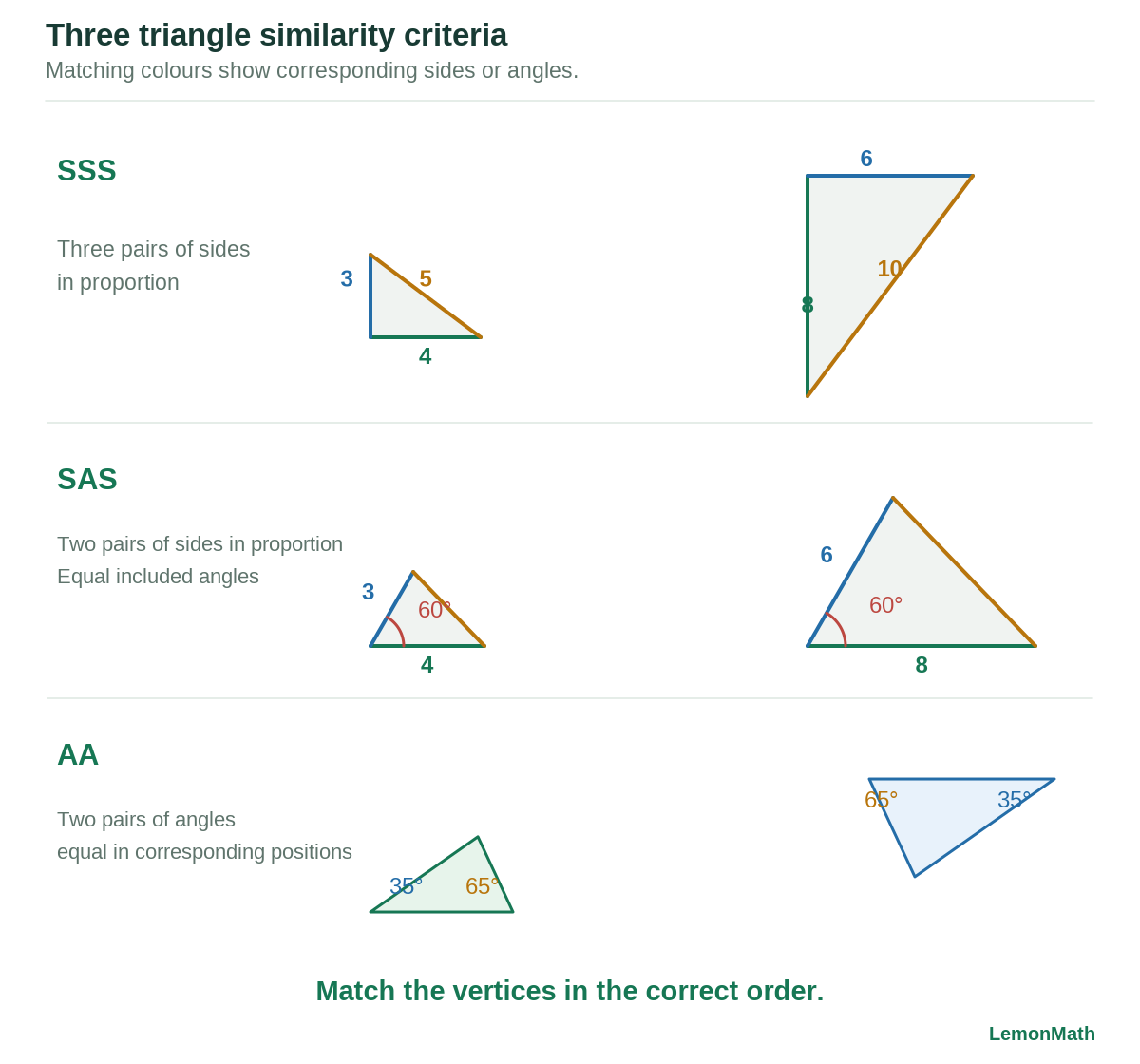
First condition: side–side–side (SSS)
Why? Suppose the common ratio k<1 (if k>1 we swap the roles of the triangles). On side AB mark a point M with AM=A'B', then draw MN\parallel BC (N\in AC). By the theorem on a parallel line, \triangle AMN\sim\triangle ABC with ratio \dfrac{AM}{AB}=k, so MN=k\cdot BC=B'C' and AN=k\cdot AC=A'C'. Triangles AMN and A'B'C' have three pairs of equal sides, so they are congruent (SSS). Hence \triangle A'B'C'\sim\triangle ABC.
Note. When comparing sides, match the shortest side with the shortest, and the longest with the longest.
Second condition: side–angle–side (SAS)
Why? Suppose k=\dfrac{A'B'}{AB}<1. On AB mark M with AM=A'B' and draw MN\parallel BC (N\in AC). Then \triangle AMN\sim\triangle ABC with ratio k, so AN=k\cdot AC=A'C'. Triangles AMN and A'B'C' have AM=A'B', \angle A=\angle A', AN=A'C', so they are congruent (SAS). Hence \triangle A'B'C'\sim\triangle ABC.
Third condition: angle–angle (AA)
Why? Since the angles of a triangle add up to 180^\circ, \angle C'=180^\circ-\angle A'-\angle B'=\angle C. Suppose A'B'<AB. On AB mark M with AM=A'B' and draw MN\parallel BC (N\in AC). Then \triangle AMN\sim\triangle ABC, so \angle AMN=\angle B=\angle B'. Triangles AMN and A'B'C' have \angle A=\angle A', AM=A'B', \angle AMN=\angle B', so they are congruent (ASA). Hence \triangle A'B'C'\sim\triangle ABC.
Similar right-angled triangles
A right-angled triangle already has a 90^\circ angle, so the conditions simplify:
- Two right-angled triangles with one pair of equal acute angles are similar (AA).
- Two right-angled triangles whose two pairs of legs are proportional are similar (SAS, since the included angle is the right angle).
We return to the pond at the start, using the four steps of solving a problem.
Connections. This lesson relies on the definition of similar triangles and the theorem on a parallel line from similar triangles, together with the congruence conditions for triangles. The next lesson, Pythagoras' theorem and its applications, can be proved very neatly using similar triangles, as you will see in the challenge exercise.
Key terms
Summary
- SSS: three pairs of corresponding sides proportional \Rightarrow similar.
- SAS: two pairs of corresponding sides proportional and the included angles equal \Rightarrow similar.
- AA: two pairs of equal angles \Rightarrow similar.
- Right-angled triangles: one pair of equal acute angles, or two pairs of proportional legs \Rightarrow similar.
- Always write the corresponding vertices in the right order; from similarity we get equal angles and ratios of sides.
Practice
Each exercise comes with what you need and how to start. Try it yourself first, then open the solution.
Triangle ABC has sides 5, 12, 13 and triangle DEF has sides 10, 24, 26. Are the triangles similar? State the scale factor.
What you need: the SSS condition.
Steps:
- Match the shortest side with the shortest, and so on.
- Work out the three ratios.
Show solution
We compare the ratios of corresponding sides, listing the sides in increasing order: 5\leftrightarrow10, 12\leftrightarrow24, 13\leftrightarrow26.
We have \frac{10}{5}=2,\qquad\frac{24}{12}=2,\qquad\frac{26}{13}=2.
The three ratios are equal, so by the side - side - side condition (SSS), \triangle ABC\sim\triangle DEF with scale factor 2 (from \triangle ABC to \triangle DEF).
So the two triangles are similar with scale factor 2.
Answer. Similar, scale factor 2.
Are two triangles with sides 3, 5, 7 and 6, 10, 15 similar?
What you need: SSS needs all three ratios to be equal.
Steps:
- Match the sides in increasing order.
- Work out the three ratios.
Show solution
We compare the ratios of corresponding sides, listing the sides in increasing order: 3\leftrightarrow6, 5\leftrightarrow10, 7\leftrightarrow15.
We have \frac63=2,\qquad\frac{10}{5}=2,\qquad\frac{15}{7}\neq2\ \ (\text{since }2\cdot7=14\neq15).
The three ratios are not equal, so the corresponding sides of the two triangles are not proportional.
So the two triangles are not similar.
Answer. Not similar.
Triangle ABC has AB=4, AC=6, \angle A=60^\circ and triangle A'B'C' has A'B'=6, A'C'=9, \angle A'=60^\circ. Prove that the triangles are similar. If BC=5, find B'C'.
What you need: the SAS condition.
Steps:
- Work out \dfrac{A'B'}{AB} and \dfrac{A'C'}{AC}.
- Use the scale factor for the remaining side.
Show solution
First we prove that the triangles are similar. In \triangle A'B'C' and \triangle ABC, we have \frac{A'B'}{AB}=\frac64=\frac32,\qquad\frac{A'C'}{AC}=\frac96=\frac32.
Hence \dfrac{A'B'}{AB}=\dfrac{A'C'}{AC}=\dfrac32. Moreover, the angles included between these pairs of sides are equal: \angle A'=\angle A=60^\circ.
By the side - angle - side condition (SAS), \triangle A'B'C'\sim\triangle ABC with scale factor \dfrac32.
Now we find B'C'. Since the triangles are similar, \dfrac{B'C'}{BC}=\dfrac32. With BC=5, we get B'C'=\frac32\cdot5=7.5.
So the triangles are similar and B'C'=7.5.
Answer. Similar; B'C'=7.5.
Triangle ABC has \angle A=50^\circ, \angle B=70^\circ and triangle MNP has \angle M=50^\circ, \angle P=60^\circ. Prove that the triangles are similar and write the vertices in the correct order.
What you need: the AA condition; the angles of a triangle add up to 180^\circ.
Steps:
- Work out the remaining angle of each triangle.
- Match the equal angles.
Show solution
In \triangle ABC, the angles sum to 180^\circ, so \angle C=180^\circ-\angle A-\angle B=180^\circ-50^\circ-70^\circ=60^\circ.
Similarly, in \triangle MNP, \angle N=180^\circ-\angle M-\angle P=180^\circ-50^\circ-60^\circ=70^\circ.
We have \angle A=\angle M=50^\circ, \angle B=\angle N=70^\circ and \angle C=\angle P=60^\circ.
By the angle - angle condition (AA), \triangle ABC\sim\triangle MNP, with corresponding vertices A\leftrightarrow M, B\leftrightarrow N, C\leftrightarrow P.
So \triangle ABC\sim\triangle MNP (vertices written in corresponding order).
Answer. \triangle ABC\sim\triangle MNP (AA).
Triangle ABC is right-angled at A with AB=3, AC=4; triangle DEF is right-angled at D with DE=6, DF=8. Prove that the triangles are similar and find EF.
What you need: two pairs of legs proportional.
Steps:
- Work out \dfrac{DE}{AB} and \dfrac{DF}{AC}.
- Find BC, then EF.
Show solution
First we prove that the triangles are similar. In \triangle DEF and \triangle ABC, we have \frac{DE}{AB}=\frac63=2,\qquad\frac{DF}{AC}=\frac84=2.
Hence \dfrac{DE}{AB}=\dfrac{DF}{AC}=2. The two included angles are right angles, so \angle D=\angle A=90^\circ.
By the SAS condition, \triangle DEF\sim\triangle ABC with scale factor 2.
Now we find EF. Apply Pythagoras' theorem in \triangle ABC, right-angled at A: BC^2=AB^2+AC^2=3^2+4^2=25,\ \text{so}\ BC=5.
Since the triangles are similar, \dfrac{EF}{BC}=2, hence EF=2\cdot5=10.
So the triangles are similar and EF=10.
Answer. Similar, EF=10.
In \triangle ABC, the point D lies on side AC with \angle ABD=\angle ACB. Given AB=10 and AD=5, find AC and DC.
What you need: \triangle ABD\sim\triangle ACB, so AB^2=AD\cdot AC.
Steps:
- Show that the two triangles are similar by AA.
- Use the relation to find AC, then DC=AC-AD.
Show solution
Consider \triangle ABD and \triangle ACB. Since D lies on side AC, the two triangles share the angle A. By hypothesis, \angle ABD=\angle ACB.
By the AA condition, \triangle ABD\sim\triangle ACB (corresponding vertices A\leftrightarrow A, B\leftrightarrow C, D\leftrightarrow B).
Hence \frac{AB}{AC}=\frac{AD}{AB},\ \text{that is}\ AB^2=AD\cdot AC.
Substituting AB=10 and AD=5, we get 100=5\cdot AC, so AC=20.
Since D lies on side AC, we have DC=AC-AD=20-5=15.
So AC=20 and DC=15.
Answer. AC=20; DC=15.
Suppose that to measure the distance AB between two points on opposite sides of a lake, people choose a point O and measure OA=90 m, OB=120 m. They mark A'\in OA with OA'=30 m, B'\in OB with OB'=40 m and measure A'B'=25 m. Find AB.
What you need: triangles OA'B' and OAB share the angle O.
Steps:
- Check \dfrac{OA'}{OA} and \dfrac{OB'}{OB}.
- Use SAS to get the ratio of A'B' to AB.
Show solution
Consider \triangle OA'B' and \triangle OAB. Since A'\in OA and B'\in OB, the two triangles share the angle O.
We have \frac{OA'}{OA}=\frac{30}{90}=\frac13,\qquad\frac{OB'}{OB}=\frac{40}{120}=\frac13.
Hence \dfrac{OA'}{OA}=\dfrac{OB'}{OB}=\dfrac13. By the SAS condition, \triangle OA'B'\sim\triangle OAB with scale factor \dfrac13.
Therefore \dfrac{A'B'}{AB}=\dfrac13, so AB=3\cdot A'B'=3\cdot25=75\ \text{(m)}.
So the distance AB is 75 m.
Answer. 75 m.
Suppose that to measure the height of a building, a small mirror is placed on the ground 30 m from the foot of the building. A person 1.6 m tall, standing 2 m from the mirror, sees the top of the building in the mirror. Find the height of the building. (The incoming ray and the reflected ray make equal angles with the ground.)
What you need: two right-angled triangles with one pair of equal acute angles are similar.
Steps:
- Recognise the two similar right-angled triangles (person with mirror, building with mirror).
- Write \dfrac{\text{height of person}}{\text{distance to mirror}}=\dfrac{\text{height of building}}{30}.
Show solution
Let AB be the building (B the foot, A the top), M the position of the mirror, and CD the person (D the foot, C the top of the head, taken as the eye level). Let h=AB (m), h>0. By hypothesis, BM=30 m, DM=2 m and CD=1.6 m.
Consider \triangle ABM, right-angled at B, and \triangle CDM, right-angled at D. The incoming ray and the reflected ray make equal angles with the ground, so \angle AMB=\angle CMD.
The two right-angled triangles have one pair of equal acute angles, so by the AA condition, \triangle ABM\sim\triangle CDM.
Hence \frac{AB}{BM}=\frac{CD}{DM},\ \text{that is}\ \frac h{30}=\frac{1.6}{2}.
Therefore h=\dfrac{30\cdot1.6}{2}=24 (m).
So the height of the building is 24 m.
Answer. 24 m.
In trapezium ABCD, AB\parallel CD; the diagonals AC and BD meet at O. Prove that \triangle OAB\sim\triangle OCD and find CD when OA=4, OC=6, AB=8. (Revise similar triangles.)
What you need: alternate angles are equal when two lines are parallel.
Steps:
- Find two pairs of equal angles to use AA.
- Write \dfrac{CD}{AB}=\dfrac{OC}{OA}.
Show solution
First we prove \triangle OAB\sim\triangle OCD. Since AB\parallel CD and A, O, C are collinear, \angle OAB=\angle OCD (alternate angles).
Since AB\parallel CD and B, O, D are collinear, \angle OBA=\angle ODC (alternate angles).
By the AA condition, \triangle OAB\sim\triangle OCD (corresponding vertices O\leftrightarrow O, A\leftrightarrow C, B\leftrightarrow D).
Now we find CD. From the similar triangles, we have \frac{CD}{AB}=\frac{OC}{OA}=\frac64=\frac32.
Substituting AB=8, we get CD=8\cdot\dfrac32=12.
So \triangle OAB\sim\triangle OCD and CD=12.
Answer. Proved; CD=12.
Triangle ABC is right-angled at A, with altitude AH (H\in BC).
a) Prove that \triangle HBA\sim\triangle ABC and AB^2=BH\cdot BC. Similarly AC^2=CH\cdot BC.
b) Deduce that AB^2+AC^2=BC^2. Find BH when AB=6, BC=10.
What you need: AA for right-angled triangles; BH+CH=BC.
Steps:
- Triangles HBA and ABC share the angle B and both have a right angle.
- Add the two relations and use BH+CH=BC.
Show solution
a) Triangles HBA (right-angled at H) and ABC (right-angled at A) share the angle B, so \triangle HBA\sim\triangle ABC (AA). Hence \dfrac{BH}{AB}=\dfrac{AB}{BC}, that is AB^2=BH\cdot BC. In exactly the same way \triangle HCA\sim\triangle ACB gives AC^2=CH\cdot BC.
b) Adding the two relations: AB^2+AC^2=BC\cdot(BH+CH)=BC\cdot BC=BC^2. With AB=6, BC=10: BH=\dfrac{AB^2}{BC}=\dfrac{36}{10}=3.6.
So we have proved Pythagoras' theorem, and BH=3.6.
Answer. BH=3.6.
Mini test
Marked like the Vietnamese graduation exam: Part I 0.25 points per question; Part II up to 1 point per question (1, 2, 3, 4 correct statements give 0.1, 0.25, 0.5, 1 point); Part III 0.5 points per question.
Part I. Multiple choice
\dfrac64=\dfrac96=\dfrac{12}{8}=\dfrac32. A inverts the ratio; B and D are not ratios of corresponding sides.
This is the AA condition. They need not be congruent (they may differ in size) and need not be isosceles.
The angle must lie between the two pairs of proportional sides. The other options do not guarantee similar triangles.
AB^2=AD\cdot AC, so AC=\dfrac{100}{5}=20. C is DC; A and D do not satisfy the relation.
Part II. True or false
| a) \triangle MNP\sim\triangle ABC by the SAS condition. | ||
| b) The scale factor of \triangle MNP to \triangle ABC is \dfrac32. | ||
| c) \angle N=\angle C. | ||
| d) If BC=12 then NP=8. |
a) True: \dfrac46=\dfrac69=\dfrac23 and the included angles are equal. b) False: the scale factor is \dfrac23. c) False: \angle N=\angle B. d) True: NP=\dfrac23\cdot12=8.
Part III. Short answer
\triangle MNP\sim\triangle ABC (SAS) with scale factor \dfrac23, so NP=\dfrac23\cdot12=8.
AB^2=AD\cdot AC, so AC=\dfrac{100}{5}=20.
Show answers and explanations
- Part I, question 1: B. \dfrac64=\dfrac96=\dfrac{12}{8}=\dfrac32. A inverts the ratio; B and D are not ratios of corresponding sides.
- Part I, question 2: C. This is the AA condition. They need not be congruent (they may differ in size) and need not be isosceles.
- Part I, question 3: D. The angle must lie between the two pairs of proportional sides. The other options do not guarantee similar triangles.
- Part I, question 4: A. AB^2=AD\cdot AC, so AC=\dfrac{100}{5}=20. C is DC; A and D do not satisfy the relation.
- Part II, question 1: a) True; b) False; c) False; d) True. a) True: \dfrac46=\dfrac69=\dfrac23 and the included angles are equal. b) False: the scale factor is \dfrac23. c) False: \angle N=\angle B. d) True: NP=\dfrac23\cdot12=8.
- Part III, question 1: 8. \triangle MNP\sim\triangle ABC (SAS) with scale factor \dfrac23, so NP=\dfrac23\cdot12=8.
- Part III, question 2: 20. AB^2=AD\cdot AC, so AC=\dfrac{100}{5}=20.