Cube of a sum. Cube of a difference. Sum and difference of two cubes
🖨 Print a self-study sheet Why print?
A gift box is a cube with edge cm. Suppose we make a larger box by lengthening every edge by cm. How much more volume does the new box have than the old one? The new volume is , so we need to know how to expand the cube of a sum.
We might also ask: what is ? Since , we shall be able to calculate it in our heads. This lesson continues the previous one, with four identities about cubes.
The cube of a sum and of a difference
Explore: from squares to cubes
We already know . To find , we multiply by one more factor : Multiplying term by term:
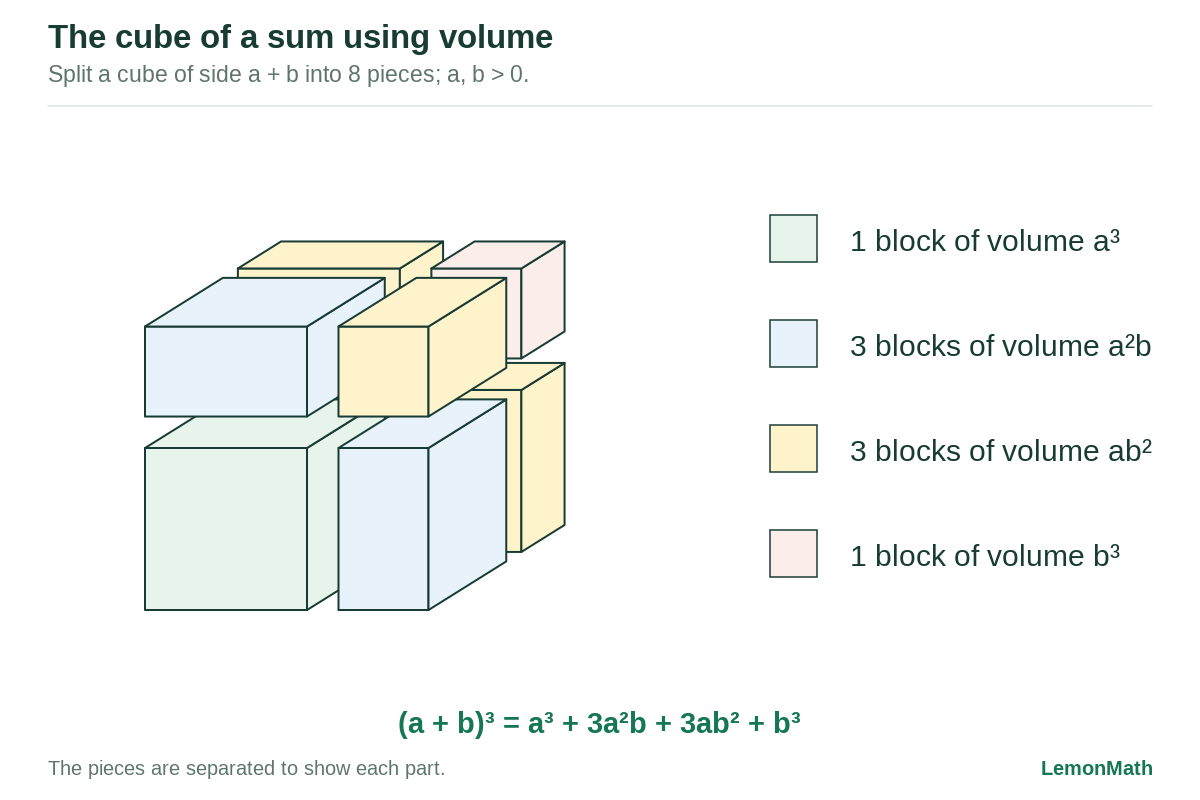
We can also see it as a volume: a cube of edge is made of a cube of edge (volume ), a cube of edge (volume ), three boxes (each of volume ) and three boxes a\times b\times b (each of volume ab^2). Adding the eight pieces gives a^3+3a^2b+3ab^2+b^3.
Replacing b by -b in this identity gives the cube of a difference.
Going deeper. In (a-b)^3 the signs alternate: +,-,+,-. The coefficients 1,3,3,1 are the same in both identities.
The sum and difference of two cubes
We multiply (a+b) by (a^2-ab+b^2): (a+b)(a^2-ab+b^2)=a^3-a^2b+ab^2+a^2b-ab^2+b^3=a^3+b^3, because -a^2b and +a^2b, and +ab^2 and -ab^2, cancel each other. In the same way, (a-b)(a^2+ab+b^2)=a^3-b^3.
These identities hold for monomials and polynomials too, provided we treat a and b as expressions. For instance (2x)^3=8x^3, not 2x^3.
Examples
We begin with the cube of a sum and of a difference.
Next we use the identities for mental calculation.
Now we use the sum and difference of two cubes.
We also read the identities backwards.
Next we simplify and evaluate.
Finally, the problem about the box from the start.
Connections. These identities continue the lesson on squares, and all come from multiplying polynomials. They let us expand very quickly, and when read backwards they help us factorise polynomials in the next lesson.
Key terms
Summary
- (a+b)^3=a^3+3a^2b+3ab^2+b^3.
- (a-b)^3=a^3-3a^2b+3ab^2-b^3 (alternating signs).
- a^3+b^3=(a+b)(a^2-ab+b^2).
- a^3-b^3=(a-b)(a^2+ab+b^2).
- Note that (2x)^3=8x^3, and watch the sign of the middle term in the second factor.
Practice
Each exercise has the knowledge you need and the steps. Try it yourself first, then open the solution.
Expand:
a) (x+1)^3.
b) (x-3)^3.
c) (2x+1)^3.
What you need: (a+b)^3=a^3+3a^2b+3ab^2+b^3 and (a-b)^3=a^3-3a^2b+3ab^2-b^3.
Steps:
- Identify a and b.
- Write the four terms, paying attention to the signs.
Show solution
Use the identity for the cube of a sum (A+B)^3=A^3+3A^2B+3AB^2+B^3 and the cube of a difference (A-B)^3=A^3-3A^2B+3AB^2-B^3.
a) With A=x, B=1, we have (x+1)^3=x^3+3\cdot x^2\cdot1+3\cdot x\cdot1^2+1^3=x^3+3x^2+3x+1.
b) With A=x, B=3, we have (x-3)^3=x^3-3\cdot x^2\cdot3+3\cdot x\cdot3^2-3^3=x^3-9x^2+27x-27.
c) With A=2x, B=1, we have (2x+1)^3=(2x)^3+3\cdot(2x)^2\cdot1+3\cdot2x\cdot1^2+1^3=8x^3+12x^2+6x+1.
So a) x^3+3x^2+3x+1; b) x^3-9x^2+27x-27; c) 8x^3+12x^2+6x+1.
Answer. a) x^3+3x^2+3x+1. b) x^3-9x^2+27x-27. c) 8x^3+12x^2+6x+1.
Expand:
a) (3x-2y)^3.
b) (x^2+2)^3.
c) \left(\dfrac12x+2\right)^3.
What you need: the identities hold when a and b are monomials; remember to cube both the coefficient and the variable.
Steps:
- Identify a and b.
- Work out a^3, 3a^2b, 3ab^2, b^3.
Show solution
Use (A+B)^3=A^3+3A^2B+3AB^2+B^3 and (A-B)^3=A^3-3A^2B+3AB^2-B^3.
a) With A=3x, B=2y, we have \begin{aligned}(3x-2y)^3&=(3x)^3-3\cdot(3x)^2\cdot2y+3\cdot3x\cdot(2y)^2-(2y)^3\\&=27x^3-54x^2y+36xy^2-8y^3.\end{aligned}
b) With A=x^2, B=2, we have (x^2+2)^3=(x^2)^3+3\cdot(x^2)^2\cdot2+3\cdot x^2\cdot2^2+2^3=x^6+6x^4+12x^2+8.
c) With A=\dfrac12x, B=2, we have \begin{aligned}\left(\frac12x+2\right)^3&=\left(\frac12x\right)^3+3\cdot\left(\frac12x\right)^2\cdot2+3\cdot\frac12x\cdot2^2+2^3\\&=\frac18x^3+\frac32x^2+6x+8.\end{aligned}
So a) 27x^3-54x^2y+36xy^2-8y^3; b) x^6+6x^4+12x^2+8; c) \dfrac18x^3+\dfrac32x^2+6x+8.
Answer. a) 27x^3-54x^2y+36xy^2-8y^3. b) x^6+6x^4+12x^2+8. c) \dfrac18x^3+\dfrac32x^2+6x+8.
Expand:
a) (x+4)(x^2-4x+16).
b) (3x-1)(9x^2+3x+1).
c) (2x+3y)(4x^2-6xy+9y^2).
What you need: (a+b)(a^2-ab+b^2)=a^3+b^3 and (a-b)(a^2+ab+b^2)=a^3-b^3.
Steps:
- Recognise a, b and the shape of the second factor.
- Write the result as a sum or difference of two cubes.
Show solution
Use the identity for the sum of two cubes (A+B)(A^2-AB+B^2)=A^3+B^3 and for the difference of two cubes (A-B)(A^2+AB+B^2)=A^3-B^3.
a) With A=x, B=4, we have A^2-AB+B^2=x^2-4x+16, so (x+4)(x^2-4x+16)=x^3+4^3=x^3+64.
b) With A=3x, B=1, we have A^2+AB+B^2=9x^2+3x+1, so (3x-1)(9x^2+3x+1)=(3x)^3-1^3=27x^3-1.
c) With A=2x, B=3y, we have A^2-AB+B^2=4x^2-6xy+9y^2, so (2x+3y)(4x^2-6xy+9y^2)=(2x)^3+(3y)^3=8x^3+27y^3.
So a) x^3+64; b) 27x^3-1; c) 8x^3+27y^3.
Answer. a) x^3+64. b) 27x^3-1. c) 8x^3+27y^3.
Calculate mentally using identities:
a) 21^3.
b) 19^3.
c) 31^3.
What you need: write the given number as a sum or difference of a multiple of ten and a small number.
Steps:
- Write 21=20+1, 19=20-1, 31=30+1.
- Apply the matching identity.
Show solution
We split each number into a sum or difference of a round number and a small number, then use the identities for cubes.
a) We have 21=20+1, so 21^3=(20+1)^3=20^3+3\cdot20^2\cdot1+3\cdot20\cdot1^2+1^3=8000+1200+60+1=9261.
b) We have 19=20-1, so 19^3=(20-1)^3=20^3-3\cdot20^2\cdot1+3\cdot20\cdot1^2-1^3=8000-1200+60-1=6859.
c) We have 31=30+1, so 31^3=(30+1)^3=30^3+3\cdot30^2\cdot1+3\cdot30\cdot1^2+1^3=27\,000+2700+90+1=29\,791.
So a) 9261; b) 6859; c) 29\,791.
Answer. a) 9261. b) 6859. c) 29\,791.
Write each expression as the cube of a sum (or difference), or as a product:
a) x^3+12x^2+48x+64.
b) 8x^3-125.
c) 27+x^3.
What you need: read the identities backwards.
Steps:
- Recognise a and b (the first and last terms are cubes).
- Choose the matching identity.
Show solution
a) We see that x^3=x^3, 64=4^3, 12x^2=3\cdot x^2\cdot4 and 48x=3\cdot x\cdot4^2. With a=x, b=4, the expression has the form a^3+3a^2b+3ab^2+b^3, so x^3+12x^2+48x+64=x^3+3\cdot x^2\cdot4+3\cdot x\cdot4^2+4^3=(x+4)^3.
b) We have 8x^3=(2x)^3 and 125=5^3. Using the difference of two cubes a^3-b^3=(a-b)(a^2+ab+b^2) with a=2x, b=5: 8x^3-125=(2x)^3-5^3=(2x-5)\left(4x^2+10x+25\right).
c) We have 27=3^3. Using the sum of two cubes a^3+b^3=(a+b)(a^2-ab+b^2) with a=3, b=x: 27+x^3=3^3+x^3=(3+x)\left(9-3x+x^2\right).
So a) (x+4)^3; b) (2x-5)(4x^2+10x+25); c) (3+x)(9-3x+x^2).
Answer. a) (x+4)^3. b) (2x-5)(4x^2+10x+25). c) (3+x)(9-3x+x^2).
Simplify C=(x+3)^3-(x-3)^3 and find the value of C at x=1.
What you need: expand the two cubes, then subtract; when removing a bracket with a - sign, change the sign of every term.
Steps:
- Expand (x+3)^3 and (x-3)^3.
- Subtract the two results, then substitute x=1.
Show solution
We have (x+3)^3=x^3+9x^2+27x+27 and (x-3)^3=x^3-9x^2+27x-27. Hence C=(x^3+9x^2+27x+27)-(x^3-9x^2+27x-27)=18x^2+54. At x=1, C=18+54=72. (Check: 4^3-(-2)^3=64+8=72.)
So C=18x^2+54 and C=72 when x=1.
Answer. C=18x^2+54; 72.
Suppose a water tank is a cube with edge x m. A new tank, also a cube, is built with edges 2 m longer than the old one. Write a polynomial for the extra volume, then find it when x=3.
What you need: the volume of a cube of edge a is a^3; (x+2)^3=x^3+6x^2+12x+8.
Steps:
- Write the volumes of the new and old tanks.
- Subtract the two volumes, then substitute x=3.
Show solution
The volume of the new tank is (x+2)^3=x^3+6x^2+12x+8 (m³). The extra volume is (x^3+6x^2+12x+8)-x^3=6x^2+12x+8\ (\text{m}^3). When x=3, the extra volume is 6\cdot9+12\cdot3+8=98 (m³). (Check: 5^3-3^3=125-27=98.)
So the extra volume is 6x^2+12x+8 (m³), which equals 98 m³ when x=3.
Answer. 6x^2+12x+8 (m³); 98 m³.
Suppose there are two cubic boxes whose edges (in decimetres) are a and b, with a+b=5 and ab=6. Find the total volume a^3+b^3 of the two boxes.
What you need: a^3+b^3=(a+b)^3-3ab(a+b).
Steps:
- Expand (a+b)^3 and solve for a^3+b^3.
- Substitute a+b=5 and ab=6.
Show solution
From (a+b)^3=a^3+b^3+3ab(a+b) we get a^3+b^3=(a+b)^3-3ab(a+b). Hence a^3+b^3=5^3-3\cdot6\cdot5=125-90=35. (Check: the edges are 2 dm and 3 dm, and 2^3+3^3=8+27=35.)
So the total volume of the two boxes is 35 dm³.
Answer. 35\ \text{dm}^3.
Recall the lesson on cuboids and cubes. A cube has edge (2x-1) cm. Write its volume as a polynomial, then find it when x=2.
What you need: V=a^3 and (a-b)^3=a^3-3a^2b+3ab^2-b^3.
Steps:
- Expand (2x-1)^3.
- Substitute x=2.
Show solution
The volume of a cube with edge a is V=a^3. With edge a=2x-1 (cm), we have \begin{aligned}V=(2x-1)^3&=(2x)^3-3\cdot(2x)^2\cdot1+3\cdot2x\cdot1^2-1^3\\&=8x^3-12x^2+6x-1\ (\text{cm}^3).\end{aligned}
Substituting x=2 into the polynomial, we get V=8\cdot2^3-12\cdot2^2+6\cdot2-1=64-48+12-1=27\ (\text{cm}^3).
Check: when x=2 the edge is 2\cdot2-1=3 cm, and 3^3=27.
So the volume is V=8x^3-12x^2+6x-1\ (\text{cm}^3), which equals 27\ \text{cm}^3 when x=2.
Answer. 8x^3-12x^2+6x-1; 27\ \text{cm}^3.
Given a+b=1, prove that a^3+b^3+3ab=1.
What you need: (a+b)^3=a^3+b^3+3ab(a+b).
Steps:
- Write a^3+b^3 in terms of (a+b)^3 and 3ab(a+b).
- Substitute a+b=1 and simplify.
Show solution
We need to prove that a^3+b^3+3ab=1 when a+b=1.
By the identity for the cube of a sum, (a+b)^3=a^3+b^3+3ab(a+b). Hence a^3+b^3=(a+b)^3-3ab(a+b).
Substituting a+b=1, we get a^3+b^3=1^3-3ab\cdot1=1-3ab.
Therefore a^3+b^3+3ab=1-3ab+3ab=1.
So if a+b=1 then a^3+b^3+3ab=1.
Answer. The identity is proved.
Mini test
Marked like the Vietnamese graduation exam: Part I 0.25 points per question; Part II up to 1 point per question (1, 2, 3, 4 correct statements give 0.1, 0.25, 0.5, 1 point); Part III 0.5 points per question.
Part I. Multiple choice
(x+2)^3=x^3+3\cdot x^2\cdot2+3\cdot x\cdot4+8=x^3+6x^2+12x+8. A drops the two middle terms, B forgets the coefficients 3, D has the wrong signs.
(2x-1)^3=8x^3-3\cdot4x^2+3\cdot2x-1=8x^3-12x^2+6x-1. B is a difference of two cubes, C forgets to square the coefficient 2 in the second term, A does not alternate the signs.
x^3+27=x^3+3^3=(x+3)(x^2-3x+9). A has the wrong sign on the middle term, B has four terms, C gets the middle term wrong.
8x^3-y^3=(2x)^3-y^3=(2x-y)(4x^2+2xy+y^2). A is the cube of a difference, C is a sum of two cubes, D forgets to square the coefficient 2.
Part II. True or false
| a) (x+1)^3=x^3+1. | ||
| b) (x-1)^3=x^3-3x^2+3x-1. | ||
| c) (x+1)^3-(x-1)^3=6x^2. | ||
| d) At x=1, (x+1)^3-(x-1)^3 equals 8. |
a) False: 3x^2+3x is missing. b) True: the signs alternate. c) False: the difference is 6x^2+2. d) True: 2^3-0^3=8 and 6+2=8.
Part III. Short answer
11^3=(10+1)^3=1000+300+30+1=1331.
a^3-b^3=(a-b)^3+3ab(a-b)=1+18=19.
Show answers and explanations
- Part I, question 1: C. (x+2)^3=x^3+3\cdot x^2\cdot2+3\cdot x\cdot4+8=x^3+6x^2+12x+8. A drops the two middle terms, B forgets the coefficients 3, D has the wrong signs.
- Part I, question 2: D. (2x-1)^3=8x^3-3\cdot4x^2+3\cdot2x-1=8x^3-12x^2+6x-1. B is a difference of two cubes, C forgets to square the coefficient 2 in the second term, A does not alternate the signs.
- Part I, question 3: A. x^3+27=x^3+3^3=(x+3)(x^2-3x+9). A has the wrong sign on the middle term, B has four terms, C gets the middle term wrong.
- Part I, question 4: B. 8x^3-y^3=(2x)^3-y^3=(2x-y)(4x^2+2xy+y^2). A is the cube of a difference, C is a sum of two cubes, D forgets to square the coefficient 2.
- Part II, question 1: a) False; b) True; c) False; d) True. a) False: 3x^2+3x is missing. b) True: the signs alternate. c) False: the difference is 6x^2+2. d) True: 2^3-0^3=8 and 6+2=8.
- Part III, question 1: 1331. 11^3=(10+1)^3=1000+300+30+1=1331.
- Part III, question 2: 19. a^3-b^3=(a-b)^3+3ab(a-b)=1+18=19.