Difference of two squares. Square of a sum or a difference
🖨 Print a self-study sheet Why print?
Can you work out , or in your head, without a calculator? Multiplying by hand takes a while. But , and we shall see that needs only three very simple calculations. The trick comes from the standard identities: equalities that hold for all values of the letters and give very neat expansions.
This lesson has the first three of these identities. They are used so often that you should know them by heart.
The square of a sum and of a difference
Explore: the square of
We write and multiply two polynomials as in the last lesson: The two cross products and are equal, so together they make . The same happens for any two numbers and .
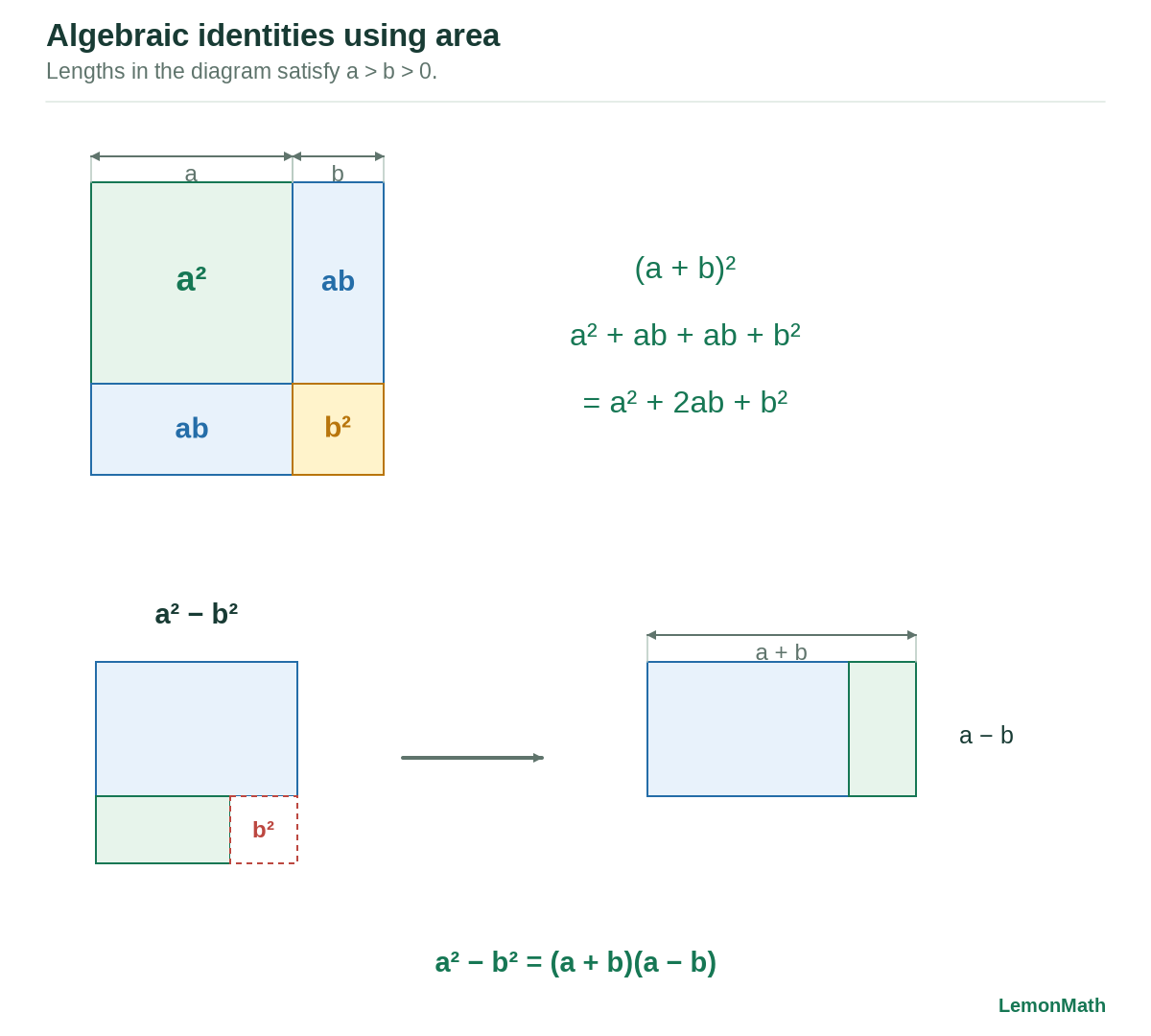
Why? We have .
We can also see it as an area: a square of side is made of a square of side (area ), a square of side b (area b^2) and two a\times b rectangles (each of area ab). Adding the four areas gives a^2+2ab+b^2.
Why? We have (a-b)^2=(a-b)(a-b)=a^2-ab-ba+b^2=a^2-2ab+b^2. We could also replace b by -b in the previous identity.
Going deeper. The term b^2 always has a + sign in both identities, because (-b)^2=b^2. Only the middle term 2ab changes sign, following the sign inside the bracket. This is also why (a-b)^2=(b-a)^2.
The difference of two squares
We multiply (a-b) by (a+b): (a-b)(a+b)=a^2+ab-ba-b^2=a^2-b^2, because the two terms ab and -ba cancel each other.
The identities hold for monomials and polynomials too, provided we treat a and b as expressions. For instance (2x)^2=4x^2, not 2x^2.
Examples
We begin with the square of a sum and of a difference.
Next we use the difference of two squares.
Now we use the identities for mental calculation.
We can also read the identities backwards.
Next we simplify and evaluate.
Finally, a real problem about reshaping a square yard.
Connections. These identities are special results of the multiplication of polynomials from the last lesson. They let us expand very quickly, and when read backwards they are the main tool for factorising polynomials in the lessons that follow.
Key terms
Summary
- (a+b)^2=a^2+2ab+b^2.
- (a-b)^2=a^2-2ab+b^2.
- a^2-b^2=(a-b)(a+b).
- The identities hold for numbers, monomials and polynomials; note that (2x)^2=4x^2.
- They can be used for mental calculation and for simplifying expressions, and read backwards to write an expression as a square or as a product.
Practice
Each exercise has the knowledge you need and the steps. Try it yourself first, then open the solution.
Expand:
a) (x+7)^2.
b) (x-6)^2.
c) (2x+1)^2.
What you need: (a+b)^2=a^2+2ab+b^2 and (a-b)^2=a^2-2ab+b^2.
Steps:
- Identify a and b.
- Write the three terms a^2, \pm2ab, b^2.
Show solution
Apply the identities for the square of a sum and the square of a difference: (A+B)^2=A^2+2AB+B^2,\qquad(A-B)^2=A^2-2AB+B^2.
a) With A=x and B=7, we have (x+7)^2=x^2+2\cdot x\cdot7+7^2=x^2+14x+49.
b) With A=x and B=6, we have (x-6)^2=x^2-2\cdot x\cdot6+6^2=x^2-12x+36.
c) With A=2x and B=1, we have (2x+1)^2=(2x)^2+2\cdot2x\cdot1+1^2=4x^2+4x+1.
So a) x^2+14x+49; b) x^2-12x+36; c) 4x^2+4x+1.
Answer. a) x^2+14x+49. b) x^2-12x+36. c) 4x^2+4x+1.
Expand:
a) (3x-2y)^2.
b) \left(\dfrac12x+3\right)^2.
c) (5x^2-y)^2.
What you need: the identities hold when a and b are monomials.
Steps:
- Identify a and b (remember to square both the coefficient and the variable).
- Work out a^2, 2ab, b^2.
Show solution
Apply the identities (A+B)^2=A^2+2AB+B^2 and (A-B)^2=A^2-2AB+B^2.
a) With A=3x and B=2y, we have (3x-2y)^2=(3x)^2-2\cdot3x\cdot2y+(2y)^2=9x^2-12xy+4y^2.
b) With A=\dfrac12x and B=3, we have \left(\frac12x+3\right)^2=\left(\frac12x\right)^2+2\cdot\frac12x\cdot3+3^2=\frac14x^2+3x+9.
c) With A=5x^2 and B=y, we have (5x^2-y)^2=(5x^2)^2-2\cdot5x^2\cdot y+y^2=25x^4-10x^2y+y^2.
So a) 9x^2-12xy+4y^2; b) \dfrac14x^2+3x+9; c) 25x^4-10x^2y+y^2.
Answer. a) 9x^2-12xy+4y^2. b) \dfrac14x^2+3x+9. c) 25x^4-10x^2y+y^2.
Expand:
a) (x-8)(x+8).
b) (4x+3y)(4x-3y).
c) (x^2+1)(x^2-1).
What you need: (a-b)(a+b)=a^2-b^2.
Steps:
- Recognise the product of a difference and a sum.
- Square the first number and subtract the square of the second.
Show solution
Apply the difference of two squares identity (A-B)(A+B)=A^2-B^2.
a) With A=x and B=8, we have (x-8)(x+8)=x^2-8^2=x^2-64.
b) With A=4x and B=3y, we have (4x+3y)(4x-3y)=(4x)^2-(3y)^2=16x^2-9y^2.
c) With A=x^2 and B=1, we have (x^2+1)(x^2-1)=(x^2)^2-1^2=x^4-1.
So a) x^2-64; b) 16x^2-9y^2; c) x^4-1.
Answer. a) x^2-64. b) 16x^2-9y^2. c) x^4-1.
Calculate mentally using identities:
a) 103^2.
b) 98^2.
c) 61\cdot59.
What you need: write the given number as a sum or difference of a round number (a multiple of ten or a hundred) and a small number.
Steps:
- Write 103=100+3, 98=100-2, 61\cdot59=(60+1)(60-1).
- Apply the matching identity.
Show solution
We write each given number as a sum or a difference of a round number and a small number, then apply an identity.
a) We have 103=100+3, so by the identity for the square of a sum, 103^2=(100+3)^2=100^2+2\cdot100\cdot3+3^2=10\,000+600+9=10\,609.
b) We have 98=100-2, so by the identity for the square of a difference, 98^2=(100-2)^2=100^2-2\cdot100\cdot2+2^2=10\,000-400+4=9604.
c) We have 61=60+1 and 59=60-1, so by the difference of two squares identity, 61\cdot59=(60+1)(60-1)=60^2-1^2=3600-1=3599.
So a) 10\,609; b) 9604; c) 3599.
Answer. a) 10\,609. b) 9604. c) 3599.
Fill in the blanks to make a correct identity:
a) x^2+10x+\ldots=(x+\ldots)^2.
b) 9x^2-\ldots+4=(3x-2)^2.
c) \ldots-36=(x-6)(x+6).
What you need: compare with a^2\pm2ab+b^2 and a^2-b^2.
Steps:
- Find a and b from the terms you are given.
- Work out the missing term.
Show solution
a) We have a=x and 2ab=10x, so b=5. Hence x^2+10x+25=(x+5)^2.
b) We have a=3x, b=2, so the middle term is 2\cdot3x\cdot2=12x. Hence 9x^2-12x+4=(3x-2)^2.
c) We have (x-6)(x+6)=x^2-36, so the blank is x^2.
So a) 25 and 5; b) 12x; c) x^2.
Answer. a) 25; 5. b) 12x. c) x^2.
Simplify B=(x+4)^2-(x-4)^2 and find the value of B at x=3.
What you need: expand the two squares, then subtract; when removing a bracket with a - sign, change the sign of every term.
Steps:
- Expand (x+4)^2 and (x-4)^2.
- Subtract the two results, then substitute x=3.
Show solution
We have (x+4)^2=x^2+8x+16 and (x-4)^2=x^2-8x+16. Hence B=(x^2+8x+16)-(x^2-8x+16)=16x. At x=3, B=16\cdot3=48. (Check: 7^2-(-1)^2=49-1=48.)
So B=16x and B=48 when x=3.
Answer. B=16x; 48.
A square garden has side x m. A path 1 m wide is built all the way round the outside of the garden. Write a polynomial for the area of the path, then find it when x=10.
What you need: area of the path = area of the large square - area of the garden.
Steps:
- Find the side of the large square made of the garden and the path.
- Use an identity, then substitute x=10.
Show solution
The large square has side x+1+1=x+2 (m). The area of the path is (x+2)^2-x^2=x^2+4x+4-x^2=4x+4\ (\text{m}^2). When x=10, the area is 4\cdot10+4=44 (m²). (Check: 12^2-10^2=144-100=44.)
So the area of the path is 4x+4 (m²), which equals 44 m² when x=10.
Answer. 4x+4 (m²); 44 m².
Suppose a rectangular plot has perimeter 20 m and area 21 m². Let its sides be a and b (in m). Find a^2+b^2, that is, the total area of the two squares built on the two sides.
What you need: a^2+b^2=(a+b)^2-2ab.
Steps:
- Find a+b from the perimeter and ab from the area.
- Substitute into the formula.
Show solution
The perimeter is 2(a+b)=20, so a+b=10. The area is ab=21. Hence a^2+b^2=(a+b)^2-2ab=10^2-2\cdot21=100-42=58. (Check: the sides are 3 m and 7 m, and 3^2+7^2=9+49=58.)
So a^2+b^2=58\ (\text{m}^2).
Answer. 58\ \text{m}^2.
Recall the lesson on cuboids. A cuboid has a square base of side (2x+1) cm and height 5 cm. Write a polynomial for the volume, then find it when x=2.
What you need: volume equals base area times height; the area of a square is the square of its side.
Steps:
- Expand (2x+1)^2.
- Multiply by 5, then substitute x=2.
Show solution
The base area is (2x+1)^2=4x^2+4x+1\ (\text{cm}^2). The volume is V=5(4x^2+4x+1)=20x^2+20x+5\ (\text{cm}^3). When x=2, V=80+40+5=125\ (\text{cm}^3). (Check: 5\cdot5^2=125.)
So V=20x^2+20x+5\ (\text{cm}^3), which equals 125\ \text{cm}^3 when x=2.
Answer. 20x^2+20x+5; 125\ \text{cm}^3.
Prove that the difference of the squares of two consecutive odd numbers is always divisible by 8.
What you need: two consecutive odd numbers have the form 2k-1 and 2k+1, where k is an integer.
Steps:
- Write the difference (2k+1)^2-(2k-1)^2.
- Use an identity, then take out 8 as a factor.
Show solution
Let the two consecutive odd numbers be 2k-1 and 2k+1, where k is an integer.
The difference of their squares (larger minus smaller) is \begin{aligned}(2k+1)^2-(2k-1)^2&=(4k^2+4k+1)-(4k^2-4k+1)\\&=4k^2+4k+1-4k^2+4k-1\\&=8k.\end{aligned}
Since k is an integer, 8k is a multiple of 8, that is, 8k is divisible by 8. If we take the smaller square minus the larger one, the difference is -8k, which is also divisible by 8.
So the difference of the squares of two consecutive odd numbers is always divisible by 8.
Answer. The difference equals 8k, which is divisible by 8.
Mini test
Marked like the Vietnamese graduation exam: Part I 0.25 points per question; Part II up to 1 point per question (1, 2, 3, 4 correct statements give 0.1, 0.25, 0.5, 1 point); Part III 0.5 points per question.
Part I. Multiple choice
(x+5)^2=x^2+2\cdot x\cdot5+5^2=x^2+10x+25. A forgets the middle term, C gets 2ab wrong, D has the wrong sign on the middle term.
(3x-2)^2=(3x)^2-2\cdot3x\cdot2+2^2=9x^2-12x+4. A is a difference of two squares, D gets 2ab wrong, C has the wrong sign on the middle term.
(7x-y)(7x+y)=(7x)^2-y^2=49x^2-y^2. B forgets to square the coefficient 7, A is a square of a difference, D has the wrong sign.
x^2-12x+36=x^2-2\cdot x\cdot6+6^2=(x-6)^2. A has the wrong sign, B equals x^2-36, C has middle term -24x.
Part II. True or false
| a) (x-3)^2=x^2-9. | ||
| b) (x-3)^2=x^2-6x+9. | ||
| c) (x-3)^2=(3-x)^2. | ||
| d) (x-3)^2=(x-3)(x+3). |
a) False: the term -6x is missing. b) True: x^2-2\cdot x\cdot3+3^2. c) True: (3-x)^2=9-6x+x^2. d) False: (x-3)(x+3)=x^2-9.
Part III. Short answer
51\cdot49=(50+1)(50-1)=50^2-1=2499.
a^2+b^2=(a+b)^2-2ab=49-24=25.
Show answers and explanations
- Part I, question 1: A. (x+5)^2=x^2+2\cdot x\cdot5+5^2=x^2+10x+25. A forgets the middle term, C gets 2ab wrong, D has the wrong sign on the middle term.
- Part I, question 2: B. (3x-2)^2=(3x)^2-2\cdot3x\cdot2+2^2=9x^2-12x+4. A is a difference of two squares, D gets 2ab wrong, C has the wrong sign on the middle term.
- Part I, question 3: C. (7x-y)(7x+y)=(7x)^2-y^2=49x^2-y^2. B forgets to square the coefficient 7, A is a square of a difference, D has the wrong sign.
- Part I, question 4: D. x^2-12x+36=x^2-2\cdot x\cdot6+6^2=(x-6)^2. A has the wrong sign, B equals x^2-36, C has middle term -24x.
- Part II, question 1: a) False; b) True; c) True; d) False. a) False: the term -6x is missing. b) True: x^2-2\cdot x\cdot3+3^2. c) True: (3-x)^2=9-6x+x^2. d) False: (x-3)(x+3)=x^2-9.
- Part III, question 1: 2499. 51\cdot49=(50+1)(50-1)=50^2-1=2499.
- Part III, question 2: 25. a^2+b^2=(a+b)^2-2ab=49-24=25.