Decimetres, metres and kilometres
🖨 Print a self-study sheet Why print?
Nam measures his desk with his hand span and gets spans. Mai measures the same desk with her hand span and gets spans. Why do the two friends get different numbers?
Because everyone's hand span is a different length, so the answers differ too. To make everyone get the same answer, we need standard units: lengths that everybody agrees to use. You already know the centimetre (cm). Today you meet three more units, which let you measure much longer things.
Let's explore
Take a ruler that is cm long. A length of cm is called decimetre, written dm.
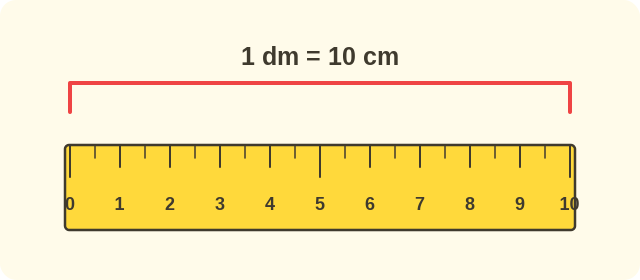
- dm cm.
Now pick up your teacher's metre rule. It is as long as of those dm rulers laid end to end. This length is called metre, written m.
- m dm.
For very long distances, like from school to another town, a metre is not very handy. So we use the kilometre, written km.
- km m.
We put all three units in one table so they are easy to remember:
| Unit | Short form | Exchange |
|---|---|---|
| decimetre | dm | dm cm |
| metre | m | m dm |
| kilometre | km | km =1000 m |
The bigger the unit, the longer the things we measure with it. A way to remember: dm for desks and chairs; m for classrooms and playgrounds; km for the way between faraway places.
Examples
Let us change metres to decimetres first.
Changing the other way, from decimetres to metres, means putting the decimetres into groups.
Once you can change units, you also need to know which unit suits which object.
Finally, we do a sum with lengths, like Nam's walk.
Key terms
Summary
- 1 dm =10 cm; 1 m =10 dm; 1 km =1000 m.
- Use dm for short objects, m for playgrounds and classrooms, km for long roads.
- In sums with lengths, keep the unit and write it in the answer. Back to the opening question: why did Nam and Mai get different numbers? Hand spans are different lengths. Standard units such as dm, m and km give everyone the same answer. Remember to write the unit in your answer, and try the practice questions.
Practice
Each exercise comes with what you need to know and a hint for how to start. Try it yourself first. If an answer is not right, that is fine: it shows you what to look at again. Then open the solution.
Write the right number in each box.
a) 1 dm =\square cm.
b) 1 m =\square dm.
c) 1 km =\square m.
What you need: remember the table of units.
Steps:
- See which smaller unit the bigger one changes to.
- Fill in each box.
Show solution
We recall how the units of length are related:
a) One decimetre is ten centimetres, so 1 dm =10 cm.
b) One metre is ten decimetres, so 1 m =10 dm.
c) One kilometre is one thousand metres, so 1 km =1000 m.
So the numbers to write in the boxes are 10, 10 and 1000.
Answer. a) 10; b) 10; c) 1000.
Change the units.
a) 3 m =\square dm.
b) 50 dm =\square m.
c) 7 dm =\square cm.
What you need: 1 m =10 dm; 1 dm =10 cm.
Steps:
- Changing to a smaller unit gives a bigger number.
- Count on in tens or split into groups of 10.
Show solution
We use 1 m =10 dm and 1 dm =10 cm.
a) Since 1 m =10 dm, 3 m is 3 times 10 dm. We have 3\times10=30. So 3 m =30 dm.
b) Every 10 dm is 1 m. The length 50 dm has 5 groups of 10 dm, so it is 5 m.
So 50 dm =5 m.
c) Since 1 dm =10 cm, 7 dm is 7 times 10 cm. We have 7\times10=70. So 7 dm =70 cm.
Answer. a) 30; b) 5; c) 70.
Remember the last lesson. Road A is 450 m long and road B is 405 m long. Write >, < or =, then say which road is longer.
What you need: compare the hundreds, then the tens.
Steps:
- Compare the hundreds of 450 and 405.
- If equal, compare the tens.
Show solution
To compare two three-digit numbers, we compare the digits starting from the hundreds.
The numbers 450 and 405 have equal hundreds, both 4.
We compare the tens next: 5>0, so 450>405.
Road A is 450 m long, which is more than road B at 405 m.
So 450>405 and road A is longer.
Answer. 450>405; road A is longer.
Work out.
a) 6 dm +3 dm.
b) 15 m -8 m.
c) 20 km -5 km.
What you need: calculate as with normal numbers and keep the unit.
Steps:
- Do the sum with the numbers.
- Write the unit in the result.
Show solution
The measures have the same unit, so we add or subtract the numbers and keep the unit.
a) We have 6+3=9. So 6 dm +3 dm =9 dm.
b) We have 15-8=7. So 15 m -8 m =7 m.
c) We have 20-5=15. So 20 km -5 km =15 km.
Answer. a) 9 dm; b) 7 m; c) 15 km.
Choose a sensible unit (dm, m or km). Why?
a) The height of a school desk.
b) The length of the school playground.
c) The road from your home to a faraway city.
What you need: dm for short things, m for playgrounds and classrooms, km for long roads.
Steps:
- Is the thing short or long?
- Choose the unit that fits.
Show solution
We choose the unit that suits the length of the thing being measured.
a) A school desk is not very long, so we measure its height in decimetres. Choose dm.
b) A playground is much longer than a desk, so we measure it in metres. Choose m.
c) The road to a faraway city is very long, so we measure it in kilometres. Choose km.
So the sensible units are dm, m and km for parts a), b) and c).
Answer. a) dm; b) m; c) km.
Mai says: "1 m =100 dm." What is wrong with what Mai says? Correct it.
What you need: one metre is ten decimetres.
Steps:
- How many 1 dm rulers placed end to end make a metre rule?
- Correct the number.
Show solution
We compare with a metre rule: a metre rule is as long as 10 rulers of 1 dm placed end to end, not 100.
So 1 m =10 dm, and 1 m =100 dm is wrong.
Mai's mistake is to write 100 instead of 10. (The number 100 is the number of centimetres in 1 m, that is 1 m =100 cm.)
So the correct statement is 1 m =10 dm.
Answer. 1 m =10 dm.
This morning Nam walks 3 km and this afternoon he walks 2 km. How many kilometres does he walk altogether?
What you need: "altogether" means putting together: use addition.
Steps:
- What do we know? 3 km and 2 km. What is asked? The total distance.
- Work out 3+2 and give the answer with its unit.
Show solution
Solution
The distance Nam walks in both parts of the day is: 3+2=5\ \text{(km)}
So Nam walks 5 km altogether.
Answer. 5 km.
A piece of string is 3 m long. It is cut into pieces that are 5 dm long. How many pieces can be cut?
What you need: 3 m =30 dm; share equally: 30\div5.
Steps:
- Change 3 m to dm.
- Divide by the length of one piece.
Show solution
Solution
The two lengths have different units, so we change them to the same unit. Since 1 m =10 dm, 3\ \text{m}=3\times10=30\ \text{(dm)}
The number of pieces is: 30\div5=6\ \text{(pieces)}
Check: 6\times5=30 (dm), which is correct.
So 6 pieces can be cut.
Answer. 6 pieces.
Mini test
Marked like the Vietnamese graduation exam: Part I 0.25 points per question; Part II up to 1 point per question (1, 2, 3, 4 correct statements give 0.1, 0.25, 0.5, 1 point); Part III 0.5 points per question.
Part I. Multiple choice
1 m =10 dm. Option C mixes it up with 100 cm.
Two cities are very far apart, so we use km.
4\times10=40 dm. Option A forgets to change the unit.
20 dm has 2 groups of 10 dm, so it is 2 m.
Part II. True or false
| a) 1 km =1000 m. | ||
| b) 1 dm =10 cm. | ||
| c) 1 m =100 dm. | ||
| d) We measure the length of a pen in km. |
a) True. b) True. c) False: 1 m =10 dm. d) False: a pen is short, so we use cm.
Part III. Short answer
5\times10=50 (dm).
60 dm has 6 groups of 10 dm, which is 6 m.
Show answers and explanations
- Part I, question 1: B. 1 m =10 dm. Option C mixes it up with 100 cm.
- Part I, question 2: D. Two cities are very far apart, so we use km.
- Part I, question 3: C. 4\times10=40 dm. Option A forgets to change the unit.
- Part I, question 4: A. 20 dm has 2 groups of 10 dm, so it is 2 m.
- Part II, question 1: a) True; b) True; c) False; d) False. a) True. b) True. c) False: 1 m =10 dm. d) False: a pen is short, so we use cm.
- Part III, question 1: 50. 5\times10=50 (dm).
- Part III, question 2: 6. 60 dm has 6 groups of 10 dm, which is 6 m.