Writing a number as hundreds, tens and ones
🖨 Print a self-study sheet Why print?
A library has books. The librarian packs them into crates of , bundles of and loose books. How many crates, bundles and loose books does she use?
You know that has hundreds, tens and ones. If we write that as an addition, we can see at once what parts the number is made of, and checking it is easier too.
Let's explore
Look at the number in the picture: hundreds, tens and ones. We find the value of each part:
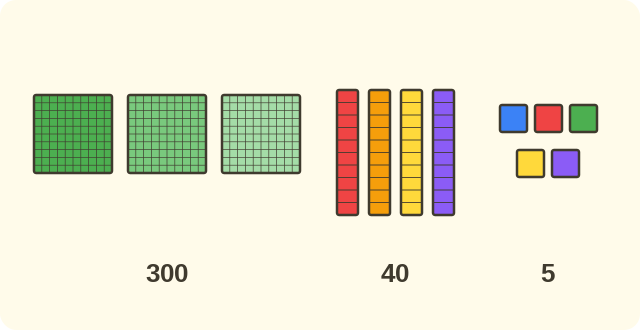
- hundreds is .
- tens is .
- ones is .
Adding the three parts gives . So we write:
Now we can answer the question at the start: the librarian uses crates, bundles and loose books.
Why do we do it this way? Each digit sits in a place, and the place tells us the value of the digit. Many people slip up here, so take care: the digit 4 in the tens place is 40, not 4.
Examples
Let us try a number with no 0 first.
Now you go the other way: you are given the sum, and you write the number.
What happens when a number has a 0? Let us see.
Finally, you use this in a shop, much like the crates and bundles in the library.
Key terms
Summary
- To write a number as a sum: hundreds + tens + ones, for example 345=300+40+5.
- A digit has the value of its place: the 4 in the tens place is 40.
- A place with 0 can be left out of the sum: 305=300+5.
- From the sum 300+40+5 you can write the number back as 345.
Back to our opening question: the library's books can be written as hundreds, tens and ones added together. Look at the place of each digit, then try the practice exercises.
Practice
Each exercise has what you need to remember and a hint to start you off. Have a go on your own first, then open the solution to check.
Write as a sum of hundreds, tens and ones.
a) 236.
b) 910.
What you need: each digit has the value of the place it is in.
Steps:
- Write the value of the hundreds, tens and ones digits.
- Leave out any place that is 0.
Show solution
a) The number 236 has 2 hundreds, 3 tens and 6 ones. 2 hundreds is 200, 3 tens is 30 and 6 ones is 6. So 236=200+30+6.
b) The number 910 has 9 hundreds, 1 ten and 0 ones. 9 hundreds is 900, 1 ten is 10, and 0 ones is 0, so we do not need to write it. So 910=900+10.
So 236=200+30+6 and 910=900+10.
Answer. a) 236=200+30+6; b) 910=900+10.
Write the number.
a) 400+50+7.
b) 800+20.
What you need: the hundreds, tens and ones are the digits of the number.
Steps:
- See how many hundreds, tens and ones each part has.
- Write a 0 in any place that is missing.
Show solution
a) The sum 400+50+7 has 4 hundreds, 5 tens and 7 ones. Writing the digits in the order hundreds, tens, ones, we get the number 457.
b) The sum 800+20 has 8 hundreds, 2 tens and no ones at all, so the ones digit is 0. Writing the digits in order, we get the number 820.
So a) the number is 457; b) the number is 820.
Answer. a) 457; b) 820.
Remember the last lesson. A number has the hundreds digit 6, the tens digit 0 and the ones digit 4. Write the number and then write it as a sum.
What you need: write the hundreds, tens and ones digits in turn.
Steps:
- Write the three digits side by side.
- Write it as a sum, leaving out the tens because they are 0.
Show solution
The number has hundreds digit 6, tens digit 0 and ones digit 4. So it has 6 hundreds, 0 tens and 4 ones, and we write it as 604.
To write it as a sum: 6 hundreds is 600, 0 tens is 0 and 4 ones is 4. We have 604=600+0+4=600+4.
So the number is 604 and 604=600+4.
Answer. 604=600+4.
Write the right number in each box.
a) 500+\square+3=573.
b) \square+40+2=942.
What you need: look at the digits of the number on the right.
Steps:
- Find the digit in the place you need.
- Write the value of that digit.
Show solution
a) The number 573 has 5 hundreds, 7 tens and 3 ones, so 573=500+70+3. Comparing with 500+\square+3, the box is 70. Check: 500+70+3=573.
b) The number 942 has 9 hundreds, 4 tens and 2 ones, so 942=900+40+2. Comparing with \square+40+2, the box is 900. Check: 900+40+2=942.
So the number in box a) is 70 and in box b) is 900.
Answer. a) 70; b) 900.
Which is right for 372: 3+7+2, 30+70+2 or 300+70+2? Why?
What you need: the digit 3 in the hundreds place has the value 300.
Steps:
- What are the values of 3, 7 and 2 in their places?
- Add the values.
Show solution
The number 372 has the digit 3 in the hundreds place, the digit 7 in the tens place and the digit 2 in the ones place. The value of each digit is:
- the digit 3 in the hundreds place has value 300;
- the digit 7 in the tens place has value 70;
- the digit 2 in the ones place has value 2.
We check each way of writing: 3+7+2=12,\qquad 30+70+2=102,\qquad 300+70+2=372.
Only 300+70+2 gives 372. The other two are wrong because they do not give each digit its value for its place.
So the right way is 372=300+70+2.
Answer. 372=300+70+2.
Lan writes "305=300+50". What is wrong with what Lan writes? Correct it.
What you need: 305 has 0 tens.
Steps:
- What is 300+50?
- How many tens and ones does 305 have?
Show solution
We work out 300+50=350, and 350\neq305. So Lan is wrong.
The number 305 has 3 hundreds, 0 tens and 5 ones. The digit 5 is in the ones place, so its value is 5, not 50. Since there are 0 tens, we do not need to write a tens part. The correct version is 305=300+5.
Check: 300+5=305.
So Lan went wrong by writing 5 ones as 50; the correct way is 305=300+5.
Answer. 305=300+5.
A library has 4 crates of 100 books, 6 bundles of 10 books and 8 loose books. How many books are there? Write it as a sum.
What you need: each crate is 100 and each bundle is 10.
Steps:
- What do we know? 4 hundreds, 6 tens, 8 ones. What is asked? The number of books.
- Write the sum and give the answer with its unit.
Show solution
Solution
4 crates, each with 100 books, make 4 hundreds of books, that is 400 books.
6 bundles, each with 10 books, make 6 tens of books, that is 60 books.
There are also 8 loose books. The number of books in the library is: 400+60+8=468\ \text{(books)}
So the library has 468 books and 468=400+60+8.
Answer. 468 books; 468=400+60+8.
Find the three-digit number of the form 400+\square0+\square, where the tens digit equals the ones digit and the ones digit is 8.
What you need: the ones digit is 8, and the tens digit is also 8.
Steps:
- Find the tens digit.
- Write the number and then the sum.
Show solution
The number has the form 400+\square0+\square, so its hundreds digit is 4.
The ones digit is 8. The tens digit equals the ones digit, so the tens digit is also 8, and the tens part is 80.
We have 400+80+8=488.
Check: the number 488 has the tens digit and the ones digit both equal to 8. Correct.
So the number is 488.
Answer. 488.
Mini test
Marked like the Vietnamese graduation exam: Part I 0.25 points per question; Part II up to 1 point per question (1, 2, 3, 4 correct statements give 0.1, 0.25, 0.5, 1 point); Part III 0.5 points per question.
Part I. Multiple choice
3 hundreds is 300, 4 tens is 40 and 5 ones is 5. Option B is the mistake of adding the digits.
6 hundreds, 2 tens and 8 ones make 628. Option A swaps the tens and ones places.
807 has 8 hundreds, 0 tens and 7 ones. Option B is 870.
5 in the hundreds place is 500 and 1 in the tens place is 10. Option C is 501.
Part II. True or false
| a) 726=700+20+6. | ||
| b) 726=7+2+6. | ||
| c) 726=700+26. | ||
| d) 726=70+20+6. |
a) True. b) False: 7+2+6=15. c) True: 20+6=26. d) False: 70+20+6=96.
Part III. Short answer
4 hundreds, 9 tens and 3 ones make 493.
259 has 5 in the tens place, value 50.
Show answers and explanations
- Part I, question 1: A. 3 hundreds is 300, 4 tens is 40 and 5 ones is 5. Option B is the mistake of adding the digits.
- Part I, question 2: B. 6 hundreds, 2 tens and 8 ones make 628. Option A swaps the tens and ones places.
- Part I, question 3: C. 807 has 8 hundreds, 0 tens and 7 ones. Option B is 870.
- Part I, question 4: D. 5 in the hundreds place is 500 and 1 in the tens place is 10. Option C is 501.
- Part II, question 1: a) True; b) False; c) True; d) False. a) True. b) False: 7+2+6=15. c) True: 20+6=26. d) False: 70+20+6=96.
- Part III, question 1: 493. 4 hundreds, 9 tens and 3 ones make 493.
- Part III, question 2: 50. 259 has 5 in the tens place, value 50.