Kilograms. Litres
🖨 Print a self-study sheet Why print?
Mai carries a bag of rice and Nam carries a bag of cotton wool. Nam says his bag is bigger so it must be heavier, but Mai feels that the rice is heavier.
How can you tell which bag is heavier, and by how much? And how can you tell how much water a bottle or a jerry can holds?
Kilograms
To find out which object is heavier, use scales. With balance scales, you put one object on each pan. The pan that goes lower holds the heavier object. If the two pans stay level, the two objects have the same mass.
To find out how heavy an object is, use scales with a dial or marks. The number the pointer shows is the mass of the object.
Measurements in kg can be added and subtracted like ordinary numbers, and then you write the unit kg in the answer. For example, . Why? Adding measurements in the same unit means putting together parts of the same kind.
Litres
Water, milk and cooking oil are liquids. To find out how much liquid a bottle or a can holds, use the litre.
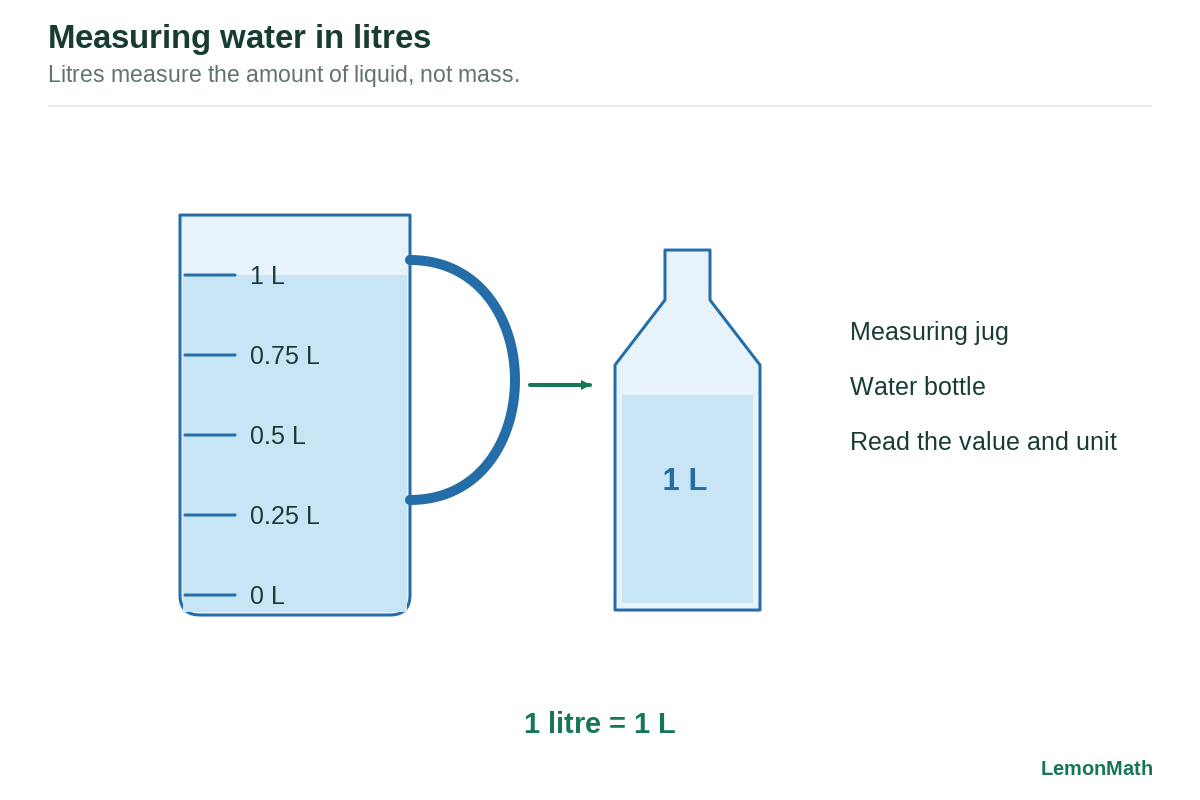
You measure out water with a cup, a jug or a bottle with marks on it. Measurements in l can also be added and subtracted like ordinary numbers. For example, . Remember: kg measures how heavy something is, and l measures the amount of liquid something holds.
Key terms
Summary
- The kilogram (kg) is a unit of mass. On balance scales, the lower pan holds the heavier object. On scales with marks, the number the pointer shows is the mass in kilograms.
- The litre (l) is a unit for measuring out liquids.
- Measurements in the same unit are added and subtracted like ordinary numbers, and then you write the unit in the answer.
- Remember to write the unit kg or l in the answer.
Practice
Each exercise comes with what you need and how to start. Try it yourself first, then open the solution.
A bag of oranges is placed on a set of scales and the pointer is exactly at the mark labelled 6. What is the mass of the bag of oranges in kilograms?
What you need: the number the pointer shows is the mass in kilograms.
Steps:
- Which mark does the pointer show?
- Write the measurement with the unit kg.
Show solution
The number at the mark the pointer shows is the mass of the object in kilograms.
The pointer is exactly at the mark labelled , so the bag of oranges has a mass of .
So the mass of the bag of oranges is .
Answer. .
On a set of balance scales, the left pan holds a grapefruit and is lower than the right pan, which holds an orange. Which is lighter?
What you need: the heavier pan goes lower.
Steps:
- Which pan is lower?
- Is the object on the other pan heavier or lighter?
Show solution
On balance scales, the object in the lower pan is heavier, and the object in the higher pan is lighter.
The left pan (with the grapefruit) is lower than the right pan (with the orange), so the grapefruit is heavier than the orange.
It follows that the orange is lighter than the grapefruit.
So the orange is lighter.
Answer. The orange is lighter.
Work out:
a)
b)
c)
d)
What you need: work with the numbers, then write the unit in the answer.
Steps:
- Do you add or subtract?
- Remember the addition and subtraction facts that bridge through 10.
Show solution
When we add or subtract measures with the same unit, we add or subtract the numbers and then write the unit in the result.
a) We have , so
b) We have 16-7=9, so 16\ \text{kg}-7\ \text{kg}=9\ \text{kg}.
c) We have 5+8=13, so 5\ \text{l}+8\ \text{l}=13\ \text{l}.
d) We have 14-6=8, so 14\ \text{l}-6\ \text{l}=8\ \text{l}.
So the results are 15\ \text{kg}, 9\ \text{kg}, 13\ \text{l} and 8\ \text{l}.
Answer. a) 15\ \text{kg}; b) 9\ \text{kg}; c) 13\ \text{l}; d) 8\ \text{l}.
Choose the unit kg or l for each gap:
a) A hen has a mass of 3 \square.
b) A bucket holds 10 \square of water.
c) A sack of rice has a mass of 5 \square.
What you need: kg measures how heavy something is, and l measures out liquids.
Steps:
- Do we want to know how heavy something is, or how much liquid it holds?
- Choose the matching unit.
Show solution
The kilogram (kg) is the unit of mass; it tells us how heavy something is. The litre (l) is the unit of capacity; it tells us how much water or other liquid a container holds.
a) "A hen has a mass of …" is about how heavy it is, so we use kg: a hen has a mass of 3\ \text{kg}.
b) "A bucket holds … of water" is about how much water it holds, so we use l: a bucket holds 10\ \text{l} of water.
c) "A sack of rice has a mass of …" is about how heavy it is, so we use kg: a sack of rice has a mass of 5\ \text{kg}.
So the units to write are kg, l, kg.
Answer. a) kg; b) l; c) kg.
Suppose Mum buys 9 kg of plain rice and 5 kg of sticky rice. How many kilograms of rice does she buy altogether?
What you need: "altogether" means putting together: use addition.
Steps:
- What do we know? What are we asked?
- How do we solve it? Which calculation do you use?
- Check: the sum must be greater than each addend.
Show solution
Solution
Mum buys plain rice and sticky rice; to find how many kilograms of rice she buys altogether, we add. The number of kilograms of rice Mum buys altogether is: 9+5=14\ \text{(kg)}
So Mum buys 14\ \text{kg} of rice altogether.
Answer. 14\ \text{kg} of rice.
Suppose the first tank holds 12 litres of water. The second tank holds 5 litres more than the first. How many litres of water does the second tank hold?
What you need: "more than" means add.
Steps:
- What do we know? What are we asked?
- Does the second tank hold more or less than the first? Which calculation do you use?
- Check: the second tank's number must be greater than 12.
Show solution
Solution
The second tank holds 5 litres more than the first tank, so to find the litres in the second tank we add 5 to the litres in the first tank. The number of litres of water the second tank holds is: 12+5=17\ \text{(l)}
So the second tank holds 17\ \text{l} of water.
Answer. 17\ \text{l} of water.
Remember the lesson "How many more or fewer?". A sack of rice has a mass of 15 kg and a sack of maize has a mass of 9 kg. Which is heavier? By how many kilograms?
What you need: to find how many more or fewer, subtract the smaller number from the larger.
Steps:
- Compare 15 and 9.
- Work out the difference and write the unit kg.
Show solution
Solution
Compare the two masses: 15>9, so the sack of rice is heavier than the sack of maize.
To find by how many kilograms the sack of rice is heavier, we subtract the smaller number from the larger one. The sack of rice is heavier than the sack of maize by: 15-9=6\ \text{(kg)}
Check: 9+6=15, which is correct.
So the sack of rice is heavier, by 6\ \text{kg}.
Answer. The sack of rice is heavier, by 6\ \text{kg}.
Suppose a can holds 10 litres of oil. The first time, 4 litres are poured out, and the second time, 3 more litres are poured out. How many litres of oil are left in the can?
What you need: "poured out" means taking away: use subtraction.
Steps:
- How many litres are left after the first time?
- How many litres are left after the second time?
Show solution
Solution
Oil is poured out twice, so we subtract one time after the other. After the first time, the can holds: 10-4=6\ \text{(l)}
After the second time, the can holds: 6-3=3\ \text{(l)}
Check. The total poured out is 4+3=7 (l) and 10-7=3 (l), which is correct.
So there are 3\ \text{l} of oil left in the can.
Answer. 3\ \text{l} of oil.
Mini test
Marked like the Vietnamese graduation exam: Part I 0.25 points per question; Part II up to 1 point per question (1, 2, 3, 4 correct statements give 0.1, 0.25, 0.5, 1 point); Part III 0.5 points per question.
Part I. Multiple choice
The pointer is at mark 4, so the bag has a mass of 4 kg. Option A uses the wrong unit, and options B and C misread the number.
8+7=15 and the unit is kg. Option B is a subtraction, and option C has the wrong unit.
"Takes out" means taking away: 18-9=9 (l). Option A is an addition by mistake, and option C has the wrong unit.
The amount of a liquid is measured out in litres, written l. The kilogram measures mass and the centimetre measures length.
Part II. True or false
| a) The object on the left pan is lighter. | ||
| b) The object on the right pan is lighter. | ||
| c) The two objects have the same mass. | ||
| d) The lighter pan goes lower. |
a) False: the lower pan holds the heavier object. b) True: the object on the right pan is lighter. c) False: if the masses were equal, the two pans would stay level. d) False: the heavier pan is the one that goes lower.
Part III. Short answer
6+9=15 (kg).
16-7=9 (l).
Show answers and explanations
- Part I, question 1: D. The pointer is at mark 4, so the bag has a mass of 4 kg. Option A uses the wrong unit, and options B and C misread the number.
- Part I, question 2: A. 8+7=15 and the unit is kg. Option B is a subtraction, and option C has the wrong unit.
- Part I, question 3: B. "Takes out" means taking away: 18-9=9 (l). Option A is an addition by mistake, and option C has the wrong unit.
- Part I, question 4: C. The amount of a liquid is measured out in litres, written l. The kilogram measures mass and the centimetre measures length.
- Part II, question 1: a) False; b) True; c) False; d) False. a) False: the lower pan holds the heavier object. b) True: the object on the right pan is lighter. c) False: if the masses were equal, the two pans would stay level. d) False: the heavier pan is the one that goes lower.
- Part III, question 1: 15. 6+9=15 (kg).
- Part III, question 2: 9. 16-7=9 (l).