Ones, tens, hundreds and thousands
🖨 Print a self-study sheet Why print?
Mai has loose marbles. She puts all into one bag. How many bags of ten marbles can loose marbles make?
Counting one by one takes a long time, especially when there are lots of marbles. To go faster, we put the marbles into groups and count the groups. Let us see how.
Let's explore
You already know how to count to . Now think about this: when we have loose objects, we can pack them into one group to keep things tidy. Each group like this is called one ten.
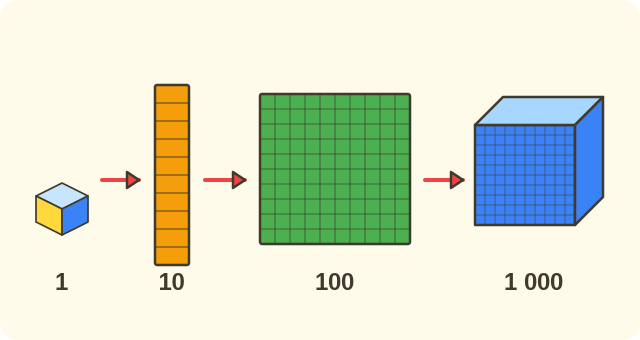
- loose objects (each is one) make ten.
- of these bags (each is ten) make hundred.
- of these boxes (each is hundred) make thousand.
We can record these exchanges in a table, so they are easy to see:
| Exchange | Make |
|---|---|
| ones | ten |
| tens | hundred |
| 10 hundreds | 1 thousand |
Now we can answer the opening question: 10 loose marbles make 1 bag of ten marbles.
Why can we exchange like this? Each time we have 10 equal groups, we simply put them together into one bigger group. Nothing is lost; we have just made counting shorter.
Examples
Let us try the simplest exchange first.
Now let us go the other way, from tens back to ones.
Now we climb one step higher: from tens to hundreds.
Finally, we use the rule in a shop, counting books.
Key terms
Summary
- 10 ones =1 ten.
- 10 tens =1 hundred.
- 10 hundreds =1 thousand.
- Making groups of 10 helps you count faster.
Back to our opening question: once we have ten loose marbles, we can put them in a bag, and that bag is one ten. Remember this way of making groups, then try the practice exercises.
Practice
Each exercise has what you need to remember and a hint to start you off. Have a go on your own first, then open the solution to check.
Write the right number in each box.
a) 10 ones =\square ten.
b) 10 tens =\square hundred.
c) 10 hundreds =\square thousand.
What you need: ten small groups make one bigger group.
Steps:
- Remember the exchange table.
- Fill in each box.
Show solution
Every ten ones make a ten, every ten tens make a hundred, and every ten hundreds make a thousand.
a) 10 ones put together make 1 ten, so 10 ones =1 ten.
b) 10 tens put together make 1 hundred, so 10 tens =1 hundred.
c) 10 hundreds put together make 1 thousand, so 10 hundreds =1 thousand.
So all three numbers to write are 1.
Answer. a) 1; b) 1; c) 1.
Write the right number in each box.
a) 1 ten =\square ones.
b) 1 hundred =\square tens.
c) 1 thousand =\square hundreds.
What you need: exchanging back: one big group has 10 groups of the next size down.
Steps:
- How many smaller groups make up one bigger group?
- Fill in each box.
Show solution
This is the reverse of the previous exercise: one ten has ten ones, one hundred has ten tens, and one thousand has ten hundreds.
a) 1 ten has 10 ones, so 1 ten =10 ones.
b) 1 hundred has 10 tens, so 1 hundred =10 tens.
c) 1 thousand has 10 hundreds, so 1 thousand =10 hundreds.
So all three numbers to write are 10.
Answer. a) 10; b) 10; c) 10.
Remember the last lesson. A tin of milk is a cylinder with 2 flat faces. How many flat faces do 10 tins have? How many tens is that?
What you need: each tin has 2 flat faces; 10 ones make 1 ten.
Steps:
- Work out 10\times2.
- Change the number you found into tens.
Show solution
Solution
Each tin of milk has 2 flat faces, and there are 10 such tins, so the number 2 is taken 10 times. The number of flat faces of 10 tins is: 10\times2=20\ \text{(flat faces)}
We have 20=10+10, and 10 is 1 ten, so 20 is 2 tens.
So 10 tins have 20 flat faces, which is 2 tens.
Answer. 20 flat faces, which is 2 tens.
Change to ones.
a) 2 tens =\square ones.
b) 3 tens =\square ones.
c) 5 tens =\square ones.
What you need: each ten has 10 ones.
Steps:
- Add the groups of 10.
- Or count on in tens: 10, 20, 30, \dots
Show solution
One ten is 10 ones. To change tens to ones, we count on in tens as many times as there are tens.
a) 2 tens is two times ten: 10+10=20. So 2 tens =20 ones.
b) 3 tens is three times ten: 10+10+10=30. So 3 tens =30 ones.
c) 5 tens: counting on in tens five times gives 10, 20, 30, 40, 50. So 5 tens =50 ones.
So the numbers to fill in are 20, 30 and 50.
Answer. a) 20; b) 30; c) 50.
You want to count 100 marbles quickly. You put 10 marbles in each bag. How many bags do you need? Why?
What you need: 1 hundred has 10 tens, and a bag of 10 marbles is 1 ten.
Steps:
- How many tens is one bag?
- How many tens is 100?
Show solution
Each bag holds 10 marbles, which is 1 ten of marbles. The number of marbles to count is 100, which is 1 hundred.
Now 1 hundred has 10 tens (because 10 tens put together make 1 hundred). So 100 marbles are 10 tens of marbles, and each ten of marbles goes into one bag.
Check: 10 bags with 10 marbles in each make 10\times10=100 (marbles), which is correct.
So you need 10 bags, because 1 hundred has 10 tens.
Answer. 10 bags.
Nam says: "1 hundred is 10 ones." What is wrong with what Nam says? Correct it.
What you need: 10 ones make only 1 ten; 1 hundred is 10 tens.
Steps:
- How many tens are 10 ones?
- How many tens make 1 hundred?
Show solution
Nam says: "1 hundred is 10 ones."
10 ones put together make only 1 ten, not yet 1 hundred. To make 1 hundred we need 10 tens, that is 100 ones.
So Nam is wrong because he mixes up 10 ones (which is 1 ten) with 1 hundred; the correct statement is that 1 hundred is 10 tens.
Answer. 1 hundred is 10 tens.
One box holds 100 exercise books. A shop has 10 such boxes. How many thousands of books are there altogether?
What you need: 10 hundreds make 1 thousand.
Steps:
- What do we know? Each box has 1 hundred books, and there are 10 boxes. What is asked? How many thousands of books.
- Change 10 hundreds into thousands and write the answer with its unit.
Show solution
Solution
Each box holds 100 exercise books, which is 1 hundred books. There are 10 such boxes, so there are 10 hundreds of books.
And 10 hundreds put together make 1 thousand.
Check: the number of books is 100\times10=1000 (books), and 1000 is 1 thousand, which is correct.
So there are 1 thousand books altogether.
Answer. 1 thousand books.
How many tens make one thousand?
What you need: 1 thousand has 10 hundreds, and 1 hundred has 10 tens.
Steps:
- How many hundreds are in one thousand?
- How many tens are in each hundred? Add ten times.
Show solution
1 thousand has 10 hundreds. Each hundred has 10 tens. So 10 hundreds have 10\times10=100 tens.
Check. 100 tens make 10 hundreds, which is 1 thousand. Correct.
Answer. 100 tens.
Mini test
Marked like the Vietnamese graduation exam: Part I 0.25 points per question; Part II up to 1 point per question (1, 2, 3, 4 correct statements give 0.1, 0.25, 0.5, 1 point); Part III 0.5 points per question.
Part I. Multiple choice
10 ones make 1 ten. Option C mixes it up with 10 tens.
1 hundred is made of 10 tens. Option C mixes up 1 hundred with 100 tens.
Ten hundreds make 1 thousand. Option D mixes up hundreds with tens.
10 boxes with 1 ten of pens each make 10 tens, which is 1 hundred pens. Option B comes from adding 10+10.
Part II. True or false
| a) 1 ten has 10 ones. | ||
| b) 1 hundred has 10 tens. | ||
| c) 10 hundreds make 100. | ||
| d) 1 thousand has 10 hundreds. |
a) True. b) True. c) False: 10 hundreds make 1 thousand. d) True.
Part III. Short answer
10+10=20 (ones).
1 thousand is made of 10 hundreds.
Show answers and explanations
- Part I, question 1: A. 10 ones make 1 ten. Option C mixes it up with 10 tens.
- Part I, question 2: B. 1 hundred is made of 10 tens. Option C mixes up 1 hundred with 100 tens.
- Part I, question 3: A. Ten hundreds make 1 thousand. Option D mixes up hundreds with tens.
- Part I, question 4: C. 10 boxes with 1 ten of pens each make 10 tens, which is 1 hundred pens. Option B comes from adding 10+10.
- Part II, question 1: a) True; b) True; c) False; d) True. a) True. b) True. c) False: 10 hundreds make 1 thousand. d) True.
- Part III, question 1: 20. 10+10=20 (ones).
- Part III, question 2: 10. 1 thousand is made of 10 hundreds.