Cylinders and spheres
🖨 Print a self-study sheet Why print?
Lan puts a ball and a tin of milk on a slightly sloping table. The ball rolls away fast. The tin rolls when it lies on its side, but when it stands up it stays still.
Why does the ball roll away fast while the tin stands still? The answer is in their shapes. You will meet two new solid shapes, and then you will be able to explain what happened on Lan's table.
Let's explore
Pick up a tin of milk. Feel both ends: the top and the bottom are flat. Feel around the side of the tin: this part is curved.
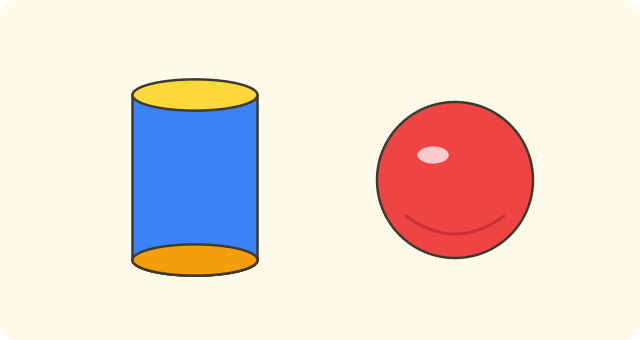
Now pick up a ball. Feel all over it: it is curved everywhere, with no flat part at all.
We write down what we found in a table, so we can compare the two side by side:
| Tin of milk | Ball | |
|---|---|---|
| Number of flat faces | ||
| Number of curved surfaces | ||
| Stands up and stacks | yes | not steadily |
| Rolling | rolls in one direction | rolls in every direction |
Now we give these shapes their names. The tin has the shape of a cylinder. The ball has the shape of a sphere.
Now you can explain what happened on Lan's table. A cylinder can be stacked because its bases are flat, so one sits on another without sliding. A sphere has no flat face to rest on, so it rolls away easily.
Examples
Let us try recognising the shape of a familiar object from your classroom.
You count the faces of a cylinder, just as you felt them on the tin.
What if many objects are mixed up together? We sort them into two groups.
Finally, we use what we have learned to help Nam choose objects for his tower.
Key terms
Summary
- A cylinder has flat circular faces (two bases) and 1 curved surface. Examples: a tin of milk, a drum.
- A sphere has only 1 curved surface and no flat faces. Examples: a ball, a marble.
- A cylinder can be stacked because it has flat bases; a sphere rolls, so it does not stack steadily.
- To tell which solid an object is, feel whether it has a flat face. Back to the opening question: why are the ball and the tin different? The tin has flat bases and the ball has none. Next time you pick up an object, feel for a flat face, and then try the practice questions.
Practice
Each exercise comes with what you need to know and a hint for how to start. Try it yourself first. If an answer is not right, that is fine: it shows you what to look at again. Then open the solution.
Is each object a cylinder or a sphere?
a) A tin of fizzy drink.
b) A table-tennis ball.
c) A drum.
d) A marble.
What you need: an object with two flat round bases is a cylinder; an object with no flat face is a sphere.
Steps:
- Think: does the object have a flat part?
- Two flat ends: choose cylinder. Otherwise: sphere.
Show solution
A cylinder has two flat bases and one curved surface. A sphere has no flat face at all.
a) The tin of fizzy drink has two flat bases, so it is a cylinder.
b) The table-tennis ball has no flat face, so it is a sphere.
c) The drum has two flat bases, so it is a cylinder.
d) The marble has no flat face, so it is a sphere.
So the tin and the drum are cylinders; the table-tennis ball and the marble are spheres.
Answer. a) cylinder; b) sphere; c) cylinder; d) sphere.
Write the right number in each box.
a) A cylinder has \square flat faces.
b) A cylinder has \square curved surfaces.
c) A sphere has \square flat faces.
What you need: a cylinder has 2 flat faces and 1 curved surface; a sphere has no flat faces.
Steps:
- Remember the table in "Let's explore".
- Fill in each box.
Show solution
A cylinder has two flat bases and one curved surface.
a) A cylinder has 2 flat faces (the two bases).
b) A cylinder has 1 curved surface.
c) A sphere has no flat face, so it has 0 flat faces.
So we write the numbers 2, 1 and 0.
Answer. a) 2; b) 1; c) 0.
Which sentences are true and which are false?
a) A sphere has a flat face.
b) Cylinders can be stacked.
c) A ball rolls in every direction.
What you need: a sphere has no flat faces; a cylinder has flat bases, so it can be stacked.
Steps:
- Read each sentence.
- Check it against the Summary.
Show solution
a) False. A sphere has no flat face, so the sentence "A sphere has a flat face" is false.
b) True. A cylinder has flat bases, so cylinders can be stacked.
c) True. A ball is a sphere, and a sphere rolls in every direction.
So sentences b) and c) are true; sentence a) is false.
Answer. a) False; b) True; c) True.
Which object does not belong with the others: a tin of milk, a drum, a ball, a cylinder-shaped cup?
What you need: an object with two flat bases is a cylinder.
Steps:
- Put each object in the group cylinder or sphere.
- Find the object in the other group.
Show solution
We decide the shape of each object.
The tin of milk has two flat bases, so it is a cylinder.
The drum has two flat bases, so it is a cylinder.
The cylinder-shaped cup is a cylinder.
The ball has no flat face, so it is a sphere.
So three objects are cylinders and the ball is a sphere; the ball does not belong with the others.
Answer. The ball.
You want to build a tall tower from objects. Do you choose a tin of milk or a ball? Why?
What you need: an object with a flat base can sit on top of another one.
Steps:
- Which object has a flat face?
- Will an object with a flat face roll away when stacked?
Show solution
A tin of milk is a cylinder with flat bases, so tins can be stacked.
A ball is a sphere with no flat face, so it will roll away and cannot be stacked.
So you choose the tin of milk to build a tall tower, because a tin has flat bases.
Answer. Choose the tin of milk.
Mai says: "A round orange has two flat faces, so it is a cylinder." What is wrong with what Mai says? Correct it.
What you need: a sphere has no flat faces.
Steps:
- Does a round orange have any flat part?
- Which solid has no flat faces?
Show solution
A round orange has no flat face at all.
A solid with no flat face is a sphere, while a cylinder is the one that has two flat faces (its two bases).
Mai is wrong when she says the orange has two flat faces, so she wrongly calls it a cylinder.
So the correct statement is: a round orange has no flat face, so it is a sphere.
Answer. A round orange has the shape of a sphere.
A shopkeeper has 20 tins of milk and stacks them into 5 equal stacks. How many tins are in each stack? (Remember your division facts for 5.)
What you need: sharing equally means dividing: 20\div5.
Steps:
- What do we know? 20 tins, 5 equal stacks. What is asked? The number of tins in each stack.
- Work out 20\div5 and write the answer with its unit.
Show solution
Solution
The shopkeeper stacks 20 tins into 5 equal stacks, so the number of tins in each stack is: 20\div5=4\ \text{(tins)}.
Check: 4\times5=20. Correct.
So each stack has 4 tins of milk.
Answer. 4 tins of milk.
A baby has 3 cylinders and 2 spheres. How many flat faces do all these solids have altogether?
What you need: each cylinder has 2 flat faces, and each sphere has 0 flat faces.
Steps:
- Work out the flat faces of 3 cylinders: 3\times2.
- Work out the flat faces of 2 spheres, then add.
Show solution
Solution
Each cylinder has 2 flat faces, so 3 cylinders have this many flat faces: 3\times2=6\ \text{(flat faces)}.
Each sphere has 0 flat faces, so 2 spheres have this many flat faces: 2\times0=0\ \text{(flat faces)}.
The total number of flat faces of all the solids is: 6+0=6\ \text{(flat faces)}.
So all these solids have 6 flat faces altogether.
Answer. 6 flat faces.
Mini test
Marked like the Vietnamese graduation exam: Part I 0.25 points per question; Part II up to 1 point per question (1, 2, 3, 4 correct statements give 0.1, 0.25, 0.5, 1 point); Part III 0.5 points per question.
Part I. Multiple choice
A football has no flat face, so it is a sphere. The other objects have two flat bases, so they are cylinders.
A cylinder has two flat bases. Option B is the number of curved surfaces, so do not mix them up.
The flat bases of a tin sit on each other without sliding. A tin is a cylinder, not a sphere, and it still has a curved surface.
A sphere has only a curved surface. A cylinder has 2 flat faces.
Part II. True or false
| a) A cylinder has 2 flat faces. | ||
| b) A cylinder has 3 curved surfaces. | ||
| c) Cylinders can be stacked. | ||
| d) A ball is a cylinder. |
a) True: it has two flat bases. b) False: a cylinder has only 1 curved surface. c) True: thanks to its flat bases. d) False: a ball is a sphere.
Part III. Short answer
Each tin is a cylinder with 2 flat faces. So 4\times2=8 (flat faces).
15\div5=3 (stacks), because 3\times5=15.
Show answers and explanations
- Part I, question 1: C. A football has no flat face, so it is a sphere. The other objects have two flat bases, so they are cylinders.
- Part I, question 2: C. A cylinder has two flat bases. Option B is the number of curved surfaces, so do not mix them up.
- Part I, question 3: A. The flat bases of a tin sit on each other without sliding. A tin is a cylinder, not a sphere, and it still has a curved surface.
- Part I, question 4: B. A sphere has only a curved surface. A cylinder has 2 flat faces.
- Part II, question 1: a) True; b) False; c) True; d) False. a) True: it has two flat bases. b) False: a cylinder has only 1 curved surface. c) True: thanks to its flat bases. d) False: a ball is a sphere.
- Part III, question 1: 8. Each tin is a cylinder with 2 flat faces. So 4\times2=8 (flat faces).
- Part III, question 2: 3. 15\div5=3 (stacks), because 3\times5=15.