Dividing decimals
🖨 Print a self-study sheet Why print?
A ribbon m long is cut into equal pieces. How many metres long is each piece?
To find out, you have to divide by . This lesson shows you how to divide decimals and where to put the decimal point in the quotient.
Let's explore
Change m dm. Dividing dm into equal parts gives dm each, which is m. So .
We can also divide straight away without changing units: divide the whole-number part , write the decimal point in the quotient, then divide the tenths digit . The quotient is .
Why does this work? A decimal is made of tenths, hundredths, ... so dividing place by place from left to right is just like dividing whole numbers; the decimal point in the quotient sits right after the ones place. Writing a digit to the right of the remainder means changing to a smaller unit: unit is tenths.
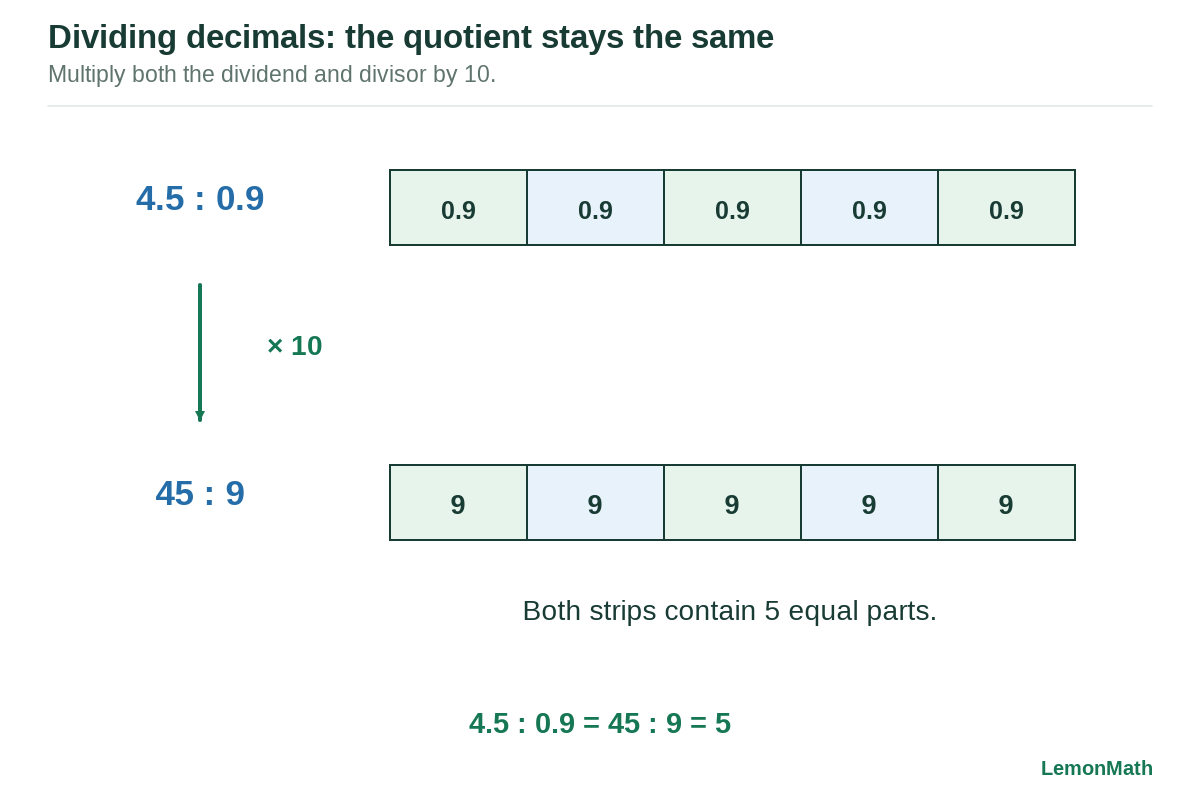
Why does this work? When you multiply both the dividend and the divisor by the same number other than , the quotient does not change. For example, is tenths and is tenths, so .
Connection. Division is the inverse of the multiplication you have just learnt, so you can check your answers by multiplying.
Examples
We start with dividing a decimal by a whole number.
When there is a remainder, write more digits 0 and keep dividing, and the quotient becomes a decimal.
Now dividing by a decimal by moving the decimal point.
Now a real-life problem, solved in four steps.
Next, a problem about finding the price of one unit.
Some divisions never end, so we round the quotient.
Key terms
Summary
- Dividing a decimal by a whole number: divide the whole-number part, write the decimal point in the quotient, then carry on dividing the decimal digits.
- If there is a remainder, write a digit 0 to the right of the remainder and carry on; the quotient may be a decimal.
- Dividing by a decimal: move the decimal point in both the dividend and the divisor to the right by the same number of places, then divide as by a whole number.
- You can round the quotient when the division does not end, and check by multiplying.
- Dividing by a number less than 1 gives a quotient greater than the dividend.
Practice
Each exercise comes with what you need and how to start. Try it yourself first, then open the solution.
Set out in columns and work out: a) 15.6\div4; b) 4.05\div5.
What you need: divide the whole-number part, write the decimal point in the quotient, then carry on with the decimal part.
Steps:
- Divide the whole-number part of the dividend by 4 and by 5.
- Write the decimal point, then bring down each digit of the decimal part to carry on dividing.
Show solution
a) 15\div4=3 (remainder 3), write the decimal point, bring down 6 to make 36, then 36\div4=9. So 15.6\div4=3.9.
b) 4\div5=0 (remainder 4), write 0 and the decimal point, bring down 0 to make 40, then 40\div5=8, bring down 5 to make 5, then 5\div5=1. So 4.05\div5=0.81.
Answer. a) 3.9; b) 0.81.
Work out: a) 7\div4; b) 18\div8; c) 5\div8.
What you need: when there is a remainder, write the decimal point in the quotient and write a digit 0 after the remainder to carry on dividing.
Steps:
- Divide the whole-number part and find the remainder.
- Write a digit 0 after the remainder and carry on until there is no remainder.
Show solution
a) 7\div4=1 (remainder 3); 30\div4=7 (remainder 2); 20\div4=5. So 7\div4=1.75.
b) 18\div8=2 (remainder 2); 20\div8=2 (remainder 4); 40\div8=5. So 18\div8=2.25.
c) 5\div8=0 (remainder 5); 50\div8=6 (remainder 2); 20\div8=2 (remainder 4); 40\div8=5. So 5\div8=0.625.
Answer. a) 1.75; b) 2.25; c) 0.625.
Work out: a) 6.3\div0.7; b) 9.6\div0.16; c) 15\div0.6.
What you need: move the decimal point in both the dividend and the divisor to the right by the same number of places, then divide.
Steps:
- Count the decimal places in the divisor.
- Move the decimal point in the dividend (write the digit 0 if there are not enough), then divide.
Show solution
When dividing a decimal by a decimal, we move the decimal points of the dividend and the divisor the same number of places to the right (that is, multiply both numbers by the same number), then divide as with whole numbers. The result does not change.
a) The divisor 0.7 has one decimal place, so we move the decimal point of both numbers one place to the right: 6.3\div0.7=63\div7=9
b) The divisor 0.16 has two decimal places, so we move the decimal point of both numbers two places to the right (the dividend 9.6 is written as 9.60): 9.6\div0.16=960\div16=60
c) The divisor 0.6 has one decimal place. We write the dividend 15 as 15.0, then move the decimal point one place to the right: 15\div0.6=150\div6=25
So the results are 9; 60; 25.
Answer. a) 9; b) 60; c) 25.
A piece of electric cable 12.6 m long is cut into 6 equal pieces. How many metres long is each piece?
What you need: sharing equally: use division.
Steps:
- What do we know? What is asked?
- Divide 12.6 by 6. Check by multiplying.
Show solution
Solution
The cable is cut into 6 equal pieces, so to find the length of each piece we divide the total length by 6. Each piece is: 12.6\div6=2.1\ \text{(m)}
Check. 2.1\times6=12.6. Correct.
So each piece of cable is 2.1 m long.
Answer. 2.1 m.
Suppose each bottle holds 0.75 litres of water and there are 9 litres of water to pour into bottles like this, filling each one. How many bottles can be filled?
What you need: to find how many equal parts an amount contains, divide the amount by the part.
Steps:
- What do we know? What is asked?
- Divide 9 by 0.75 by moving the decimal point.
Show solution
Solution
To find how many bottles can be filled, we divide the number of litres of water by the number of litres in each bottle. The number of bottles that can be filled is: 9\div0.75=900\div75=12\ \text{(bottles)} (We move the decimal point of both numbers two places to the right; 9 is written as 9.00.)
Check. 12\times0.75=9. Correct.
So 12 bottles can be filled.
Answer. 12 bottles.
Suppose 3.5 kg of apples costs 87\,500 dong. How much does 1 kg of apples cost?
What you need: the price of 1 kg is the total cost divided by the number of kilograms.
Steps:
- What do we know? What is asked?
- Divide 87\,500 by 3.5. Remember the unit.
Show solution
Solution
To find the price of 1 kg of apples, we divide the total cost by the number of kilograms. The price of 1 kg of apples is: 87\,500\div3.5=875\,000\div35=25\,000\ \text{(dong)} (We move the decimal point of both numbers one place to the right.)
Check. 25\,000\times3.5=87\,500. Correct.
So 1 kg of apples costs 25\,000 dong.
Answer. 25\,000 dong.
Remember the lesson on multiplying decimals. Find the number x such that x\times2.5=12, then check by multiplying.
What you need: to find a factor, divide the product by the other factor.
Steps:
- Write x=12\div2.5.
- Move the decimal point to divide, then multiply x by 2.5 to check.
Show solution
In the multiplication x\times2.5=12, x is an unknown factor. To find a factor, we divide the product by the other factor: x=12\div2.5
Moving the decimal point of both numbers one place to the right, we get x=120\div25=4.8
Check. 4.8\times2.5=12. Correct.
So x=4.8.
Answer. x=4.8.
Divide 17\div6, then round the quotient to one decimal place and to two decimal places.
What you need: to round to a place, look at the digit immediately to the right of that place.
Steps:
- Divide 17\div6 to a few decimal places.
- Round from the full quotient, not from an already rounded result.
Show solution
We divide 17 by 6. We have 17\div6=2 remainder 5. Writing a 0 after the remainder and continuing: 50\div6=8 remainder 2; 20\div6=3 remainder 2; 20\div6=3 remainder 2; \ldots The digit 3 repeats, so 17\div6=2.8333\ldots
To one decimal place: the hundredths digit is 3<5, so we keep the tenths digit. We get 2.8.
To two decimal places: the thousandths digit is 3<5, so we keep the hundredths digit. We get 2.83.
So the quotient is 2.8 to one decimal place and 2.83 to two decimal places.
Answer. 2.8 and 2.83.
A piece of string 5 m long is cut into pieces 0.4 m long. What is the greatest number of pieces 0.4 m long that can be cut?
What you need: the number of pieces is a whole number, so we use only the whole-number part of the quotient.
Steps:
- Divide 5 by 0.4.
- Think about what the whole-number part of the quotient tells you.
Show solution
Solution
To find how many pieces 0.4 m long can be cut, we divide the length of the string by 0.4: 5\div0.4=50\div4=12.5
The quotient 12.5 means there are 12 full pieces of length 0.4 m and a small part that is not enough for another piece. The number of pieces must be a whole number, so we take the whole-number part 12.
Check. 12\times0.4=4.8\le5 and 13\times0.4=5.2>5. Correct.
So the greatest number of pieces 0.4 m long that can be cut is 12.
Answer. 12 pieces.
Work out in the easy way: 12.5\div0.25\div4.
What you need: dividing by two numbers in turn is the same as dividing by their product: a\div b\div c=a\div(b\times c).
Steps:
- Work out 0.25\times4.
- Divide 12.5 by that result.
Show solution
We notice that 0.25\times4=1. Dividing successively by two numbers is the same as dividing by their product, so we work out the product 0.25\times4 first: 12.5\div0.25\div4=12.5\div(0.25\times4)=12.5\div1=12.5
So 12.5\div0.25\div4=12.5.
Answer. 12.5.
Mini test
Marked like the Vietnamese graduation exam: Part I 0.25 points per question; Part II up to 1 point per question (1, 2, 3, 4 correct statements give 0.1, 0.25, 0.5, 1 point); Part III 0.5 points per question.
Part I. Multiple choice
15\div4=3 (remainder 3), write the decimal point, bring down 6 to make 36 and 36\div4=9, so the quotient is 3.9. Option A forgets the decimal point; B puts the decimal point in the wrong place; D adds an extra digit 0.
3<6, so the tenths digit of the quotient is 0, then 36\div6=6, so the quotient is 0.06. Option B leaves out the digit 0; C adds an extra digit 0; D forgets the decimal point.
7.35\div1.5=73.5\div15=4.9. Option A moves the decimal point only in the dividend (73.5\div1.5); B moves it only in the divisor (7.35\div15); C moves it the wrong number of places.
187\,500\div2.5=75\,000 dong. Options A and B have the wrong number of digits 0; D is the multiplication 187\,500\times2.5.
Part II. True or false
| a) 9\div4=2.5. | ||
| b) 9 is divisible by 4, so the quotient is a whole number. | ||
| c) 9\div4=2.25. | ||
| d) The quotient of this division is less than 9. |
a) False: 9\div4=2 (remainder 1), 10\div4=2 (remainder 2), 20\div4=5, so the quotient is 2.25. b) False: 9 is not divisible by 4. c) True. d) True: 2.25<9 because we divide by a number greater than 1.
Part III. Short answer
12\div0.25=1200\div25=48.
6\div8=0 (remainder 6), 60\div8=7 (remainder 4), 40\div8=5, so the quotient is 0.75.
Show answers and explanations
- Part I, question 1: D. 15\div4=3 (remainder 3), write the decimal point, bring down 6 to make 36 and 36\div4=9, so the quotient is 3.9. Option A forgets the decimal point; B puts the decimal point in the wrong place; D adds an extra digit 0.
- Part I, question 2: A. 3<6, so the tenths digit of the quotient is 0, then 36\div6=6, so the quotient is 0.06. Option B leaves out the digit 0; C adds an extra digit 0; D forgets the decimal point.
- Part I, question 3: B. 7.35\div1.5=73.5\div15=4.9. Option A moves the decimal point only in the dividend (73.5\div1.5); B moves it only in the divisor (7.35\div15); C moves it the wrong number of places.
- Part I, question 4: C. 187\,500\div2.5=75\,000 dong. Options A and B have the wrong number of digits 0; D is the multiplication 187\,500\times2.5.
- Part II, question 1: a) False; b) False; c) True; d) True. a) False: 9\div4=2 (remainder 1), 10\div4=2 (remainder 2), 20\div4=5, so the quotient is 2.25. b) False: 9 is not divisible by 4. c) True. d) True: 2.25<9 because we divide by a number greater than 1.
- Part III, question 1: 48. 12\div0.25=1200\div25=48.
- Part III, question 2: 0.75. 6\div8=0 (remainder 6), 60\div8=7 (remainder 4), 40\div8=5, so the quotient is 0.75.