Multiplying decimals
🖨 Print a self-study sheet Why print?
Mum buys bags of rice, each with mass kg. How many kilograms of rice does she buy altogether?
To find out, you have to multiply by . This lesson shows you how to multiply decimals and place the decimal point in the product correctly.
Let's explore
Write kg as kg. Three bags of rice have mass:
Notice that , and has one decimal place because has one decimal place. Set it out in columns:
Now let us multiply two decimals. A rectangular piece of card m long and m wide has area:
This time , and the product has two decimal places, the total number of decimal places in the two factors ().
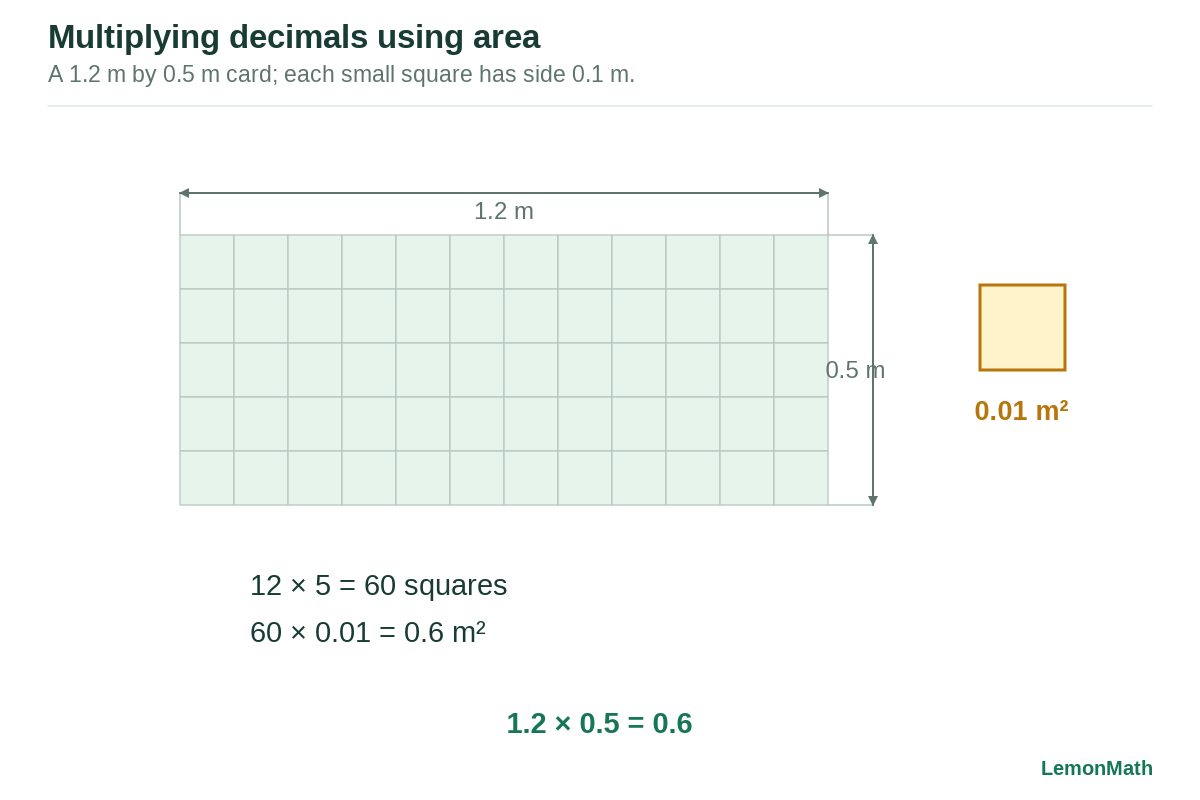
This works because : the denominators are multiplied, so the numbers of decimal places add up.
Connection. Multiplication uses the decimal fractions and the way of writing decimals from the earlier lessons. It also prepares you for dividing decimals and for multiplying by , and .
Examples
We start with multiplying a decimal by a whole number.
Next, multiplying two decimals, with a case where the product has too few digits.
The commutative and associative properties also work for decimals.
Now a real-life problem about area, solved in four steps.
Finally, a problem about money.
Multiplying by a number less than 1 makes the product smaller, and you can tell without calculating.
Key terms
Summary
- To multiply decimals, ignore the decimal points, multiply as with whole numbers, then place the decimal point in the product.
- The product has as many decimal places as the total number of decimal places in the factors; if there are too few digits, write the digit 0 on the left.
- Remove any digits 0 at the end of the decimal part of the product.
- The commutative and associative properties help you calculate quickly: 0.25\times4=1.
- Multiplying by a number less than 1 gives a product smaller than the other factor; multiplying by a number greater than 1 gives a greater product.
Practice
Each exercise comes with what you need and how to start. Try it yourself first, then open the solution.
Set out in columns and work out: a) 3.4\times2; b) 0.45\times6.
What you need: ignore the decimal point, multiply as with whole numbers, then place the decimal point in the product.
Steps:
- Work out 34\times2 and 45\times6.
- Count the decimal places of the decimal factor, place the decimal point, and remove any extra digits 0.
Show solution
To multiply a decimal by a whole number, we set out the calculation in columns and multiply as with whole numbers. Then we count the digits after the decimal point in the decimal, and put the decimal point in the product so that it has the same number of digits after it.
a) In columns: \begin{array}{r}3.4\\\times\quad2\\\hline6.8\end{array} Multiply as whole numbers: 34\times2=68. The factor 3.4 has one decimal place, so the product has one decimal place: 3.4\times2=6.8.
b) In columns: \begin{array}{r}0.45\\\times\quad6\\\hline2.70\end{array} Multiply as whole numbers: 45\times6=270. The factor 0.45 has two decimal places, so the product has two decimal places: 2.70. Dropping the final zero gives 2.7.
Check by adding: 3.4+3.4=6.8.
So 3.4\times2=6.8 and 0.45\times6=2.7.
Answer. a) 6.8; b) 2.7.
Work out: a) 2.5\times1.6; b) 0.8\times0.35; c) 12.3\times0.04; d) 0.05\times0.06.
What you need: the number of decimal places in the product is the total number of decimal places in the two factors.
Steps:
- Multiply the two numbers, ignoring the decimal points.
- Count the total decimal places; write the digit 0 on the left if there are not enough.
Show solution
To multiply two decimals, we multiply as with whole numbers, then count the decimal places in both factors altogether and give the product that many decimal places.
a) 25\times16=400. The factors 2.5 and 1.6 have 1+1=2 decimal places in total, so the product is 4.00=4.
b) 8\times35=280. The factors 0.8 and 0.35 have 1+2=3 decimal places in total, so the product is 0.280=0.28.
c) 123\times4=492. The factors 12.3 and 0.04 have 1+2=3 decimal places in total, so the product is 0.492.
d) 5\times6=30. The factors 0.05 and 0.06 have 2+2=4 decimal places in total. The product 30 has only two digits, so we write zeros on the left to make four places: 0.0030=0.003.
So a) 4; b) 0.28; c) 0.492; d) 0.003.
Answer. a) 4; b) 0.28; c) 0.492; d) 0.003.
Work out in the easy way: 0.4\times3.7\times2.5.
What you need: swapping and grouping the factors does not change the product.
Steps:
- Find two factors whose product is a round number.
- Group those two, then multiply by the remaining number.
Show solution
We notice that 0.4\times2.5=1.00=1 (because 4\times25=100 and the two factors have two decimal places in total).
Using the commutative and associative properties of multiplication, we change the order to group 0.4 with 2.5: \begin{aligned}0.4\times3.7\times2.5&=(0.4\times2.5)\times3.7\\&=1\times3.7\\&=3.7.\end{aligned}
So 0.4\times3.7\times2.5=3.7.
Answer. 3.7.
Each bottle holds 1.5 litres of water. How many litres do 8 bottles like this hold?
What you need: several equal bottles put together: use multiplication.
Steps:
- What do we know? What is asked?
- Multiply 1.5 by 8. Check: the result must be greater than 1.5.
Show solution
Solution
Each bottle holds 1.5 litres and there are 8 such bottles, so we multiply 1.5 by 8. As whole numbers: 15\times8=120; the factor 1.5 has one decimal place, so the product is 12.0=12.
The number of litres of water in 8 bottles is: 1.5\times8=12\ \text{(litres)}.
So 8 bottles hold 12 litres.
Answer. 12 litres.
Suppose each metre of electric cable costs 12\,500 dong. How much does 3.4 m of cable cost?
What you need: cost = price per metre times the number of metres.
Steps:
- What do we know? What is asked?
- Multiply 12\,500 by 3.4. Remember the unit.
Show solution
Solution
Each metre costs 12\,500 dong and we buy 3.4 m, so we multiply the price of one metre by the number of metres. As whole numbers: 12\,500\times34=425\,000; the factor 3.4 has one decimal place, so the product is 42\,500.0=42\,500.
The cost of the cable is: 12\,500\times3.4=42\,500\ \text{(dong)}.
So 3.4 m of cable costs 42\,500 dong.
Answer. 42\,500 dong.
A rectangular sheet of glass is 6.5 m long and 3.2 m wide. Find the area of the sheet of glass.
What you need: the area of a rectangle is the length times the width.
Steps:
- Are the two measurements in the same unit, metres?
- Multiply the two numbers, then write the unit as square metres.
Show solution
Solution
The area of a rectangle is its length times its width (in the same unit). As whole numbers: 65\times32=2080; the two factors have two decimal places in total, so the product is 20.80=20.8.
The area of the sheet of glass is: 6.5\times3.2=20.8\ \text{(m}^2\text{)}.
So the area of the sheet of glass is 20.8\ \text{m}^2.
Answer. 20.8\ \text{m}^2.
Without calculating, write >, < or = in the gap: a) 15\times0.9\ \ldots\ 15; b) 0.7\times1.1\ \ldots\ 0.7; c) 2.5\times1\ \ldots\ 2.5.
What you need: multiplying by a number less than 1 makes the product smaller, by a number greater than 1 makes it greater, and by 1 leaves it unchanged.
Steps:
- Compare the second factor with 1.
- Decide whether the product is greater than, less than or equal to the other factor.
Show solution
We compare the second number in each product with 1: multiplying a number (other than 0) by a number less than 1 gives a result less than that number; multiplying by a number greater than 1 gives a greater result; multiplying by 1 leaves it unchanged.
a) Since 0.9<1, we have 15\times0.9<15. We write <.
b) Since 1.1>1, we have 0.7\times1.1>0.7. We write >.
c) Any number multiplied by 1 equals itself, so 2.5\times1=2.5. We write =.
So a) 15\times0.9<15; b) 0.7\times1.1>0.7; c) 2.5\times1=2.5.
Answer. a) <; b) >; c) =.
Remember the lesson on square kilometres and hectares. A field is a rectangle 1.25 km long and 0.8 km wide. Find the area of the field in square kilometres and in hectares.
What you need: 1\ \text{km}^2=100 ha.
Steps:
- Multiply the length by the width (both in kilometres).
- Change the result into hectares.
Show solution
Solution
The length and the width are both in kilometres, so the area is in square kilometres. As whole numbers: 125\times8=1000; the two factors have three decimal places in total, so the product is 1.000=1.
The area of the field is: 1.25\times0.8=1\ \text{(km}^2\text{)}.
Change to hectares: since 1\ \text{km}^2=100 ha, the area of the field is 100 ha.
So the area of the field is 1\ \text{km}^2, which is 100 ha.
Answer. 1\ \text{km}^2, which is 100 ha.
Work out quickly: 0.125\times0.25\times32.
What you need: 0.125\times8=1 and 0.25\times4=1.
Steps:
- Write 32=8\times4.
- Group the factors to make round products.
Show solution
We look for pairs that multiply to a round number: 0.125\times8=1 and 0.25\times4=1. Since 32=8\times4, we split 32 into 8\times4.
Using the commutative and associative properties of multiplication: \begin{aligned}0.125\times0.25\times32&=0.125\times0.25\times8\times4\\&=(0.125\times8)\times(0.25\times4)\\&=1\times1\\&=1.\end{aligned}
So 0.125\times0.25\times32=1.
Answer. 1.
Mini test
Marked like the Vietnamese graduation exam: Part I 0.25 points per question; Part II up to 1 point per question (1, 2, 3, 4 correct statements give 0.1, 0.25, 0.5, 1 point); Part III 0.5 points per question.
Part I. Multiple choice
28\times7=196 and 0.28 has two decimal places, so the product is 1.96. Option B uses only one decimal place; C forgets the decimal point; D uses three decimal places.
42\times13=546 and the two factors have 1+1=2 decimal places, so the product is 5.46. Option A multiplies the parts separately; B uses only one decimal place; C uses three decimal places.
6\times5=30 and the two factors have 1+2=3 decimal places, so the product is 0.030=0.03. Option A uses only two decimal places; B uses four decimal places; D forgets the decimal point.
45\,000\times2.5=112\,500 dong. Options B and C put the decimal point in the wrong place; D only works out the cost of 2 m of cloth (45\,000\times2).
Part II. True or false
| a) 1.2\times0.5=6. | ||
| b) 1.2\times0.5=0.6. | ||
| c) The product is greater than 1.2. | ||
| d) 1.2\times0.5=0.5\times1.2. |
a) False: 12\times5=60 and the product has two decimal places, so it equals 0.60=0.6. b) True. c) False: 0.5<1, so the product is less than 1.2. d) True: swapping the factors does not change the product.
Part III. Short answer
25\times16=400, with two decimal places in total, so the product is 4.00=4.
0.3\times0.3: 3\times3=9 and there are two decimal places in total, so the product is 0.09 (\text{m}^2).
Show answers and explanations
- Part I, question 1: A. 28\times7=196 and 0.28 has two decimal places, so the product is 1.96. Option B uses only one decimal place; C forgets the decimal point; D uses three decimal places.
- Part I, question 2: B. 42\times13=546 and the two factors have 1+1=2 decimal places, so the product is 5.46. Option A multiplies the parts separately; B uses only one decimal place; C uses three decimal places.
- Part I, question 3: C. 6\times5=30 and the two factors have 1+2=3 decimal places, so the product is 0.030=0.03. Option A uses only two decimal places; B uses four decimal places; D forgets the decimal point.
- Part I, question 4: D. 45\,000\times2.5=112\,500 dong. Options B and C put the decimal point in the wrong place; D only works out the cost of 2 m of cloth (45\,000\times2).
- Part II, question 1: a) False; b) True; c) False; d) True. a) False: 12\times5=60 and the product has two decimal places, so it equals 0.60=0.6. b) True. c) False: 0.5<1, so the product is less than 1.2. d) True: swapping the factors does not change the product.
- Part III, question 1: 4. 25\times16=400, with two decimal places in total, so the product is 4.00=4.
- Part III, question 2: 0.09. 0.3\times0.3: 3\times3=9 and there are two decimal places in total, so the product is 0.09 (\text{m}^2).