Volume of a cuboid
🖨 Print a self-study sheet Why print?
Mai has a box in the shape of a cuboid. It is cm long, cm wide and cm high. Mai wants to fill it with small cubes, each with edges of cm. How many cubes does she need?
You could pack the cubes and count them one by one, and that would give the right answer. But what if the box were much bigger? Counting would take ages. There is a quicker way: you only need the three measurements of the box. Let's find it.
Let's explore
First we need a way to measure how much space the box holds. Each small cube with edges of cm has a volume of cm³. If some number of these cubes fill the box, the volume is that many cm³. So the number of cubes that fill the box is the volume of the box, in cm³.
Mai builds it up one layer at a time, starting from the bottom:
- The bottom layer covers the base of the box: cubes along the length and rows along the width. This layer has cubes.
- The box is cm high, so there are layers exactly like this.
- Every layer has the same number of cubes, so the number of cubes is .
So the box has a volume of cm³. Notice that . The number of cubes is just the three measurements of the box multiplied together. That is no accident, and we will see why in a moment.
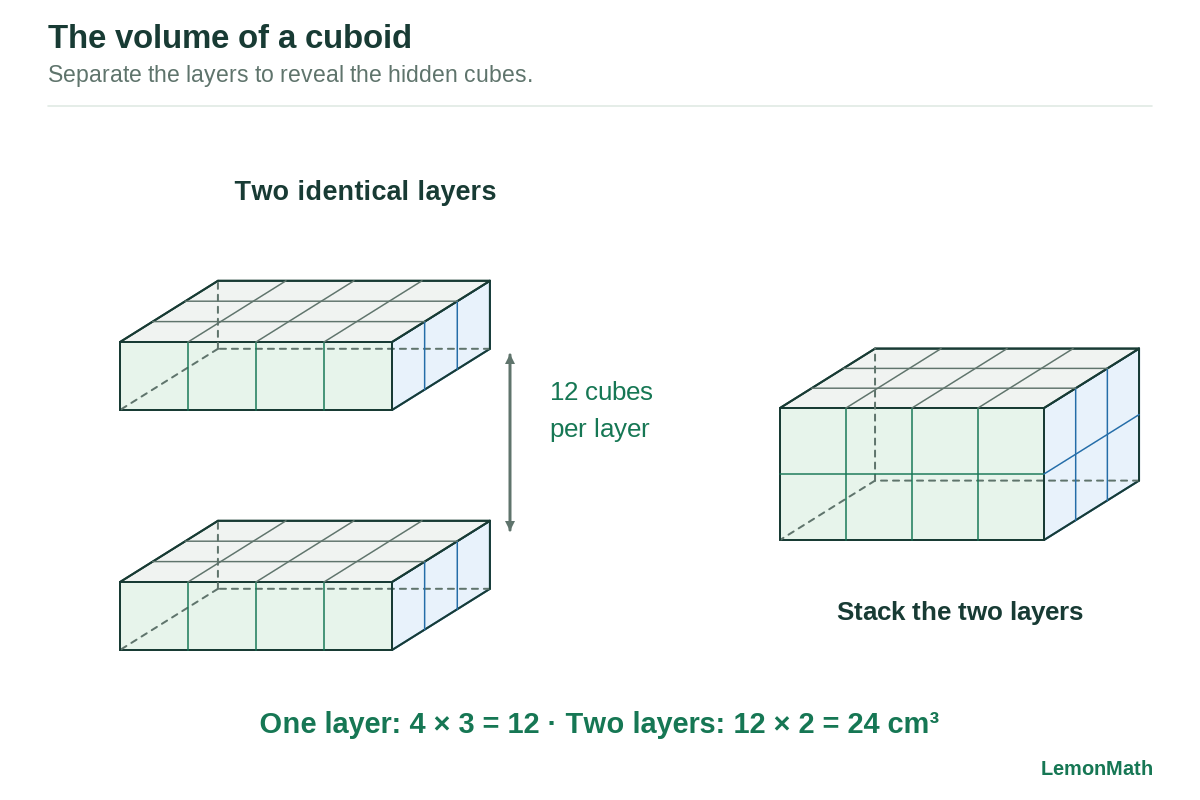
Why does the rule work? The bottom layer has cubes, which is also the base area. The box has layers like that, so the number of cubes is a\times b\times c. Here is another way to remember it: volume is base area times height. That will help us in the last example.
Examples
We start with the easiest case: a cuboid whose three measurements are in the same unit, so we just multiply the three numbers.
The rule is not only for boxes. A classroom is a cuboid too, so let's work out how much air it holds.
Sometimes the measurements come in different units. This is where many people slip: if you multiply straight away, the answer will be wrong, because the three numbers must be in the same unit. Change them to one unit first, then calculate.
Finally, let's work backwards. If you know the volume and two of the measurements, can you find the third? You can, because volume is base area times height.
Key terms
Summary
- Volume of a cuboid: V=a\times b\times c (length × width × height).
- The three measurements must be in the same unit. If they are not, change them before you calculate.
- Units of volume are cm³, dm³, m³.
- Volume is base area times height, so height is volume divided by base area. Back to Mai's question: multiply the three measurements of the box and you know the number of cubes without packing a single one. Remember just one thing: change everything to the same unit, then multiply. Try a few practice questions to make it stick.
Practice
Each exercise comes with a reminder of what you need and a hint to get started. Try it yourself first, and do not worry if you go wrong. Then open the solution.
Find the volume of a cuboid 7 cm long, 3 cm wide and 4 cm high.
What you need: V=a\times b\times c.
Steps:
- Write the product of the three measurements.
- Multiply step by step, then write the unit cm³.
Show solution
Solution
The volume of a cuboid is its length times its width times its height.
The volume of the cuboid is: 7\times3\times4=21\times4=84\ (\text{cm}^3)
So the volume of the cuboid is 84 cm³.
Answer. 84 cm³.
Find the volume of a cuboid 10 cm long, 5 cm wide and 2 cm high.
What you need: V=a\times b\times c.
Steps:
- Work out 10\times5 first.
- Multiply the result by 2.
Show solution
Solution
The volume of a cuboid is its length times its width times its height.
The volume of the cuboid is: 10\times5\times2=50\times2=100\ (\text{cm}^3)
So the volume of the cuboid is 100 cm³.
Answer. 100 cm³.
Find the volume of a cuboid 12 dm long, 5 dm wide and 3 dm high.
What you need: the measurements are all in dm, so the volume is in dm³.
Steps:
- Work out 12\times5.
- Multiply the result by 3 and write the unit dm³.
Show solution
Solution
The volume of a cuboid is its length times its width times its height.
The volume of the cuboid is: 12\times5\times3=60\times3=180\ (\text{dm}^3)
So the volume of the cuboid is 180 dm³.
Answer. 180 dm³.
Ha's pencil case is a cuboid 18 cm long, 6 cm wide and 4 cm high. What is the volume of the pencil case in cubic centimetres?
What you need: volume of a cuboid is length × width × height.
Steps:
- What do we know? The three measurements of the case. What is asked? The volume.
- Work out 18\times6\times4 and write the answer with its unit.
Show solution
Solution
The pencil case is a cuboid, so its volume is its length times its width times its height.
The volume of the pencil case is: 18\times6\times4=108\times4=432\ (\text{cm}^3)
So the volume of the pencil case is 432 cubic centimetres.
Answer. 432 cm³.
A fish tank is a cuboid 1 m long, 6 dm wide and 5 dm high. Find the volume of the tank in dm³.
What you need: 1 m =10 dm. The three measurements must be in the same unit.
Steps:
- Change the length to dm.
- Multiply the three measurements and write the unit dm³.
Show solution
Solution
All the measurements must be in the same unit, decimetres. Change 1 m =10 dm.
The volume of the tank is: 10\times6\times5=60\times5=300\ (\text{dm}^3)
So the volume of the tank is 300 dm³.
Answer. 300 dm³.
Remember the last lesson: a cube has edges of 4 cm. Find its lateral surface area and its total surface area.
What you need: the area of one face is edge × edge. The lateral surface has 4 faces and the total surface has 6 faces.
Steps:
- Work out the area of one face.
- Multiply by 4 for the lateral surface area, and by 6 for the total surface area.
Show solution
Solution
A cube has 6 equal square faces; the 4 side faces make up the lateral surface.
The area of one face is: 4\times4=16\ (\text{cm}^2)
The lateral surface area of the cube is: 16\times4=64\ (\text{cm}^2)
The total surface area of the cube is: 16\times6=96\ (\text{cm}^2)
So the lateral surface area is 64 cm² and the total surface area is 96 cm².
Answer. Lateral surface area 64 cm², total surface area 96 cm².
A cuboid has volume 120 cm³, length 8 cm and width 5 cm. Find its height.
What you need: height is the volume divided by the base area.
Steps:
- Work out the base area 8\times5.
- Divide 120 by the base area.
Show solution
Solution
The volume equals the base area times the height, so the height equals the volume divided by the base area.
The base area of the cuboid is: 8\times5=40\ (\text{cm}^2)
The height of the cuboid is: 120\div40=3\ (\text{cm})
Check: 8\times5\times3=120 (cm³), as required.
So the height of the cuboid is 3 cm.
Answer. 3 cm.
A crate is a cuboid 40 cm long, 30 cm wide and 20 cm high. You pack small cuboid boxes, each 10 cm long, 10 cm wide and 5 cm high, into the crate with no gaps until it is full. What is the greatest number of small boxes that fit?
What you need: the small boxes fill the crate, so the volume of the crate equals the total volume of the small boxes.
Steps:
- Work out the volume of the crate and the volume of one small box.
- Divide the volume of the crate by the volume of one small box.
Show solution
Solution
Since the small boxes fit exactly with no gaps, the number of small boxes equals the volume of the crate divided by the volume of one small box.
The volume of the crate is: 40\times30\times20=24\,000\ (\text{cm}^3)
The volume of one small box is: 10\times10\times5=500\ (\text{cm}^3)
The number of small boxes is: 24\,000\div500=48\ (\text{boxes})
Check: along the length there are 40\div10=4 boxes, along the width 30\div10=3 boxes, and in height 20\div5=4 layers. The number of boxes is 4\times3\times4=48, which is correct.
So the greatest number of small boxes that fit is 48.
Answer. 48 boxes.
Mini test
Marked like the Vietnamese graduation exam: Part I 0.25 points per question; Part II up to 1 point per question (1, 2, 3, 4 correct statements give 0.1, 0.25, 0.5, 1 point); Part III 0.5 points per question.
Part I. Multiple choice
5\times4\times3=60 (cm³). Option D has the wrong unit, B adds the three numbers, and C forgets the height.
Change 3 dm =30 cm, so 30\times20\times10=6000 (cm³). Option C is the mistake of not changing the unit.
The base area is 8\times4=32 (cm²), so the height is 96\div32=3 (cm). Options B and A divide by only one measurement, and D subtracts.
The volumes are 36, 48, 32 and 12 (cm³). Option B has the greatest sum of measurements, but the smallest volume.
Part II. True or false
| a) The volume of the box is 120 cm³. | ||
| b) The volume of the box is 6+5+4=15 cm³. | ||
| c) If the length and width stay the same and the height becomes 8 cm, the volume is 240 cm³. | ||
| d) You can say the volume of the box is 120 cm². |
a) True: 6\times5\times4=120. b) False: you must multiply, not add. c) True: 6\times5\times8=240. d) False: the unit of volume is cm³, not cm².
Part III. Short answer
9\times5\times4=45\times4=180 (cm³).
The number of cubes equals the volume of the box: 5\times3\times2=30 (cubes).
Show answers and explanations
- Part I, question 1: A. 5\times4\times3=60 (cm³). Option D has the wrong unit, B adds the three numbers, and C forgets the height.
- Part I, question 2: B. Change 3 dm =30 cm, so 30\times20\times10=6000 (cm³). Option C is the mistake of not changing the unit.
- Part I, question 3: C. The base area is 8\times4=32 (cm²), so the height is 96\div32=3 (cm). Options B and A divide by only one measurement, and D subtracts.
- Part I, question 4: D. The volumes are 36, 48, 32 and 12 (cm³). Option B has the greatest sum of measurements, but the smallest volume.
- Part II, question 1: a) True; b) False; c) True; d) False. a) True: 6\times5\times4=120. b) False: you must multiply, not add. c) True: 6\times5\times8=240. d) False: the unit of volume is cm³, not cm².
- Part III, question 1: 180. 9\times5\times4=45\times4=180 (cm³).
- Part III, question 2: 30. The number of cubes equals the volume of the box: 5\times3\times2=30 (cubes).