Circles. Circumference and area of a circle
🖨 Print a self-study sheet Why print?
Suppose the bicycle wheel of your friend Nam has diameter m. When the wheel rolls once along the road, the bicycle travels exactly the length of the outline of the wheel.
How far does the bicycle travel when the wheel rolls once? And how far does it travel when the wheel rolls times?
Let's explore
Take a piece of thread and wrap it exactly once round three round objects, then measure the length of the thread. Suppose the results are as follows (rounded):
| Diameter | Circumference (length of thread) | Circumference ÷ diameter |
|---|---|---|
| cm | cm | |
| cm | cm | |
| cm | cm |
Whether the object is big or small, the circumference divided by the diameter always gives about the same number. That number is called pi (written ), and in this lesson we use .
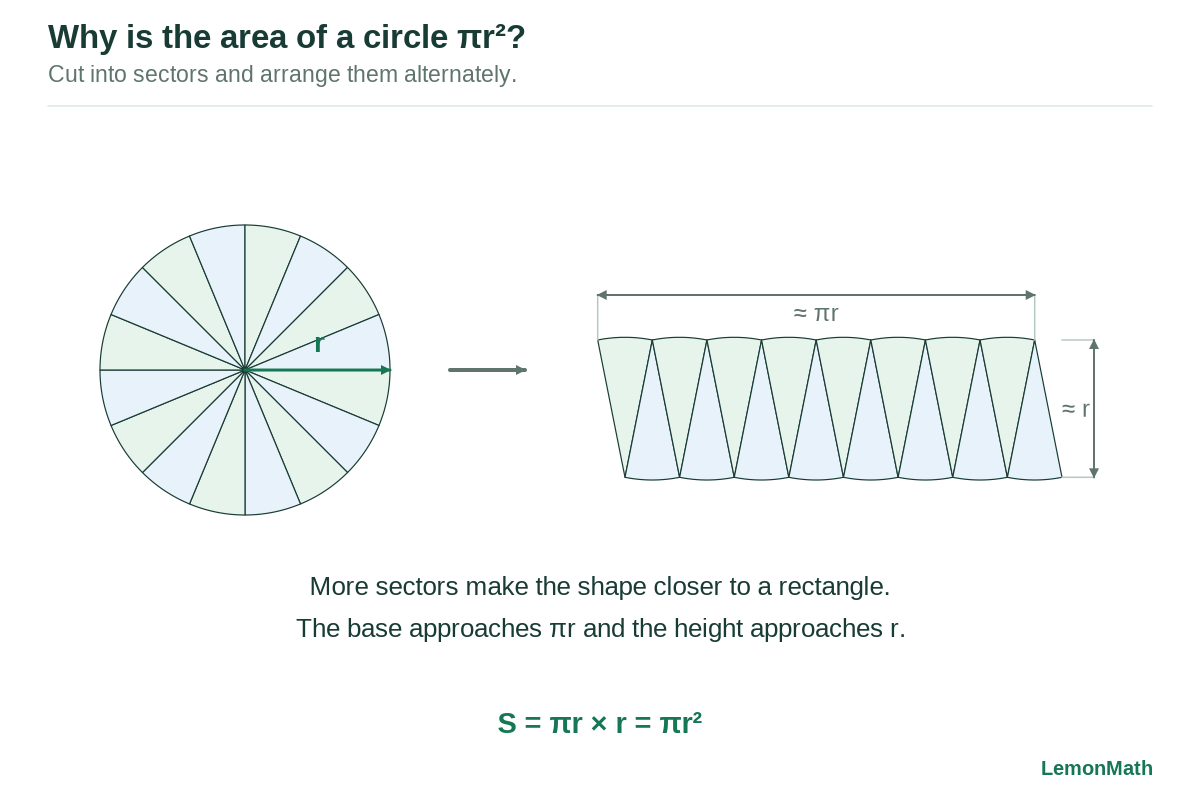
Why does this work? The circumference formula is just how we define \pi: the circumference divided by the diameter is always \pi\approx3.14. For the area, cut the disc into many small sectors and place them side by side, alternately upside down, and you get a shape close to a rectangle whose length is half the circumference, that is, r\times3.14, and whose width is r. The area is r\times3.14\times r.
Connection. The number \pi\approx3.14 is a decimal, so you use the multiplication and division of decimals and the rounding you have learnt.
Examples
We start with radius and diameter.
Next, the circumference.
Now the area; remember to change the diameter into the radius.
If you know the circumference, you can find the diameter.
Now back to Nam's bicycle wheel, solved in four steps.
Finally, a problem about area.
Key terms
Summary
- The diameter is d=r\times2; the diameter is twice the radius.
- Circumference of a circle: C=d\times3.14=r\times2\times3.14.
- Area of a circle: S=r\times r\times3.14 (use the radius).
- If you know the circumference, the diameter is the circumference divided by 3.14.
- The number \pi\approx3.14 is an approximation; round your answer if the question asks you to.
Practice
Each exercise comes with what you need and how to start. Try it yourself first, then open the solution.
Find the missing numbers:
a) A radius of 7 cm means a diameter of ? cm; b) a diameter of 1.6 m means a radius of ? m; c) a radius of 2.5 dm means a diameter of ? dm.
What you need: the diameter is twice the radius.
Steps:
- Multiply the radius by 2 to get the diameter.
- Divide the diameter by 2 to get the radius.
Show solution
The diameter is twice the radius. So to find the diameter we multiply the radius by 2, and to find the radius we divide the diameter by 2.
a) A radius of 7 cm gives a diameter of: 7\times2=14\ \text{(cm)}
b) A diameter of 1.6 m gives a radius of: 1.6\div2=0.8\ \text{(m)}
c) A radius of 2.5 dm gives a diameter of: 2.5\times2=5\ \text{(dm)}
So the missing numbers are: a) 14 cm; b) 0.8 m; c) 5 dm.
Answer. a) 14; b) 0.8; c) 5.
Find the circumference of the circle with: a) diameter 5 cm; b) radius 3 cm; c) diameter 0.4 m.
What you need: C=d\times3.14 or C=r\times2\times3.14.
Steps:
- Decide whether you are given the diameter or the radius.
- Multiply by 3.14 (and by 2 first if it is the radius).
Show solution
To find the circumference of a circle, we multiply the diameter by 3.14. If we know the radius, we multiply it by 2 to get the diameter, then multiply by 3.14.
a) The circumference of the circle with diameter 5 cm is: 5\times3.14=15.7\ \text{(cm)}
b) A circle with radius 3 cm has diameter 3\times2=6 cm. Its circumference is: 3\times2\times3.14=18.84\ \text{(cm)}
c) The circumference of the circle with diameter 0.4 m is: 0.4\times3.14=1.256\ \text{(m)}
So the circumferences are 15.7 cm, 18.84 cm and 1.256 m.
Answer. a) 15.7 cm; b) 18.84 cm; c) 1.256 m.
Find the area of the circle with: a) radius 3 cm; b) diameter 10 dm; c) radius 1.5 m.
What you need: S=r\times r\times3.14.
Steps:
- Find the radius (part b: divide the diameter by 2).
- Multiply the radius by itself, then by 3.14.
Show solution
To find the area of a circle, we multiply the radius by the radius, then by 3.14. If we know the diameter, we first divide it by 2 to find the radius.
a) The area of the circle with radius 3 cm is: 3\times3\times3.14=28.26\ \left(\text{cm}^2\right)
b) The radius of the circle is 10\div2=5 dm. The area of the circle is: 5\times5\times3.14=78.5\ \left(\text{dm}^2\right)
c) We have 1.5\times1.5=2.25. The area of the circle with radius 1.5 m is: 2.25\times3.14=7.065\ \left(\text{m}^2\right)
So the areas are 28.26\ \text{cm}^2, 78.5\ \text{dm}^2 and 7.065\ \text{m}^2.
Answer. a) 28.26\ \text{cm}^2; b) 78.5\ \text{dm}^2; c) 7.065\ \text{m}^2.
Find the diameter and the radius of the circle with circumference: a) 31.4 cm; b) 25.12 m.
What you need: d=C\div3.14 and r=d\div2.
Steps:
- Divide the circumference by 3.14 by moving the decimal point.
- Divide the diameter by 2.
Show solution
Since the circumference equals the diameter times 3.14, to find the diameter we divide the circumference by 3.14. Then the radius is the diameter divided by 2.
a) The diameter of the circle with circumference 31.4 cm is: 31.4\div3.14=10\ \text{(cm)} The radius of the circle is: 10\div2=5\ \text{(cm)}
b) The diameter of the circle with circumference 25.12 m is: 25.12\div3.14=8\ \text{(m)} The radius of the circle is: 8\div2=4\ \text{(m)}
So the circle in a) has diameter 10 cm and radius 5 cm, and the circle in b) has diameter 8 m and radius 4 m.
Answer. a) d=10 cm, r=5 cm; b) d=8 m, r=4 m.
Suppose Lan's bicycle wheel has diameter 0.65 m. How far does the bicycle travel when the wheel rolls 10 times?
What you need: each time the wheel rolls once, the bicycle travels a distance equal to the circumference of the wheel.
Steps:
- Find the circumference of the wheel.
- Multiply it by 10 by moving the decimal point.
Show solution
Solution
In each roll, the bicycle travels a distance equal to the circumference of the wheel. The circumference of the wheel is: 0.65\times3.14=2.041\ \text{(m)}
The distance travelled when the wheel rolls 10 times is: 2.041\times10=20.41\ \text{(m)}
So the bicycle travels 20.41 m when the wheel rolls 10 times.
Answer. 20.41 m.
Suppose a round pond has radius 20 m. Find the circumference and the area of the pond.
What you need: C=r\times2\times3.14 and S=r\times r\times3.14.
Steps:
- You are given the radius, so find the circumference with r\times2\times3.14.
- Find the area with r\times r\times3.14.
Show solution
Solution
The pond is a circle with radius 20 m. The circumference of the pond is: 20\times2\times3.14=125.6\ \text{(m)}
The area of the pond is: 20\times20\times3.14=1256\ \left(\text{m}^2\right)
So the circumference of the pond is 125.6 m and its area is 1256\ \text{m}^2.
Answer. Circumference 125.6 m; area 1256\ \text{m}^2.
A piece of string 94.2 cm long goes exactly once round a round box. Find the diameter of the box.
What you need: a string that goes exactly once round has length equal to the circumference of the box.
Steps:
- The length of the string is the circumference of the circle.
- Divide the circumference by 3.14. Check by multiplying.
Show solution
Solution
The string goes exactly once round the box, so its length equals the circumference of the box. Since the circumference is the diameter times 3.14, the diameter of the box is: 94.2\div3.14=30\ \text{(cm)}
Check. 30\times3.14=94.2. Correct.
So the diameter of the box is 30 cm.
Answer. 30 cm.
Remember the review lesson on the area of a square. A square has side 10 cm, and inside it is drawn a circle with diameter 10 cm (the circle touches all four sides of the square). Find the area of the part of the square outside the circle.
What you need: the area of a square is side times side; a circle with diameter 10 cm has radius 5 cm.
Steps:
- Find the area of the square and the area of the circle.
- Subtract the area of the circle from the area of the square.
Show solution
Solution
The circle has diameter 10 cm, so its radius is 10\div2=5 cm.
The area of the square is: 10\times10=100\ \left(\text{cm}^2\right)
The area of the circle is: 5\times5\times3.14=78.5\ \left(\text{cm}^2\right)
The area of the part of the square outside the circle is: 100-78.5=21.5\ \left(\text{cm}^2\right)
So the area of the part of the square outside the circle is 21.5\ \text{cm}^2.
Answer. 21.5\ \text{cm}^2.
Circle A has radius 3 cm and circle B has radius 6 cm (twice as big). How many times as great as the circumference of A is the circumference of B? How many times as great as the area of A is the area of B?
What you need: work out the circumference and area of each circle, then divide.
Steps:
- Work out C and S for A and for B.
- Divide the results for B by the results for A.
Show solution
Solution
Find the circumference and the area of circle A (radius 3 cm): C_A=3\times2\times3.14=18.84\ \text{(cm)} S_A=3\times3\times3.14=28.26\ \left(\text{cm}^2\right)
Find the circumference and the area of circle B (radius 6 cm): C_B=6\times2\times3.14=37.68\ \text{(cm)} S_B=6\times6\times3.14=113.04\ \left(\text{cm}^2\right)
The number of times the circumference of B is as great as that of A is: 37.68\div18.84=2
The number of times the area of B is as great as that of A is: 113.04\div28.26=4
So the circumference of B is 2 times as great as that of A, and the area of B is 4 times as great as that of A.
Answer. The circumference is 2 times as great; the area is 4 times as great.
Mini test
Marked like the Vietnamese graduation exam: Part I 0.25 points per question; Part II up to 1 point per question (1, 2, 3, 4 correct statements give 0.1, 0.25, 0.5, 1 point); Part III 0.5 points per question.
Part I. Multiple choice
C=12\times3.14=37.68 cm. Option A multiplies the diameter by 2 and then by 3.14; B forgets to multiply by 2 when using the radius 6; C is the area, wrongly found using the diameter.
S=5\times5\times3.14=78.5\ \text{cm}^2. Option B is the circumference; C is 5\times3.14; D uses the diameter 10 instead of the radius.
d=62.8\div3.14=20 cm. Option A is the radius; B multiplies instead of dividing; D divides the circumference by 2.
The circumference of the wheel is 0.65\times3.14=2.041 m, and after 10 rolls the bicycle travels 20.41 m. Option A is only one roll; C multiplies by 100; D multiplies the diameter by 10.
Part II. True or false
| a) The diameter of the circle is 4 dm. | ||
| b) The circumference of the circle is 4\times2\times3.14=25.12 dm. | ||
| c) The area of the circle is 4\times4\times3.14=50.24\ \text{dm}^2. | ||
| d) If the radius is doubled, the circumference is also doubled. |
a) False: the diameter is 4\times2=8 dm. b) True. c) True. d) True: the circumference is r\times2\times3.14, so it doubles when r doubles.
Part III. Short answer
C=20\times3.14=62.8 cm.
S=10\times10\times3.14=314\ \text{cm}^2.
Show answers and explanations
- Part I, question 1: D. C=12\times3.14=37.68 cm. Option A multiplies the diameter by 2 and then by 3.14; B forgets to multiply by 2 when using the radius 6; C is the area, wrongly found using the diameter.
- Part I, question 2: A. S=5\times5\times3.14=78.5\ \text{cm}^2. Option B is the circumference; C is 5\times3.14; D uses the diameter 10 instead of the radius.
- Part I, question 3: B. d=62.8\div3.14=20 cm. Option A is the radius; B multiplies instead of dividing; D divides the circumference by 2.
- Part I, question 4: C. The circumference of the wheel is 0.65\times3.14=2.041 m, and after 10 rolls the bicycle travels 20.41 m. Option A is only one roll; C multiplies by 100; D multiplies the diameter by 10.
- Part II, question 1: a) False; b) True; c) True; d) True. a) False: the diameter is 4\times2=8 dm. b) True. c) True. d) True: the circumference is r\times2\times3.14, so it doubles when r doubles.
- Part III, question 1: 62.8. C=20\times3.14=62.8 cm.
- Part III, question 2: 314. S=10\times10\times3.14=314\ \text{cm}^2.