Circles: centre, radius and diameter
🖨 Print a self-study sheet Why print?
Nam draws a circle with compasses. He puts the sharp point at a point and opens the compasses to cm. How many centimetres is the diameter of the circle he draws?
To answer that, we first need names for the parts of a circle. Once you know the names and how the parts are linked, you can find the diameter with one short calculation.
Let's explore
Watch what happens when we draw with compasses. The sharp point stays still at and the pencil turns all the way round. So every point on the line is the same distance from , equal to the opening of the compasses.
Let's look at the picture and name each part:
- Point , where the sharp point stays still, is the centre of the circle.
- A line segment from the centre to a point on the circle (such as , , ) is called a radius.
- The line segment passes through the centre and has both ends on the circle. It is called a diameter.
Look closely: the diameter is made of two radii, and , end to end. So the diameter is double the radius. The centre sits exactly in the middle, so it is the midpoint of the diameter .
Why is this true? Every point on the circle is the same distance from the centre, equal to the opening of the compasses, so all radii are equal. And the diameter is two radii end to end, so it is double the radius.
Back to Nam's question. With the compasses open to cm, the radius is cm, so the diameter is cm.
Examples
Let's start by naming line segments.
If we know the radius, how do we find the diameter? We double it, as in this example.
And if we know the diameter? We go the other way and take half.
Circles are everywhere, on a dinner plate for example. Try this problem.
Finally, back to the compasses: how far should we open them?
Key terms
Summary
- Point O is the centre; every point on the circle is the same distance from O.
- A radius joins the centre to a point on the circle; all radii are equal.
- A diameter passes through the centre with both ends on the circle; the centre is its midpoint.
- Diameter = radius \times2; radius = diameter \div2.
- The opening of the compasses is the radius; write the unit in the answer.
So Nam's question has an answer: the opening of the compasses is the radius, and the diameter is double it. Try a few questions in the practice section to remember it.
Practice
Each exercise gives you what you need to remember and a hint to get started. Try it yourself first, look at the hint if you are stuck, and open the solution only when you have finished. A wrong answer is not a problem; putting it right is how you learn.
In a circle with centre O, the points A and B are on the circle and O is on the line segment AB.
a) What is OA?
b) What is AB?
c) How does OB compare with OA?
What you need: a radius joins the centre to a point on the circle; a diameter passes through the centre; all radii are equal.
Steps:
- Is one end of the segment the centre?
- Does it pass through the centre with both ends on the circle?
Show solution
In the circle with centre O, the points A and B are on the circle and O is on the line segment AB.
a) OA is a line segment joining the centre O to the point A on the circle, so OA is a radius.
b) AB is a line segment that passes through the centre O and has both ends A and B on the circle, so AB is a diameter.
c) OB also joins the centre O to the point B on the circle, so OB is a radius too. All radii of a circle are equal, hence OB=OA.
So OA is a radius, AB is a diameter, and OB=OA.
Answer. a) A radius; b) a diameter; c) equal.
Find the diameter of a circle with radius:
a) 4 cm.
b) 6 cm.
c) 10 cm.
What you need: diameter = radius \times2.
Steps:
- Take the radius.
- Multiply by 2 and write the unit.
Show solution
In a circle, the diameter is twice as long as the radius, so to find the diameter we multiply the radius by 2.
a) A circle with radius 4 cm has diameter 4\times2=8 (cm).
b) A circle with radius 6 cm has diameter 6\times2=12 (cm).
c) A circle with radius 10 cm has diameter 10\times2=20 (cm).
So these circles have diameters 8 cm, 12 cm and 20 cm respectively.
Answer. a) 8 cm; b) 12 cm; c) 20 cm.
Remember the last lesson on midpoints. The centre O is the midpoint of the diameter AB. Given AB=18 cm, find OA and OB.
What you need: a midpoint splits a segment into two equal parts; OA=AB\div2.
Steps:
- O is the midpoint of AB.
- Divide AB by 2.
Show solution
The centre O is the midpoint of the diameter AB, so O divides AB into two equal parts.
We have OA=AB\div2=18\div2=9\ (\text{cm}).
Since O is the midpoint of AB, we get OB=OA=9 cm.
Check: OA+OB=9+9=18 (cm), which equals AB. Correct.
So OA=9 cm and OB=9 cm.
Answer. OA=9 cm and OB=9 cm.
Find the radius of a circle with diameter:
a) 12 cm.
b) 20 cm.
c) 30 cm.
What you need: radius = diameter \div2.
Steps:
- Take the diameter.
- Divide by 2 and write the unit.
Show solution
In a circle, the radius is half of the diameter, so to find the radius we divide the diameter by 2.
a) A circle with diameter 12 cm has radius 12\div2=6 (cm).
b) A circle with diameter 20 cm has radius 20\div2=10 (cm).
c) A circle with diameter 30 cm has radius 30\div2=15 (cm).
So these circles have radii 6 cm, 10 cm and 15 cm respectively.
Answer. a) 6 cm; b) 10 cm; c) 15 cm.
True or false? Why?
a) All radii of a circle are equal.
b) A line segment joining any two points on the circle is a diameter.
c) The diameter is twice as long as the radius.
What you need: a diameter passes through the centre and is made of two radii.
Steps:
- Recall what each segment is.
- Look for an example that shows a statement is false.
Show solution
a) True. Every point on the circle is the same distance from the centre, so all radii of a circle are equal.
b) False. A segment joining two points on the circle that does not pass through the centre is not a diameter. A diameter must pass through the centre.
c) True. The diameter is made of two radii placed end to end (on the two sides of the centre), so the diameter is twice as long as the radius.
So statements a) and c) are true; statement b) is false.
Answer. a) True; b) false; c) true.
Lan says: "A circle with diameter 10 cm has radius 20 cm". Where did Lan go wrong? Correct it.
What you need: radius = diameter \div2.
Steps:
- Can a radius be longer than the diameter?
- Use the right operation.
Show solution
In a circle, the radius is half of the diameter, so to find the radius we must divide the diameter by 2.
Lan multiplied by 2 (10\times2=20) instead of dividing by 2, so Lan used the wrong operation. Lan's answer also makes no sense: a radius of 20 cm gives a diameter of 20\times2=40 (cm), which is not 10 cm.
Correcting it: 10\div2=5\ (\text{cm}).
Check: 5\times2=10. Correct.
So Lan used the wrong operation; the radius of the circle is 5 cm.
Answer. Lan used the wrong operation; the radius is 5 cm.
a) A wheel has radius 35 cm. How many centimetres is the diameter of the wheel?
b) To draw a circle with diameter 10 cm, how many centimetres do you open the compasses?
What you need: diameter = radius \times2; the opening of the compasses is the radius.
Steps:
- Are we given the radius or the diameter?
- Multiply or divide by 2 and write the answer with its unit.
Show solution
a) The diameter is twice the radius, so the diameter of the wheel is 35\times2=70\ (\text{cm}).
b) When we draw a circle with compasses, the opening of the compasses equals the radius of the circle. A circle with diameter 10 cm has radius 10\div2=5\ (\text{cm}).
So the diameter of the wheel is 70 cm, and we open the compasses 5 cm.
Answer. a) 70 cm; b) 5 cm.
Three equal circles, each with radius 4 cm, are placed in a row so that neighbouring circles touch. How many centimetres long is the row (from the left edge of the first circle to the right edge of the last)?
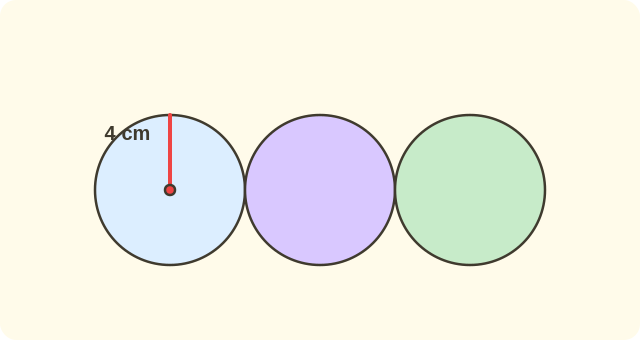
What you need: the width of one circle is its diameter.
Steps:
- Work out the diameter of each circle.
- The row is 3 diameters end to end.
Show solution
Solution
The diameter of each circle is: 4\times2=8\ (\text{cm}).
The three equal circles are in a row and neighbouring circles touch, so the length of the row is the sum of three diameters. The row is: 8\times3=24\ (\text{cm})\ \text{long}.
Check: the row is 6 radii long, so 4\times6=24 (cm). Correct.
So the row is 24 cm long.
Answer. 24 cm.
Mini test
Marked like the Vietnamese graduation exam: Part I 0.25 points per question; Part II up to 1 point per question (1, 2, 3, 4 correct statements give 0.1, 0.25, 0.5, 1 point); Part III 0.5 points per question.
Part I. Multiple choice
The diameter is double the radius: 7\times2=14 cm. Option B is the mistake of mixing up radius and diameter.
The radius is half the diameter: 18\div2=9 cm. Option A is the mistake of doubling.
Only AB passes through the centre with both ends on the circle. OA and OC are radii, and AC does not pass through the centre.
The opening of the compasses is the radius, that is 6 cm. Option C is the mistake of using the diameter.
Part II. True or false
| a) The radius of the circle is 10 cm. | ||
| b) OA=OB. | ||
| c) O is the midpoint of AB. | ||
| d) The radius is longer than the diameter. |
a) True: 20\div2=10. b) True: two radii are equal. c) True: O is between A and B and OA=OB. d) False: the radius is only half of the diameter.
Part III. Short answer
15\times2=30 (cm).
26\div2=13 (cm).
Show answers and explanations
- Part I, question 1: A. The diameter is double the radius: 7\times2=14 cm. Option B is the mistake of mixing up radius and diameter.
- Part I, question 2: B. The radius is half the diameter: 18\div2=9 cm. Option A is the mistake of doubling.
- Part I, question 3: C. Only AB passes through the centre with both ends on the circle. OA and OC are radii, and AC does not pass through the centre.
- Part I, question 4: B. The opening of the compasses is the radius, that is 6 cm. Option C is the mistake of using the diameter.
- Part II, question 1: a) True; b) True; c) True; d) False. a) True: 20\div2=10. b) True: two radii are equal. c) True: O is between A and B and OA=OB. d) False: the radius is only half of the diameter.
- Part III, question 1: 30. 15\times2=30 (cm).
- Part III, question 2: 13. 26\div2=13 (cm).