The area of a shape. Square centimetres. Area of rectangles and squares
🖨 Print a self-study sheet Why print?
Lan wants to stick coloured paper on a rectangular piece of card cm long and cm wide. Each piece of paper is a square with sides of cm. How many pieces of paper does Lan need to cover the card completely?
The number of pieces tells you how much surface the card has. This lesson teaches you to measure how much surface a shape has, using area.
The area of a shape
Let's explore
Every shape covers part of a flat surface, as a piece of card covers part of a table. The part of a flat surface that a shape covers is called the area of the shape.
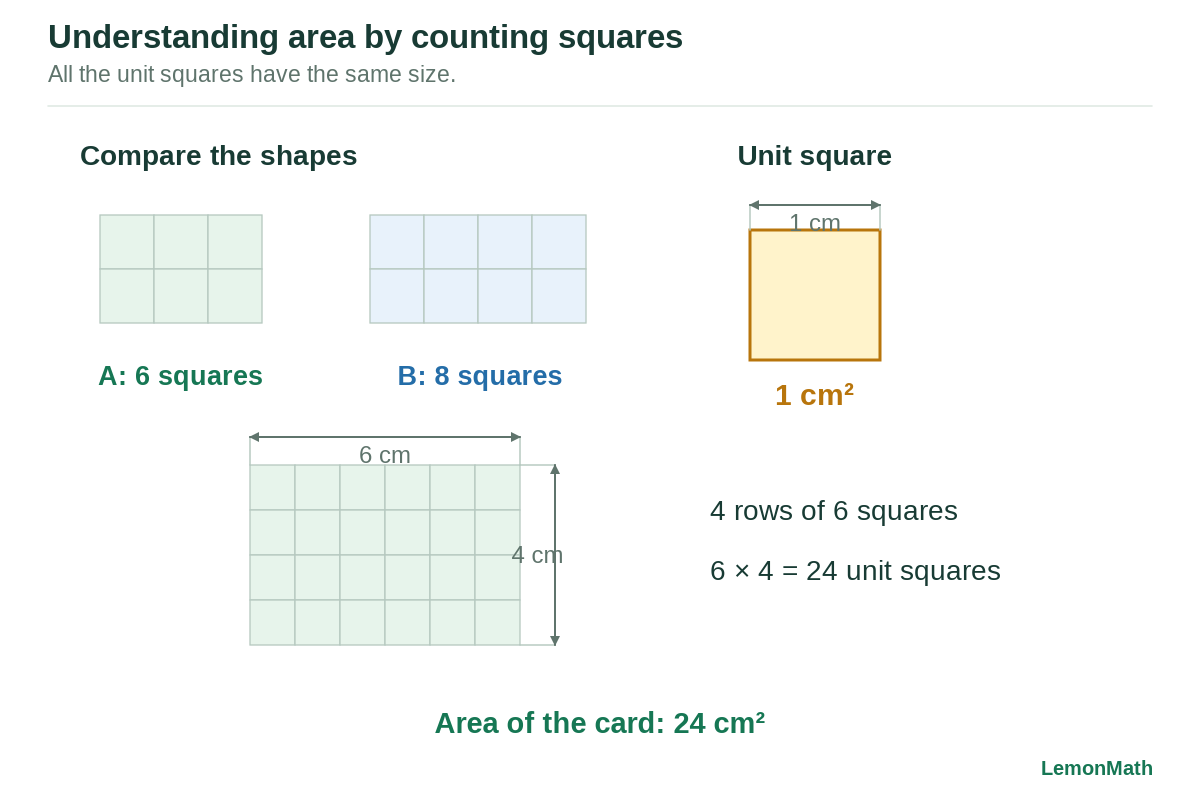
You compare two shapes by counting how many equal squares each is made of. Shape has rows with squares in each row:
■ ■ ■
■ ■ ■
Shape has rows with squares in each row:
■ ■ ■ ■
■ ■ ■ ■
Shape has squares and shape has squares. Since , shape has a greater area than shape .
Why use equal squares? If the squares were different sizes, the number of squares would no longer tell you which shape covers more. With the same kind of square, comparing the numbers of squares compares the areas.
Square centimetres
Let's explore
To say how big an area is, you need a unit of measurement. Choose a square whose side is cm long. The area of that square is square centimetre, written .
Shape above is made of such squares, so its area is . Shape is made of squares, so its area is 8\ \text{cm}^2.
Why is it called "square"? Because this unit is the area of a square, and it is different from the centimetre, which measures length. When you write an area, you must write \text{cm}^2, not cm.
Examples
Area of rectangles and squares
Let's explore
Back to Lan's card: 6 cm long and 4 cm wide. Lay the 1\ \text{cm}^2 pieces of paper in 4 rows with 6 pieces in each row. The number of pieces is 6\times 4=24. So the card has an area of 24\ \text{cm}^2, and Lan needs 24 pieces of paper.
Why multiply? Because a rectangle is made of rows of equal squares: the number of squares in a row is the length, the number of rows is the width, and multiplying is a quick way to count equal rows. A square is a rectangle whose length equals its width, so its area is side times side.
Examples
We start with a rectangle.
Now a square.
Use the rules to solve a problem from everyday life.
Compare the areas of two shapes.
The next problem is a little harder, so we use four steps: understand, plan, solve, look back.
Connection. You have already learned the perimeter of rectangles and squares. Perimeter measures the length around a shape, while area measures how much surface is inside it. Multiplication lets you find area quickly, and it is the same multiplication you have used all year.
Key terms
Summary
- Area is the part of a flat surface a shape covers; a shape made of more squares has the greater area.
- The unit of area is the square centimetre (\text{cm}^2).
- Area of a rectangle = length \times width; area of a square = side \times side.
- Do not mix up area and perimeter; always convert to the same unit before multiplying.
Practice
Each exercise comes with what you need and how to start. Try it yourself first, then open the solution.
A shape is made of two rows of 1\ \text{cm}^2 squares with 5 squares in each row. Find the area of the shape.
What you need: the area equals the number of 1\ \text{cm}^2 squares.
Steps:
- How many squares are there altogether?
Show solution
The shape is made of two rows of squares with 5 squares in each row, so the number of squares is 5+5=10\ \text{(squares)}.
Each square has an area of 1\ \text{cm}^2, so the area of the shape is 10\times1=10\ (\text{cm}^2).
So the area of the shape is 10\ \text{cm}^2.
Answer. 10\ \text{cm}^2.
Find the area of a rectangle 8 cm long and 3 cm wide.
What you need: area of a rectangle = length \times width.
Steps:
- Write the multiplication 8\times 3.
Show solution
To find the area of a rectangle, we multiply its length by its width (in the same unit).
The area of the rectangle is: 8\times3=24\ (\text{cm}^2).
So the rectangle has an area of 24\ \text{cm}^2.
Answer. 24\ \text{cm}^2.
Find the area of a square with sides of 7 cm.
What you need: area of a square = side \times side.
Steps:
- Write the multiplication 7\times 7.
Show solution
To find the area of a square, we multiply the length of a side by itself.
The area of the square is: 7\times7=49\ (\text{cm}^2).
So the square has an area of 49\ \text{cm}^2.
Answer. 49\ \text{cm}^2.
The lid of a biscuit tin is a rectangle 15 cm long and 9 cm wide. What is the area of the lid in square centimetres?
What you need: multiply a two-digit number by a one-digit number.
Steps:
- What do we know? What is asked?
- Write the multiplication 15\times 9.
Show solution
Solution
The lid is a rectangle, so its area is its length times its width: 15\times9=135\ (\text{cm}^2).
So the area of the lid is 135\ \text{cm}^2.
Answer. 135\ \text{cm}^2.
Shape A is a rectangle 9 cm long and 4 cm wide. Shape B is a square with sides of 6 cm. Which shape has the greater area?
What you need: find the area of each shape, then compare.
Steps:
- Work out 9\times 4 and 6\times 6.
Show solution
Shape A is a rectangle, so its area is 9\times4=36\ (\text{cm}^2).
Shape B is a square, so its area is 6\times6=36\ (\text{cm}^2).
Comparing the two areas: 36=36.
So the two shapes have equal areas; neither shape has the greater area.
Answer. The two shapes have equal areas.
A rectangular sheet of paper is 10 cm long and 6 cm wide. A square with sides of 2 cm is cut out. What is the area of the paper that is left, in square centimetres?
What you need: this problem has two steps: find two areas, then subtract.
Steps:
- Find the area of the sheet and the area of the square cut out.
- Subtract the area of the square from the area of the sheet.
Show solution
Solution
The area of the sheet is: 10\times6=60\ (\text{cm}^2).
The area of the square cut out is: 2\times2=4\ (\text{cm}^2).
The area of the paper left is: 60-4=56\ (\text{cm}^2).
So the paper that is left has an area of 56\ \text{cm}^2.
Answer. 56\ \text{cm}^2.
Remember numerical expressions. A piece of card is made of two rectangles joined together: the first is 5 cm long and 3 cm wide; the second is 4 cm long and 3 cm wide. Write an expression and work out the total area of the card.
What you need: multiply first, then add.
Steps:
- Write the area of each rectangle, then add.
Show solution
Solution
The area of the first rectangle is 5\times3=15\ (\text{cm}^2).
The area of the second rectangle is 4\times3=12\ (\text{cm}^2).
The total area of the card is the sum of the areas of the two rectangles. The expression is 5\times3+4\times3. We work it out: 5\times3+4\times3=15+12=27\ (\text{cm}^2).
So the total area of the card is 27\ \text{cm}^2.
Answer. 27\ \text{cm}^2.
A square has a perimeter of 24 cm. Find the area of the square.
What you need: a square has 4 equal sides.
Steps:
- Find the length of one side from the perimeter.
- Find the area.
Show solution
Solution
A square has four equal sides, so the length of one side is the perimeter divided by 4: 24\div4=6\ (\text{cm}).
The area of the square is: 6\times6=36\ (\text{cm}^2).
Check: the perimeter of a square with sides of 6 cm is 6\times4=24 (cm). Correct.
So the square has an area of 36\ \text{cm}^2.
Answer. 36\ \text{cm}^2.
Mini test
Marked like the Vietnamese graduation exam: Part I 0.25 points per question; Part II up to 1 point per question (1, 2, 3, 4 correct statements give 0.1, 0.25, 0.5, 1 point); Part III 0.5 points per question.
Part I. Multiple choice
6\times 4=24, and the unit is \text{cm}^2. A adds the two numbers, B is the perimeter, C has the wrong unit.
7\times 7=49. A adds 7+7, C is the perimeter, D joins the digits.
12\times 8=96. A adds the two numbers, C is the perimeter, D is the difference of the two numbers.
1 dm =10 cm, so 10\times 5=50\ \text{cm}^2. B does not convert the unit, A and D use the wrong operation.
Part II. True or false
| a) The area of the square is 25\ \text{cm}^2. | ||
| b) The area of the rectangle is 11\ \text{cm}^2. | ||
| c) The square has a greater area than the rectangle. | ||
| d) Area is measured in centimetres. |
a) True: 5\times 5=25. b) False: 8\times 3=24, and 11 is 8+3. c) True: 25>24. d) False: area is measured in square centimetres.
Part III. Short answer
9\times 4=36\ (\text{cm}^2).
8\times 8=64\ (\text{cm}^2).
Show answers and explanations
- Part I, question 1: D. 6\times 4=24, and the unit is \text{cm}^2. A adds the two numbers, B is the perimeter, C has the wrong unit.
- Part I, question 2: A. 7\times 7=49. A adds 7+7, C is the perimeter, D joins the digits.
- Part I, question 3: B. 12\times 8=96. A adds the two numbers, C is the perimeter, D is the difference of the two numbers.
- Part I, question 4: C. 1 dm =10 cm, so 10\times 5=50\ \text{cm}^2. B does not convert the unit, A and D use the wrong operation.
- Part II, question 1: a) True; b) False; c) True; d) False. a) True: 5\times 5=25. b) False: 8\times 3=24, and 11 is 8+3. c) True: 25>24. d) False: area is measured in square centimetres.
- Part III, question 1: 36. 9\times 4=36\ (\text{cm}^2).
- Part III, question 2: 64. 8\times 8=64\ (\text{cm}^2).
===== HẾT: 16 bài, 32 bản =====