Angles: right angles and non-right angles
🖨 Print a self-study sheet Why print?
The corner of a book, the corner of a sheet of paper and the corner of a window all have the same shape. How can you be sure that an angle is a "right angle"?
Judging by eye is easy to get wrong, but a small tool can make us sure: the set square. We will learn the names of the parts of an angle, and then use a set square to test for a right angle.
Let's explore
Look at the two blades of scissors, the two hands of a clock or two sticks joined at one point. Where they meet, they make an angle. The shared point is the vertex of the angle, and the two lines are its two sides.
The picture below shows the angle with vertex and sides and . Can you see the small square mark at the vertex ? It tells us this is a right angle.
The next picture is also an angle with vertex , but its sides and open in a different way. It looks smaller than a right angle. An angle like this is not a right angle.
But judging by eye is easy to get wrong, especially for an angle that is nearly right. We use a set square, a tool with one right angle built in, to test:
- Put the right-angled corner of the set square on the vertex of the angle to test.
- Line up one side of the set square with one side of the angle.
- Look at the other side of the set square: if it lines up with the other side of the angle, the angle is a right angle.
The length of the sides does not matter. For example, an angle with sides cm long and an angle with sides cm long are both right angles if they fit the set square.
Examples
We start by naming the parts of an angle: the vertex and the sides.
Now it is time to use the set square. Let's see how two friends test their angles.
Right angles are all around you. Let's look for a few.
You can now spot a right angle. Next, draw one yourself, with the set square to help.
Finally, a more surprising place to look: the letters of the alphabet.
Key terms
Summary
- An angle has one vertex and two sides; the vertex is the point shared by both sides.
- Use a set square to test for a right angle: both sides of the angle must line up with both sides of the set square.
- An angle that does not fit the set square is not a right angle.
- The length of the sides does not change whether an angle is a right angle.
- Do not judge by eye alone; use a set square. Back to the opening question: to be sure an angle is a right angle, fit a set square to it and check. Next time you meet an angle, try the set square on it.
Practice
Each exercise comes with what you need and a hint to get started. Try it yourself first. If you get stuck, read the hint, and only then open the solution to compare.
An angle has vertex K and sides KA and KB.
a) Which point is the vertex?
b) What are the two sides?
c) Which point is shared by both sides?
What you need: the vertex is the point shared by the two sides.
Steps:
- Which point do KA and KB both have?
- That point is the vertex.
Show solution
By the problem, the angle has vertex K and sides KA and KB. The two sides of an angle both start from the vertex of that angle.
a) The vertex is the point where the two sides start. Here it is the point K.
b) The two sides of the angle are the two segments starting from the vertex K, that is KA and KB.
c) The sides KA and KB both have one end at the vertex K, so the point shared by both sides is K.
So the vertex is K; the sides are KA and KB; the point shared by both sides is K.
Answer. a) K; b) KA, KB; c) K.
You put a set square on three angles. Is each angle a right angle or not?
a) The other side of the set square lines up with the other side of the angle.
b) The other side of the set square sticks out of the angle, leaving a gap.
c) The other side of the angle falls inside the corner of the set square.
What you need: a right angle fits the corner of the set square exactly.
Steps:
- Do both sides of the angle line up with both sides of the set square?
- If there is a gap or it falls inside, it is not a right angle.
Show solution
To check whether an angle is a right angle, you place the set square so that its right-angle corner is on the vertex of the angle and one side of the set square lines up with one side of the angle. Then you see whether the other side of the set square lines up with the other side of the angle.
a) The other side of the set square lines up with the other side of the angle, so it is a right angle.
b) The other side of the set square sticks out of the angle, leaving a gap, so the two sides do not line up and it is not a right angle.
c) The other side of the angle falls inside the corner of the set square, so the two sides do not line up and it is not a right angle.
So the angle in a) is a right angle; the angles in b) and c) are not right angles.
Answer. a) Right angle; b) not a right angle; c) not a right angle.
Remember the last lesson on circles. A circle with centre O has radius 4 cm. The points A and B are on the circle. The angle with vertex O and sides OA and OB has two sides. How many centimetres long is each side?
What you need: all radii of a circle are equal.
Steps:
- What kind of segments are OA and OB?
- Use the radius given.
Show solution
The circle with centre O has radius 4 cm. The points A and B are on the circle, so OA and OB are segments joining the centre O to points on the circle.
Hence OA and OB are both radii of the circle, and each is 4 cm long. The two sides of the angle with vertex O are equal.
So each side of the angle is 4 cm long.
Answer. OA=4 cm and OB=4 cm.
Which of these has a right angle?
a) A corner of a book.
b) The two hands of a clock at exactly 1 o'clock.
c) A corner of a blackboard.
d) A roof shaped like the letter A.
What you need: use a set square to test for a right angle.
Steps:
- Imagine putting a set square in each corner.
- Choose the ones that fit the set square.
Show solution
You use a set square to check each angle. An angle that fits the right-angle corner of the set square is a right angle.
a) The corner of a book fits the set square, so it is a right angle.
b) The clock hands at exactly 1 o'clock are close together and do not fit the right-angle corner of the set square, so it is not a right angle.
c) The corner of a blackboard fits the set square, so it is a right angle.
d) The A-shaped roof is closer together and does not fit the right-angle corner of the set square, so it is not a right angle.
So the things that have a right angle are the corner of a book and the corner of a blackboard.
Answer. The corner of a book and the corner of a blackboard.
Two right angles: one has sides 3 cm long and the other has sides 6 cm long. Are the two angles "equal"? Why?
What you need: right angles are tested with a set square; the length of the sides does not change the angle.
Steps:
- Do both angles fit the set square?
- Does the length of the sides affect whether an angle is right?
Show solution
Both angles are right angles. All right angles are equal, because when one is placed on top of the other, their sides line up exactly.
The lengths of the sides (3 cm or 6 cm) only tell us how long the sides are; they do not change whether an angle is a right angle.
So the two angles are equal, because both are right angles.
Answer. Equal, because both are right angles.
Nam says: "This angle looks like a right angle, so it is a right angle". What is wrong with what Nam says? What would you do?
What you need: use a set square to test for a right angle.
Steps:
- Can the eye be fooled?
- Which tool makes sure?
Show solution
Nam only used his eyes. Eyes can mistake an angle that is nearly right for a right angle, so an angle that only "looks like" a right angle cannot yet be called one.
You would use a set square to test it:
- Put the right-angle corner of the set square on the vertex of the angle.
- Line up one side of the set square with one side of the angle.
- See whether the other side of the set square lines up with the other side of the angle. If it does, the angle is a right angle; if it does not, it is not a right angle.
So what is wrong with what Nam says is that he relied only on his eyes; you must test the angle with a set square.
Answer. It must be tested with a set square.
a) Of the letters L, V and T, which have a right angle?
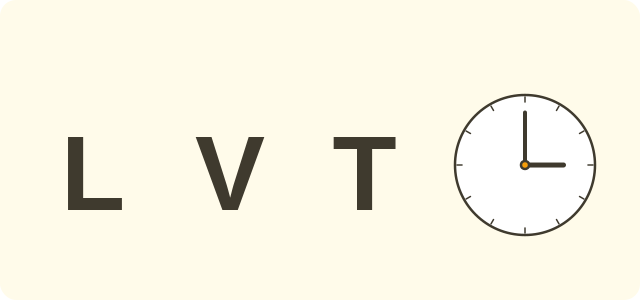
b) What kind of angle do the clock hands make at exactly 3 o'clock?
What you need: a right angle fits a set square.
Steps:
- Imagine putting a set square where two strokes meet.
- Decide using the set square.
Show solution
a) We check, with a set square, the place where the two strokes of each letter meet.
In the letter L, the two strokes meet at a right angle. In the letter T, the horizontal stroke and the vertical stroke also meet at a right angle. In the letter V, the two strokes come together closely and do not make a right angle.
b) At exactly 3 o'clock, the hour hand points at 3 and the minute hand points at 12. The two hands make a right angle.
So the letters L and T have a right angle; the clock hands at exactly 3 o'clock make a right angle.
Answer. a) L, T; b) a right angle.
A rectangular sheet of paper has 4 right angles. You cut off one corner with a single straight cut (the cut does not pass through any other corner). How many right angles does the sheet have left?
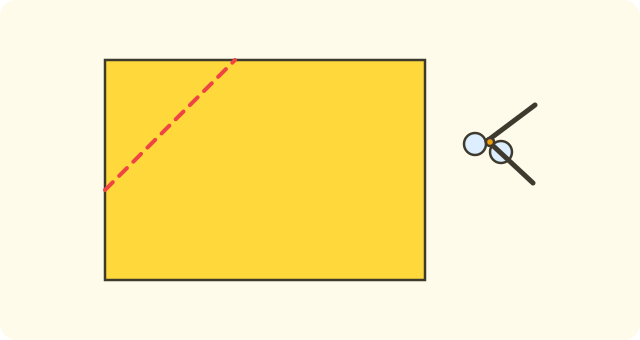
What you need: cutting off a corner removes one right angle from the sheet.
Steps:
- Count the 4 right angles at the start.
- One corner is cut off; two new corners appear along the cut but they are not right angles.
Show solution
The rectangular sheet of paper has 4 right angles at the start.
The straight cut removes one corner, so 1 right angle is lost. The cut does not pass through any other corner, so the other 3 right angles are not affected. Two new corners appear along the cut, and these two new corners are not right angles.
The number of right angles left is: 4-1=3\ \text{(right angles)}.
So the sheet has 3 right angles left.
Answer. 3 right angles.
Mini test
Marked like the Vietnamese graduation exam: Part I 0.25 points per question; Part II up to 1 point per question (1, 2, 3, 4 correct statements give 0.1, 0.25, 0.5, 1 point); Part III 0.5 points per question.
Part I. Multiple choice
A set square has a right angle to compare with the angle being tested. Option A is the mistake of using a ruler, which measures length.
The vertex is the point shared by the sides OA and OB, that is O.
The corner of a book fits the set square. The other options are closer together than a right angle.
The length of the sides does not change whether an angle is a right angle. Option A is a mistake people often make by eye.
Part II. True or false
| a) If both sides of the angle line up with both sides of the set square, it is a right angle. | ||
| b) If a side of the set square leaves a gap, the angle is not a right angle. | ||
| c) Looking by eye is enough to be sure it is a right angle. | ||
| d) The lengths of the two sides decide whether the angle is a right angle. |
a) True: fitting the set square means a right angle. b) True: a gap means it is not a right angle. c) False: the eye is easily fooled. d) False: the length of the sides does not decide.
Part III. Short answer
The two strokes of the letter L meet at one right angle.
Cutting off one right angle leaves 4-1=3 right angles.
Show answers and explanations
- Part I, question 1: B. A set square has a right angle to compare with the angle being tested. Option A is the mistake of using a ruler, which measures length.
- Part I, question 2: C. The vertex is the point shared by the sides OA and OB, that is O.
- Part I, question 3: C. The corner of a book fits the set square. The other options are closer together than a right angle.
- Part I, question 4: B. The length of the sides does not change whether an angle is a right angle. Option A is a mistake people often make by eye.
- Part II, question 1: a) True; b) True; c) False; d) False. a) True: fitting the set square means a right angle. b) True: a gap means it is not a right angle. c) False: the eye is easily fooled. d) False: the length of the sides does not decide.
- Part III, question 1: 1. The two strokes of the letter L meet at one right angle.
- Part III, question 2: 3. Cutting off one right angle leaves 4-1=3 right angles.