How likely is an event?
🖨 Print a self-study sheet Why print?
Mai has a closed box, and inside there are only red marbles. Mai shuts her eyes and takes out one marble. Can she get a blue marble? Is she certain to get a red one?
You can answer questions like these just by looking at what is in the box. That is the idea we will practise here.
Let's explore
Here are three boxes. Each time, we shut our eyes and take out one marble.
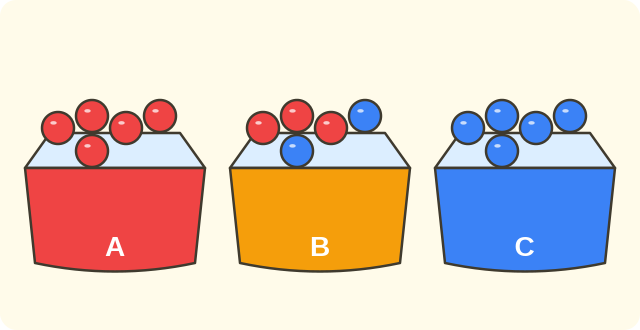
- Box A: red marbles.
- Box B: red marbles and blue marbles.
- Box C: blue marbles. Before we pick, try guessing which colours could come out of each box.
Box A. There are only red marbles in this box. However we pick, we get a red marble. So we say: getting a red marble is certain, and getting a blue marble is impossible.
Box B. This box has red and blue marbles. This time we might get red, and next time we might get blue. So we say: getting a red marble is possible, and getting a blue marble is also possible.
Box C. There are only blue marbles here. Getting a blue marble is certain, and getting a red marble is impossible. Three boxes give us three levels of likelihood. Let us name them:
Why is looking in the box enough? Because you know everything inside it. If the thing you want is not there, it is impossible. If everything in the box is that thing, it is certain. Anything in between is possible.
Examples
First, a box that holds only one kind of ball.
This time the bag holds two kinds of sweets. Let us see what changes.
The same thinking works for numbers on cards.
You meet questions like these outside school too.
Finally, let us try it for real and record the results in a data table, as in the last lesson.
Key terms
Summary
- Certain: always happens. Impossible: never happens. Possible: sometimes happens, sometimes does not.
- Look at what is in the box: if the thing you want is not there, it is impossible; if everything is that thing, it is certain.
- If the box holds several kinds, each kind is possible to take out, even if there are only a few of that kind.
- Record the results of a trial with tally marks and a data table. Back to Mai's box at the start: it holds only red marbles, so a blue marble is impossible and a red marble is certain. Looking in the box was all it took. A few practice questions will make it feel natural.
Practice
Every exercise gives you the idea you need and a hint for getting started. Have a go on your own first. If you get stuck, read the hint, and only then open the solution to compare.
A box has 5 blue marbles. Shut your eyes and take out one. Say how likely each event is:
a) you take a blue marble;
b) you take a red marble.
What you need: look at what is in the box.
Steps:
- Which colours are in the box?
- Is the colour you want in the box?
Show solution
a) The box has only blue marbles and no other marbles. If you shut your eyes and take out one, it is certainly blue. So taking a blue marble is certain.
b) There is no red marble in the box. If you shut your eyes and take out one, you can never get red. So taking a red marble is impossible.
Answer. a) Certain. b) Impossible.
A bag has 3 orange sweets and 3 strawberry sweets. Shut your eyes and take out one. Say how likely each event is:
a) you take an orange sweet;
b) you take a strawberry sweet;
c) you take a lemon sweet.
What you need: if several kinds are in the bag, each kind is possible; if a kind is not in the bag, it is impossible.
Steps:
- Which sweets are in the bag?
- Look at parts a), b), c) one by one.
Show solution
a) The bag has 3 orange sweets. The sweet you take out might be orange, but it might also be strawberry. So taking an orange sweet is possible.
b) The bag has 3 strawberry sweets. The sweet you take out might be strawberry, but it might also be orange. So taking a strawberry sweet is possible.
c) There is no lemon sweet in the bag, so you cannot take a lemon sweet. So taking a lemon sweet is impossible.
Answer. a) Possible. b) Possible. c) Impossible.
Say whether each event is certain, possible or impossible:
a) A week has 7 days.
b) A cat flies to the Moon.
c) It is sunny tomorrow.
What you need: always happens means certain; never happens means impossible; sometimes happens means possible.
Steps:
- Think: does the event always happen?
- Choose one of the three levels.
Show solution
a) Every week has exactly 7 days. So the event "A week has 7 days" is certain.
b) A cat cannot fly to the Moon. So this event is impossible.
c) Some days are sunny and some days are not, so it may or may not be sunny tomorrow. So this event is possible.
Answer. a) Certain. b) Impossible. c) Possible.
A box has 4 cards with the numbers 2, 4, 6, 8. Shut your eyes and take out one. Say how likely each event is:
a) you take a card with an even number;
b) you take the card with 5;
c) you take a card with a number greater than 5.
What you need: write down the numbers you could take, then look at each part.
Steps:
- The numbers in the box are 2, 4, 6, 8.
- Which numbers fit each part?
Show solution
a) The numbers 2, 4, 6 and 8 are all even. Whichever card you take, its number is even. So this event is certain.
b) None of the cards has the number 5. So taking the card with 5 is impossible.
c) The numbers 6 and 8 are greater than 5, while 2 and 4 are not. You might take a card with a number greater than 5, but you might not. So this event is possible.
Answer. a) Certain. b) Impossible. c) Possible.
A box has 1 red marble and 9 blue marbles. Nam says: "If I shut my eyes and take one, I am certain to get blue." Is Nam right? Why?
What you need: "certain" means it always happens.
Steps:
- What do we know? The box has 1 red marble and 9 blue marbles.
- Could you ever get the red marble?
Show solution
The box has 1 red marble and 9 blue marbles. The red marble is still in the box, so when you shut your eyes and take one, you might get red. So we cannot say that you are certain to get blue.
Since there are 9 blue marbles, getting blue can still happen, but it is not certain.
So Nam is not right, because the red marble can still be taken out.
Answer. Nam is not right: getting blue is only possible.
Lan says: "A box has 4 blue marbles and 1 red marble. You cannot get red because there is so little red." Where is Lan wrong? Correct it.
What you need: if it is in the box, you might take it out, even if there is only one.
Steps:
- Is there a red marble in the box?
- Choose the right level.
Show solution
Lan says: "You cannot get red because there is so little red." Lan is wrong in thinking that having only a little red means you cannot get it.
There is 1 red marble in the box, so when you shut your eyes and take one, you can still get red. An event is impossible only when there is no red marble at all in the box.
So Lan should correct it: getting red can happen, it is not impossible.
Answer. Lan is wrong: getting red is possible, not impossible.
Remember the last lesson (data tables). Mai takes a marble from a box, writes down its colour, puts it back, and does this 12 times: red, blue, red, red, blue, red, blue, red, red, blue, red, blue.
a) Make a data table (with tally marks).
b) Are there both colours in the box? Why?
What you need: count with tally marks, then add to check the total.
Steps:
- Read the list once and draw a stroke in the row of the right colour.
- Add the two numbers and compare with 12.
Show solution
a) We count how many times each colour appears in the 12 draws: red, blue, red, red, blue, red, blue, red, red, blue, red, blue. Red appears in draws 1, 3, 4, 6, 8, 9, 11, that is 7 times. Blue appears in draws 2, 5, 7, 10, 12, that is 5 times. The data table is:
| Colour | Tally marks | Number of times |
|---|---|---|
| Red | /////// | 7 |
| Blue | ///// | 5 |
Check: 7+5=12, which is exactly the number of times Mai took a marble.
b) Both red and blue marbles were taken out in the 12 draws. So the box has both colours.
Answer. a) Red 7 times, blue 5 times. b) Yes, both colours.
A box has 3 red marbles and 5 blue marbles.
a) How many blue marbles must you take out so that you are certain to get a red marble?
b) If you keep the 5 blue marbles, how many red marbles must you take out so that getting a red marble is impossible?
What you need: certain means only that colour is in the box; impossible means that colour is not in the box.
Steps:
- In part a), which marbles must be left in the box?
- In part b), which marbles must be gone?
Show solution
a) The box has 3 red marbles and 5 blue marbles. To be certain to get a red marble, only red marbles may be left in the box, so all the blue marbles must be taken out. When all 5 blue marbles are taken out, only 3 red marbles are left. So you must take out 5 blue marbles.
b) For getting a red marble to be impossible, no red marble may be left in the box, so all the red marbles must be taken out. When all 3 red marbles are taken out, only 5 blue marbles are left. So you must take out 3 red marbles.
Answer. a) 5 blue marbles. b) 3 red marbles.
Mini test
Marked like the Vietnamese graduation exam: Part I 0.25 points per question; Part II up to 1 point per question (1, 2, 3, 4 correct statements give 0.1, 0.25, 0.5, 1 point); Part III 0.5 points per question.
Part I. Multiple choice
There are only yellow marbles, so every marble you take out is yellow. Option B forgets that there is no other colour in the box.
The box has both red and blue marbles, so getting blue is possible. Option A mixes up "possible" and "certain".
There is no card with 7 in the box. Option A comes from not looking in the box.
Tuesday always comes after Monday. A and D are possible, and C is impossible.
Part II. True or false
| a) It is possible to get a red marble. | ||
| b) You are certain to get a blue marble. | ||
| c) It is impossible to get a yellow marble. | ||
| d) You are certain to get a red or a blue marble. |
a) True: the red marble is in the box. b) False: the red marble might still be taken out. c) True: there is no yellow marble. d) True: every marble in the box is red or blue.
Part III. Short answer
The box has red and blue marbles, so you might get 2 colours.
You must take out all 3 blue marbles so that only red marbles are left.
Show answers and explanations
- Part I, question 1: C. There are only yellow marbles, so every marble you take out is yellow. Option B forgets that there is no other colour in the box.
- Part I, question 2: D. The box has both red and blue marbles, so getting blue is possible. Option A mixes up "possible" and "certain".
- Part I, question 3: B. There is no card with 7 in the box. Option A comes from not looking in the box.
- Part I, question 4: B. Tuesday always comes after Monday. A and D are possible, and C is impossible.
- Part II, question 1: a) True; b) False; c) True; d) True. a) True: the red marble is in the box. b) False: the red marble might still be taken out. c) True: there is no yellow marble. d) True: every marble in the box is red or blue.
- Part III, question 1: 2. The box has red and blue marbles, so you might get 2 colours.
- Part III, question 2: 3. You must take out all 3 blue marbles so that only red marbles are left.