Making a number several times larger. Making a number several times smaller
🖨 Print a self-study sheet Why print?
Lan has marbles. Nam has times as many marbles as Lan. How many marbles does Nam have? Then, if you know that Nam has marbles, how can you find Lan's number again?
These two questions are two sides of the same idea: making larger and then making smaller. This lesson teaches you both.
Making a number several times larger
Let's explore
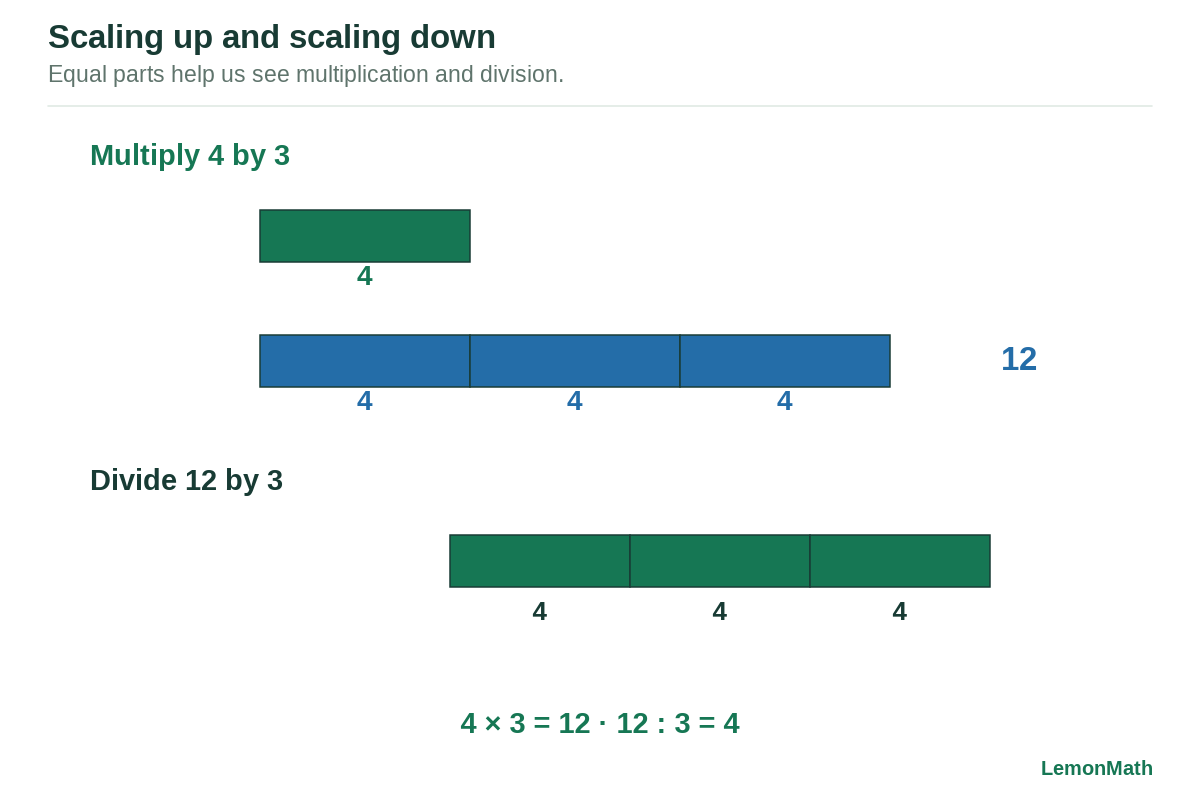
Lan has marbles. "Nam has times as many marbles as Lan" means that Nam's marbles make groups, each group having marbles like Lan's.
Add the groups: . Adding equal numbers is done by multiplication: So Nam has marbles.
Why multiply? Because " times as many" means taking equal groups, each equal to the number, and adding equal groups is exactly multiplication.
Examples
We start with a simple one.
The number being made larger can also have two digits.
Now use this to solve a word problem.
Making a number several times smaller
Let's explore
Above, 4 made 3 times larger gives 12. Now go the other way: Nam has 12 marbles, and Lan's number of marbles is Nam's number made 3 times smaller. How many marbles does Lan have?
"Made 3 times smaller" means sharing the 12 marbles into 3 equal groups and taking one group: 12\div3=4. So Lan has 4 marbles. Check: 4\times 3=12. Correct.
Why divide? Because making a number n times smaller undoes making it n times larger. Making larger multiplies by n, so making smaller divides by n.
Examples
We start with a simple one.
Now try another number.
The next problem is a little harder, so we use four steps: understand, plan, solve, look back.
Connection. Making larger is multiplying, making smaller is dividing, and these two operations undo each other. In the next lesson you will use this idea to find how many times larger one number is than another.
Key terms
Summary
- To make a number n times larger, multiply it by n.
- To make a number n times smaller, divide it by n.
- "Several times larger" is not adding, and "several times smaller" is not subtracting.
- Check: if 12 made 3 times smaller is 4, then 4\times 3 must equal 12.
Practice
Each exercise comes with what you need and how to start. Try it yourself first, then open the solution.
Make 6 become 3 times larger.
What you need: to make a number n times larger, multiply it by n.
Steps:
- Write the multiplication 6\times 3.
Show solution
Making a number several times larger means multiplying that number by the number of times.
To make 6 become 3 times larger, we multiply 6 by 3: 6\times3=18.
So 6 made 3 times larger is 18.
Answer. 18.
Make 15 become 5 times larger.
What you need: multiply a two-digit number by a one-digit number.
Steps:
- Write the multiplication 15\times 5, multiplying the ones first.
Show solution
Making a number several times larger means multiplying that number by the number of times.
To make 15 become 5 times larger, we multiply 15 by 5: 15\times5=75.
So 15 made 5 times larger is 75.
Answer. 75.
Make 32 become 4 times smaller.
What you need: to make a number n times smaller, divide it by n.
Steps:
- Write the division 32\div4.
Show solution
Making a number several times smaller means dividing that number by the number of times.
To make 32 become 4 times smaller, we divide 32 by 4: 32\div4=8.
Check: 8\times4=32. The result is correct.
So 32 made 4 times smaller is 8.
Answer. 8.
Make 54 become 6 times smaller.
What you need: use the 6 times table to divide.
Steps:
- Which number multiplied by 6 gives 54?
Show solution
Making a number several times smaller means dividing that number by the number of times.
To make 54 become 6 times smaller, we divide 54 by 6: 54\div6=9.
Check: 9\times6=54. The result is correct.
So 54 made 6 times smaller is 9.
Answer. 9.
Lan's family keeps 9 hens. They keep 4 times as many ducks as hens. How many ducks does Lan's family keep?
What you need: "4 times as many" means multiply by 4.
Steps:
- What do we know? What is asked?
- Write the calculation, then answer.
Show solution
Solution
There are 4 times as many ducks as hens, so the number of ducks Lan's family keeps is: 9\times4=36\ \text{(ducks)}.
So Lan's family keeps 36 ducks.
Answer. 36 ducks.
In the morning a shop sold 72 pens. In the afternoon it sold the morning's number made 8 times smaller. How many pens did the shop sell in the afternoon? How many pens did it sell in the whole day?
What you need: making 8 times smaller means dividing by 8; "the whole day" means putting together.
Steps:
- Find the afternoon's number with a division.
- Add the pens from the two parts of the day.
Show solution
Solution
The number of pens sold in the afternoon is the morning's number made 8 times smaller, so it is: 72\div8=9\ \text{(pens)}.
The number of pens sold in the whole day is: 72+9=81\ \text{(pens)}.
So the shop sold 9 pens in the afternoon and 81 pens in the whole day.
Answer. 9 pens in the afternoon; 81 pens in the whole day.
Remember the 6 times table: you know that 6\times 7=42. Make 42 become 6 times smaller and make 42 become 7 times smaller.
What you need: from one multiplication fact you can find two division facts.
Steps:
- Write the two divisions 42\div6 and 42\div7.
Show solution
We have 6\times7=42. From this multiplication we get two divisions: 42\div6=7 and 42\div7=6.
To make 42 become 6 times smaller, we divide 42 by 6: 42\div6=7.
To make 42 become 7 times smaller, we divide 42 by 7: 42\div7=6.
So 42 made 6 times smaller is 7 and 42 made 7 times smaller is 6.
Answer. 42 made 6 times smaller is 7; 42 made 7 times smaller is 6.
A number is made 4 times larger and then 2 times smaller, and the result is 18. Find the number.
What you need: work backwards step by step: undoing "2 times smaller" means making 2 times larger.
Steps:
- What was the number before it was made 2 times smaller?
Show solution
We work backwards through the steps applied to the unknown number.
The number is made 4 times larger and then 2 times smaller, and the result is 18. Before being made 2 times smaller, the number was: 18\times2=36.
Before being made 4 times larger, the number was: 36\div4=9.
Check: 9\times4=36, then 36\div2=18. The result is correct.
So the number is 9.
Answer. 9.
Mini test
Marked like the Vietnamese graduation exam: Part I 0.25 points per question; Part II up to 1 point per question (1, 2, 3, 4 correct statements give 0.1, 0.25, 0.5, 1 point); Part III 0.5 points per question.
Part I. Multiple choice
8\times 6=48. A adds 8+6, B subtracts 8-6, D joins the digits.
56\div7=8. A adds, D subtracts, C multiplies.
"5 times as many" means multiply: 7\times 5=35. B adds, A subtracts, D joins the digits.
"Made 6 times smaller" means divide: 42\div6=7 (m). A subtracts, C adds, B multiplies.
Part II. True or false
| a) 9 made 4 times larger is 13. | ||
| b) 36 made 4 times smaller is 9. | ||
| c) To make a number 4 times smaller, multiply it by 4. | ||
| d) 9 made 4 times larger and then 4 times smaller is 9 again. |
a) False: making larger is multiplying, 9\times 4=36. b) True: 36\div4=9. c) False: making smaller means dividing by 4. d) True: 9\times 4=36, then 36\div4=9.
Part III. Short answer
13\times 5=65.
72\div9=8 (flowers).
Show answers and explanations
- Part I, question 1: A. 8\times 6=48. A adds 8+6, B subtracts 8-6, D joins the digits.
- Part I, question 2: B. 56\div7=8. A adds, D subtracts, C multiplies.
- Part I, question 3: C. "5 times as many" means multiply: 7\times 5=35. B adds, A subtracts, D joins the digits.
- Part I, question 4: D. "Made 6 times smaller" means divide: 42\div6=7 (m). A subtracts, C adds, B multiplies.
- Part II, question 1: a) False; b) True; c) False; d) True. a) False: making larger is multiplying, 9\times 4=36. b) True: 36\div4=9. c) False: making smaller means dividing by 4. d) True: 9\times 4=36, then 36\div4=9.
- Part III, question 1: 65. 13\times 5=65.
- Part III, question 2: 8. 72\div9=8 (flowers).