Millilitres. Temperature and units of temperature
🖨 Print a self-study sheet Why print?
A bottle holds l of water. You pour water into cups, ml in each cup. How many full cups can you fill? Outside in the yard a thermometer shows , and inside the fridge a thermometer shows . Which place is colder?
To answer, you need to learn two things: the millilitre for measuring amounts of water, and the degree Celsius for measuring how warm or cold something is.
Millilitres
Let's explore
You already know that the litre (l) measures capacity, for example a bottle holds l. For smaller amounts of water, such as a cup, you use the millilitre, written ml.
Just as and , you have Sharing a l bottle into cups of ml gives cups, because . You have answered the first question.
Why do we need millilitres? Because the litre is too big to measure a cup of water or a spoonful of medicine. Small amounts are easier to read in millilitres.
Examples
We start with converting from litres to millilitres.
And convert the other way.
Now use millilitres to solve a word problem.
The next problem is a little harder, so we use four steps: understand, plan, solve, look back.
Temperature and units of temperature
Let's explore
To find out whether today is warm or cold, you use a thermometer. A thermometer shows the temperature. Temperature is measured in the unit degree Celsius, written ^\circ\text{C}. The measurement 30\ ^\circ\text{C} is read "thirty degrees Celsius".
Remember two marks for water under normal conditions: water starts to freeze at 0\ ^\circ\text{C} and boils at 100\ ^\circ\text{C}. The higher the temperature, the warmer it is.
Outside in the yard the thermometer shows 30\ ^\circ\text{C} and in the fridge it shows 5\ ^\circ\text{C}. Since 5<30, it is colder in the fridge than in the yard.
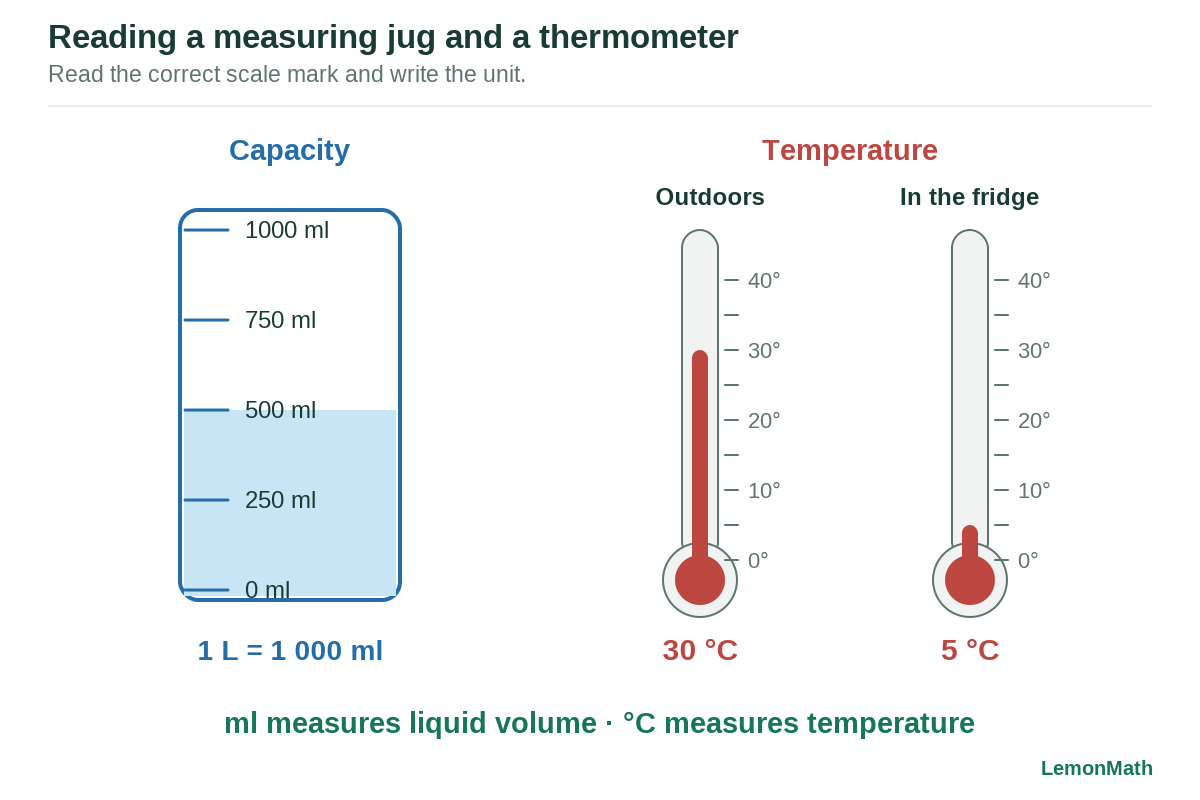
Why can you compare the numbers? Because a thermometer has a scale of numbers, like a ruler: the bigger the number, the higher the temperature.
Examples
We start with comparing warm and cold.
The temperature can rise or fall, and you use addition and subtraction.
Connection. The millilitre is like the millimetre and the gram: each is a small unit, one thousandth of a larger one. The degree Celsius is a new unit, but you still compare measurements as you compare other numbers.
Key terms
Summary
- 1\ \text{l}=1000\ \text{ml}; to add or subtract measurements of capacity, convert them to the same unit.
- A thermometer measures temperature; the unit is the degree Celsius (^\circ\text{C}).
- The higher the temperature, the warmer it is; water freezes at 0\ ^\circ\text{C} and boils at 100\ ^\circ\text{C}.
- Always write the unit in the answer.
Practice
Each exercise comes with what you need and how to start. Try it yourself first, then open the solution.
Convert to millilitres: a) 5\ \text{l}; b) 3\ \text{l}\ 200\ \text{ml}.
What you need: 1\ \text{l}=1000\ \text{ml}.
Steps:
- Convert the litres to millilitres, then add the extra millilitres.
Show solution
a) Since 1\ \text{l}=1000\ \text{ml}, we multiply 5 by 1000: 5\ \text{l}=5\times 1000=5000\ \text{ml}
b) We have 3\ \text{l}=3000\ \text{ml}, so: 3\ \text{l}\ 200\ \text{ml}=3000\ \text{ml}+200\ \text{ml}=3200\ \text{ml}
So 5\ \text{l}=5000\ \text{ml} and 3\ \text{l}\ 200\ \text{ml}=3200\ \text{ml}.
Answer. a) 5000 ml; b) 3200 ml.
Convert 2500\ \text{ml} to litres and millilitres.
What you need: 2000\ \text{ml}=2\ \text{l}.
Steps:
- Split 2500\ \text{ml} into 2000\ \text{ml} and 500\ \text{ml}.
Show solution
We split 2500\ \text{ml} into whole thousands of millilitres and the rest: 2500\ \text{ml}=2000\ \text{ml}+500\ \text{ml}
Since 2000\ \text{ml}=2\ \text{l}, we get: 2500\ \text{ml}=2\ \text{l}+500\ \text{ml}=2\ \text{l}\ 500\ \text{ml}
So 2500\ \text{ml}=2\ \text{l}\ 500\ \text{ml}.
Answer. 2\ \text{l}\ 500\ \text{ml}.
Fill in >, < or =: 1\ \text{l}\ 300\ \text{ml}\ \ldots\ 1200\ \text{ml}.
What you need: convert both measurements to the same unit, then compare.
Steps:
- Convert 1\ \text{l}\ 300\ \text{ml} to millilitres.
Show solution
To compare, we convert 1\ \text{l}\ 300\ \text{ml} to millilitres: 1\ \text{l}\ 300\ \text{ml}=1000\ \text{ml}+300\ \text{ml}=1300\ \text{ml}
Comparing the numbers 1300 and 1200, we see that 1300>1200.
So 1\ \text{l}\ 300\ \text{ml}>1200\ \text{ml}.
Answer. >.
The first jug holds 600 ml of water and the second jug holds 800 ml. How many millilitres of water do the two jugs hold altogether? Write the result in litres and millilitres.
What you need: "altogether" is an addition; 1000\ \text{ml}=1\ \text{l}.
Steps:
- Add the two measurements.
- Split the result into 1000\ \text{ml} and the rest.
Show solution
Solution
The number of millilitres of water in the two jugs is: 600+800=1400\ \text{(ml)}
We write the result in litres and millilitres: 1400\ \text{ml}=1000\ \text{ml}+400\ \text{ml}. Since 1000\ \text{ml}=1\ \text{l}, we have 1400\ \text{ml}=1\ \text{l}\ 400\ \text{ml}.
So the two jugs hold 1400 ml of water altogether, which is 1\ \text{l}\ 400\ \text{ml}.
Answer. 1400 ml, which is 1\ \text{l}\ 400\ \text{ml}.
Mum pours 3 cups of orange juice, 300 ml in each cup. How many millilitres of orange juice has she poured? How many millilitres less than 1 l is that?
What you need: work out 3 hundreds times 3 in your head; convert 1 l to millilitres.
Steps:
- Find the amount of orange juice Mum has poured.
- Subtract it from 1000.
Show solution
Solution
The number of millilitres of orange juice Mum has poured is: 300\times 3=900\ \text{(ml)}
Since 1\ \text{l}=1000\ \text{ml}, the number of millilitres less than 1 l is: 1000-900=100\ \text{(ml)}
So Mum has poured 900 ml of orange juice, which is 100 ml less than 1 l.
Answer. 900 ml; it is 100 ml less than 1 l.
In the morning the temperature is 22\ ^\circ\text{C}. At noon it rises by 9\ ^\circ\text{C} and in the afternoon it falls by 5\ ^\circ\text{C}. What is the temperature in the afternoon, in degrees Celsius?
What you need: "rises by" is an addition, "falls by" is a subtraction.
Steps:
- Find the temperature at noon.
- From that, find the temperature in the afternoon.
Show solution
Solution
At noon the temperature rises by 9\ ^\circ\text{C}, so we add. The temperature at noon is: 22+9=31\ (^\circ\text{C})
In the afternoon the temperature falls by 5\ ^\circ\text{C}, so we subtract. The temperature in the afternoon is: 31-5=26\ (^\circ\text{C})
So the temperature in the afternoon is 26\ ^\circ\text{C}.
Answer. 26\ ^\circ\text{C}.
Remember the lesson on making a number several times larger. A small bottle holds 200 ml of water. A large bottle holds 5 times as much as the small bottle. How many millilitres does the large bottle hold? How many litres is that?
What you need: 5 times as much means multiply by 5.
Steps:
- Multiply 200 by 5.
- Convert the result to litres.
Show solution
Solution
The large bottle holds 5 times as much as the small bottle, so the number of millilitres the large bottle holds is: 200\times 5=1000\ \text{(ml)}
Since 1000\ \text{ml}=1\ \text{l}, the large bottle holds 1 l.
So the large bottle holds 1000 ml of water, which is 1 l.
Answer. 1000 ml, which is 1 l.
A jug holds 2 l of water. You pour out 3 cups of 300 ml each, then pour 400 ml more into a kettle. How many millilitres of water are left in the jug?
What you need: convert 2 l to millilitres first; this problem needs three steps.
Steps:
- Find the water poured into 3 cups.
- Add the water poured into the kettle, then subtract from 2000 ml.
Show solution
Solution
We have 2\ \text{l}=2000\ \text{ml}.
The water poured into 3 cups is: 300\times 3=900\ \text{(ml)}
The water poured out altogether is: 900+400=1300\ \text{(ml)}
The water left in the jug is: 2000-1300=700\ \text{(ml)}
So 700 ml of water is left in the jug.
Answer. 700 ml.
Mini test
Marked like the Vietnamese graduation exam: Part I 0.25 points per question; Part II up to 1 point per question (1, 2, 3, 4 correct statements give 0.1, 0.25, 0.5, 1 point); Part III 0.5 points per question.
Part I. Multiple choice
3\ \text{l}=3000\ \text{ml}, so 3000+200=3200\ \text{ml}. A treats 1 l as 100 ml, C and D join the digits wrongly.
1500\ \text{ml}=1000\ \text{ml}+500\ \text{ml}=1\ \text{l}\ 500\ \text{ml}. A converts the unit wrongly, B and D are missing digits 0.
"Together" is an addition: 600+800=1400\ \text{ml}=1\ \text{l}\ 400\ \text{ml}. A is a subtraction, B has the wrong unit, C is missing a digit 0.
Since 30>5, the place with thermometer A is warmer. B and D think the smaller number is warmer, C does not compare the two numbers.
Part II. True or false
| a) 1\ \text{l}=1000\ \text{ml}. | ||
| b) 20\ ^\circ\text{C} is warmer than 8\ ^\circ\text{C}. | ||
| c) Under normal conditions, water boils at 0\ ^\circ\text{C}. | ||
| d) 2\ \text{l}\ 50\ \text{ml}=250\ \text{ml}. |
a) True: 1 litre is 1000 millilitres. b) True: 20>8. c) False: water boils at 100\ ^\circ\text{C}, and 0\ ^\circ\text{C} is where water starts to freeze. d) False: 2\ \text{l}\ 50\ \text{ml}=2050\ \text{ml}.
Part III. Short answer
4\times 1000=4000 (ml).
18+11=29 (^\circ\text{C}).
Show answers and explanations
- Part I, question 1: B. 3\ \text{l}=3000\ \text{ml}, so 3000+200=3200\ \text{ml}. A treats 1 l as 100 ml, C and D join the digits wrongly.
- Part I, question 2: C. 1500\ \text{ml}=1000\ \text{ml}+500\ \text{ml}=1\ \text{l}\ 500\ \text{ml}. A converts the unit wrongly, B and D are missing digits 0.
- Part I, question 3: D. "Together" is an addition: 600+800=1400\ \text{ml}=1\ \text{l}\ 400\ \text{ml}. A is a subtraction, B has the wrong unit, C is missing a digit 0.
- Part I, question 4: A. Since 30>5, the place with thermometer A is warmer. B and D think the smaller number is warmer, C does not compare the two numbers.
- Part II, question 1: a) True; b) True; c) False; d) False. a) True: 1 litre is 1000 millilitres. b) True: 20>8. c) False: water boils at 100\ ^\circ\text{C}, and 0\ ^\circ\text{C} is where water starts to freeze. d) False: 2\ \text{l}\ 50\ \text{ml}=2050\ \text{ml}.
- Part III, question 1: 4000. 4\times 1000=4000 (ml).
- Part III, question 2: 29. 18+11=29 (^\circ\text{C}).